
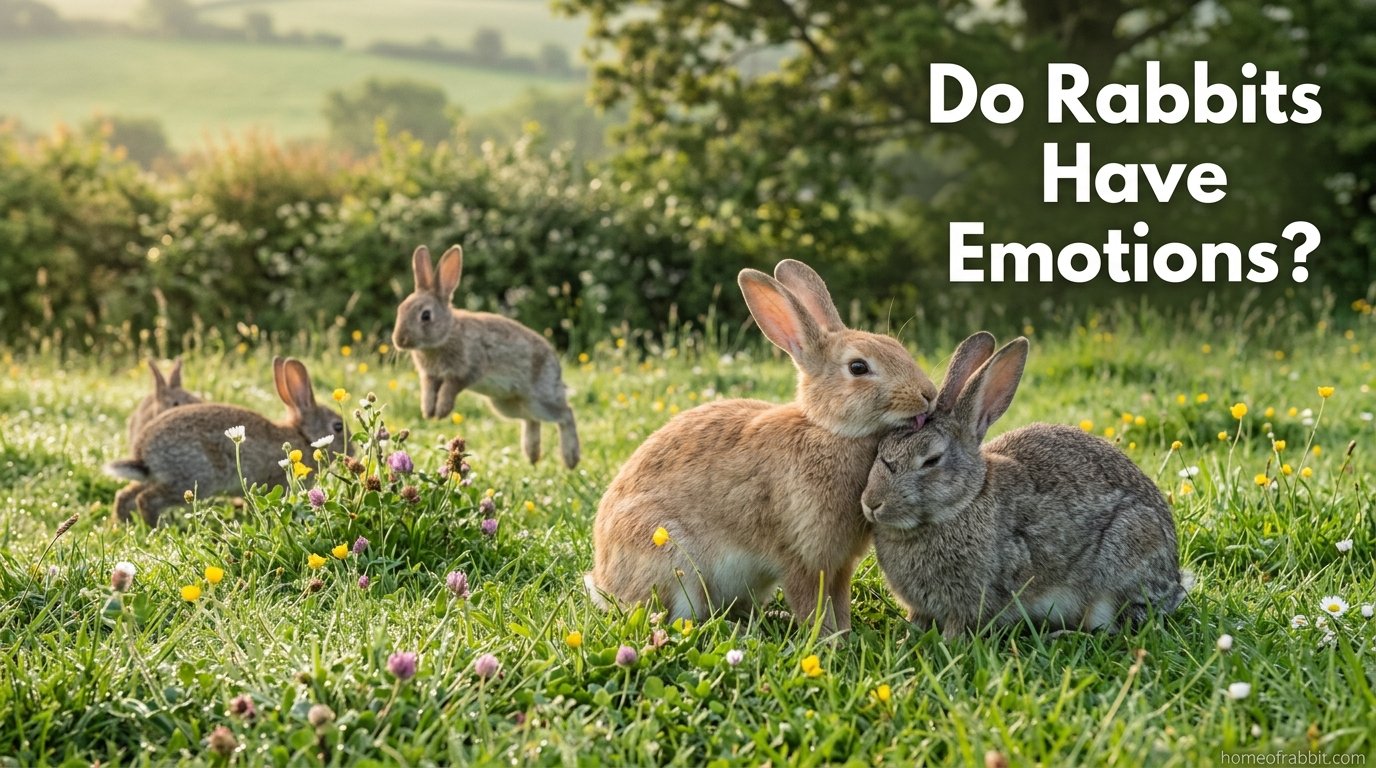
Quick answer: Yes. Rabbits have the brain structures, hormones, and behavioral patterns associated with emotion in mammals, and researchers who study animal welfare treat rabbit emotional states as real and measurable — not just projection from owners. Rabbits show recognizable happiness, fear, frustration, anxiety, and something close to grief. What they don’t have is the same emotional range or self-awareness as humans, and as a prey species, they’re built to hide distress rather than broadcast it.
If you live with a rabbit, you’ve probably already suspected this. The question isn’t really whether rabbits feel anything — it’s how to tell what they’re feeling, since a rabbit won’t cry or whine the way a dog does.
What “having emotions” actually means for an animal
Before going further, it helps to separate two different questions that get mixed together:
- Does the animal have internal states that function like emotions — states that shape behavior, memory, and decision-making?
- Does the animal experience those states subjectively, the way a human experiences feeling happy or afraid?
Science can answer the first question with reasonable confidence. The second question — subjective experience, or consciousness — is much harder to test in any animal, including humans other than yourself. Researchers who study this professionally are often careful about this distinction; a 2024 survey of animal behavior scientists published in Royal Society Open Science found that most researchers were willing to attribute emotional responses to a wide range of species, but were more cautious about attributing full consciousness. That caution isn’t unique to rabbits — it applies to how scientists talk about animal minds generally.
For a practical, non-philosophical purpose (caring for a pet well), the first question is the one that matters. And on that front, the evidence for rabbits is solid.
The scientific case for rabbit emotions
Brain structures and neurochemistry
Rabbits have the same core brain structures involved in emotional processing that other mammals have, including the amygdala (involved in fear and threat response), the hypothalamus, and a limbic system that interacts with hormones like cortisol and neurotransmitters like serotonin and dopamine. This is the same basic biological toolkit used to study emotion in mice, dogs, and primates. Having the hardware doesn’t prove subjective feeling, but it does mean rabbits aren’t running on some fundamentally different, purely reflexive system.
Cognitive bias testing — measuring optimism and pessimism
One of the more rigorous tools in animal welfare science is the judgment bias test. The idea: train an animal to expect a reward for one signal and nothing (or something unpleasant) for a different signal, then present an ambiguous, in-between signal. An animal in a positive emotional state tends to respond to the ambiguous signal optimistically, expecting a reward. An animal in a negative state responds pessimistically. This method has been used across dozens of species — including pigs, sheep, dogs, and rodents — and the underlying logic (that mood biases how an individual interprets uncertain information) is well established in the animal welfare literature. The technique treats mood as something that can shift measurable behavior, which is exactly what you’d expect if emotional states are real and not just a human story we’re telling about the animal.
Applied specifically to rabbits, this kind of research is part of a broader shift in how the field treats them. A 2020 survey of over 1,500 rabbit owners, published in the journal Animals, looked at what owners believed about their rabbits’ mental capacities and how those beliefs connected to the resources and care those rabbits actually received — a strong signal that the scientific and welfare community now takes rabbit mental states seriously enough to study the practical consequences of how we perceive them.
The Rabbit Grimace Scale — reading pain and distress on the face
Perhaps the clearest evidence that rabbits have identifiable internal states comes from pain research. Veterinary researchers developed the Rabbit Grimace Scale, a validated tool that scores five facial features — orbital tightening (squinted eyes), nostril shape, cheek flattening, whisker position, and ear position — to assess how much pain a rabbit is in. It was developed after researchers documented that these facial changes reliably tracked painful procedures and eased with pain relief.
What makes this scale especially relevant to the emotions question is a 2023 study that found something telling: rabbits’ grimace scores were lower when a human observer stood nearby, even during high-pain periods after surgery, and closer to normal when no one was watching. In other words, rabbits actively mask outward signs of distress in the presence of a person. That’s not evidence against emotion — it’s evidence for a very specific kind of emotional/behavioral strategy that prey animals evolved: don’t look weak or sick where a predator might see you.
The emotions rabbits show — with real behaviors
Rabbits communicate mostly through body posture, ear position, and a handful of behaviors rather than vocalizations. Here’s how the most common signals map to what a rabbit is likely feeling:
| Emotion | What it looks like | What it typically means |
|---|---|---|
| Happiness / excitement | Binky (a mid-air jump and twist), zoomies, soft tooth-clicking or “purring” while being petted | The rabbit is comfortable, stimulated, and feeling good |
| Contentment / safety | Flopping onto their side, “melting” flat on the floor with legs extended | Full relaxation — a rabbit only does this when it feels secure |
| Curiosity | Periscoping (standing tall on hind legs), ears forward, faster nose twitching | Investigating something new or interesting |
| Fear / anxiety | Freezing flat to the ground, ears pinned back, wide eyes showing the whites | The rabbit feels threatened and is deciding whether to bolt |
| Irritation / warning | Thumping hind feet, grunting | Signaling danger to others, or telling you or another rabbit to back off |
| Anger / strong displeasure | Flicking feet while hopping away, boxing with front paws, lunging | The rabbit is asserting boundaries or reacting to something it dislikes |
| Affection | Chinning (rubbing scent glands on you or objects), nudging your hand, grooming you | Marking you as trusted or “theirs,” and seeking closeness |
| Distress / grief-like state | Reduced appetite, lethargy, hiding, searching behavior | Often follows the loss of a bonded companion or a major disruption |
None of these behaviors require imagining anything on the rabbit’s part — they’re documented, repeatable patterns described by veterinary behaviorists and welfare organizations. The value of learning them is practical: they’re your best real-time window into how your rabbit is doing.
Why rabbits hide their feelings (and how that trips owners up)
This is the part that causes the most confusion for new rabbit owners. Rabbits are prey animals. In the wild, showing pain, fear, or weakness is an invitation to predators. That instinct doesn’t disappear just because a rabbit lives in a living room instead of a meadow.
This creates two common mistakes:
- Assuming a quiet rabbit is a content rabbit. A rabbit that isn’t thumping or fleeing isn’t necessarily calm — it may be suppressing a stress response because that’s its default survival strategy.
- Missing pain until it’s advanced. Because rabbits mask pain so effectively, especially around observers, conditions like GI stasis or dental disease are sometimes caught late. Subtle grimace changes, a hunched posture, or reduced appetite are often the earliest signals, well before a rabbit acts “obviously sick.”
The practical takeaway: don’t wait for dramatic signals. Small, sustained changes in eating, posture, or activity level deserve attention precisely because rabbits are so good at hiding bigger problems.
Do rabbits bond with their owners?
Yes, in a meaningful behavioral sense. Bonded pet rabbits reliably distinguish their primary caregiver from strangers — showing excitement, approaching, or seeking contact with familiar people while staying wary of unfamiliar ones. Rabbits form comparable bonds with each other, which is why rescue organizations bond rabbits in pairs whenever possible: companionship is now widely treated as a core welfare need for a highly social species, not a nice extra.
That said, a rabbit’s affection looks different from a dog’s. It’s expressed through proximity, chinning, grooming, and soft physical contact rather than tail-wagging enthusiasm at the door. Learning your individual rabbit’s specific signals matters more than expecting textbook behavior.
Do rabbits grieve?
This is one of the more emotionally loaded questions rabbit owners ask, usually after losing one of a bonded pair. There’s no controlled scientific study proving rabbits experience grief exactly as humans define it — that kind of research would be extremely difficult to design. But the behavioral pattern after a companion’s death is well documented and consistent across many owner and rescue reports: the surviving rabbit may become withdrawn, eat less, sleep differently, search for the missing companion, or become unusually clingy toward humans.
Two things are worth being clear about:
- What’s confirmed: significant behavioral change after loss of a bonded companion is common and well documented by rescues and rabbit-focused veterinary resources.
- What’s not confirmed: whether the rabbit’s internal experience matches human grief. That’s a claim about subjective experience that current research tools can’t fully verify.
Either way, the practical guidance is the same: monitor appetite and droppings closely after a companion’s death, since stress-related appetite loss can trigger gastrointestinal stasis, which is dangerous in rabbits. If a surviving rabbit stops eating or produces noticeably fewer droppings, that’s a same-day veterinary concern, not a “wait and see.”
Common mistakes people make when reading rabbit emotions
- Reading dog or cat body language onto a rabbit. A wagging tail in a rabbit is often defiance, not friendliness — the opposite of what it means in a dog.
- Interpreting flopping as a medical emergency. A sudden, dramatic side-flop looks alarming the first time you see it, but it’s usually a sign of total relaxation, not a seizure.
- Assuming a single rabbit is fine alone. Rabbits are a social species; a rabbit kept permanently solo, with only human contact, may be missing a major emotional need even if it seems “fine.”
- Punishing thumping or grunting. These are communication, not misbehavior. Punishing them tends to increase fear rather than resolve whatever triggered the signal.
- Waiting for obvious distress before acting. Given how well rabbits mask pain and stress, subtle changes deserve just as much attention as dramatic ones.
A simple checklist for reading your rabbit’s emotional state
Use this as a quick daily or weekly check, not a diagnostic tool:
- Is appetite and hay intake normal for this individual rabbit?
- Are droppings a normal size, shape, and quantity?
- Is the rabbit interacting (approaching, binkying, chinning) at its usual level?
- Are ears in a relaxed, forward, or curious position rather than pinned back?
- Is posture relaxed (flopping, stretching) at some point in the day?
- Any new hiding, grinding teeth loudly (a sign of pain, distinct from soft purring), or hunching?
- Any change since a recent event — a new pet, a move, a companion’s death, a diet change?
If several answers point toward “off,” that’s a pattern worth investigating rather than a single behavior to dismiss.
When emotional or behavior changes mean “call the vet”
Rabbits are experts at hiding illness, which means behavior changes are often the first real warning sign, not a footnote. Contact a rabbit-experienced veterinarian promptly if you notice:
- Not eating or drinking for more than 12 hours
- No droppings, or noticeably fewer/smaller droppings, for 12+ hours
- Loud teeth grinding (different from the soft, contented tooth-click) combined with a hunched posture — a strong pain signal
- Sudden lethargy or unwillingness to move
- Persistent hiding paired with reduced appetite after a stressful event, such as losing a companion
These aren’t “wait a day” situations. Rabbits can decline quickly once digestion slows down, so acting on early behavioral changes is genuinely protective, not overcautious.
Conclusion
Rabbits have emotions in every practical sense that matters for their care: measurable brain and hormonal systems tied to affect, behavior that shifts in consistent, testable ways with their mood, and pain responses precise enough to be scored on a validated clinical scale. What they don’t do is express those emotions the way a dog or a human does — they’re quieter, more guarded, and built by evolution to mask vulnerability. Learning to read the subtler signals — ear position, posture, thumping, flopping, grinding teeth — is the real skill, and it pays off directly in how early you catch problems and how well you understand the animal you’re living with.
FAQ
Do rabbits feel love the way humans do?
Rabbits form clear attachments — recognizing and preferring specific people or rabbits, seeking closeness, and grooming those they’re bonded with. Whether that internal experience matches human love isn’t something science can currently confirm or rule out, but the attachment behavior itself is well documented.
Can rabbits get depressed?
Owners and rescues commonly report depression-like states in rabbits, especially after losing a companion or being kept isolated — reduced activity, appetite loss, and withdrawal. There’s no formal clinical diagnosis of “depression” in rabbits the way there is in humans, but the behavioral pattern is consistent enough that most rabbit-focused vets and behaviorists take it seriously.
How can I tell if my rabbit is happy?
Look for binkying, zoomies, flopping or melting onto the floor, soft tooth-clicking during petting, and a relaxed, forward or loosely positioned ear posture. A happy rabbit is also generally food-motivated and interactive at its usual level.
Why does my rabbit thump for no reason?
It’s rarely truly “no reason” — thumping usually signals that the rabbit senses something concerning (a sound, smell, or change) that you may not have noticed, or that it’s expressing displeasure about something specific, like being handled.
Is it cruel to keep a rabbit alone?
Rabbits are a highly social species, and most welfare organizations recommend keeping rabbits in bonded pairs or groups when possible. A solo rabbit can still have a good quality of life with substantial daily human interaction, but going without any companionship — human or rabbit — is now considered a welfare risk worth actively addressing.

1 Comment
Pingback: Do Rabbits Recognize Their Owners? Signs, Senses, and How to Build Trust - homeofrabbit