
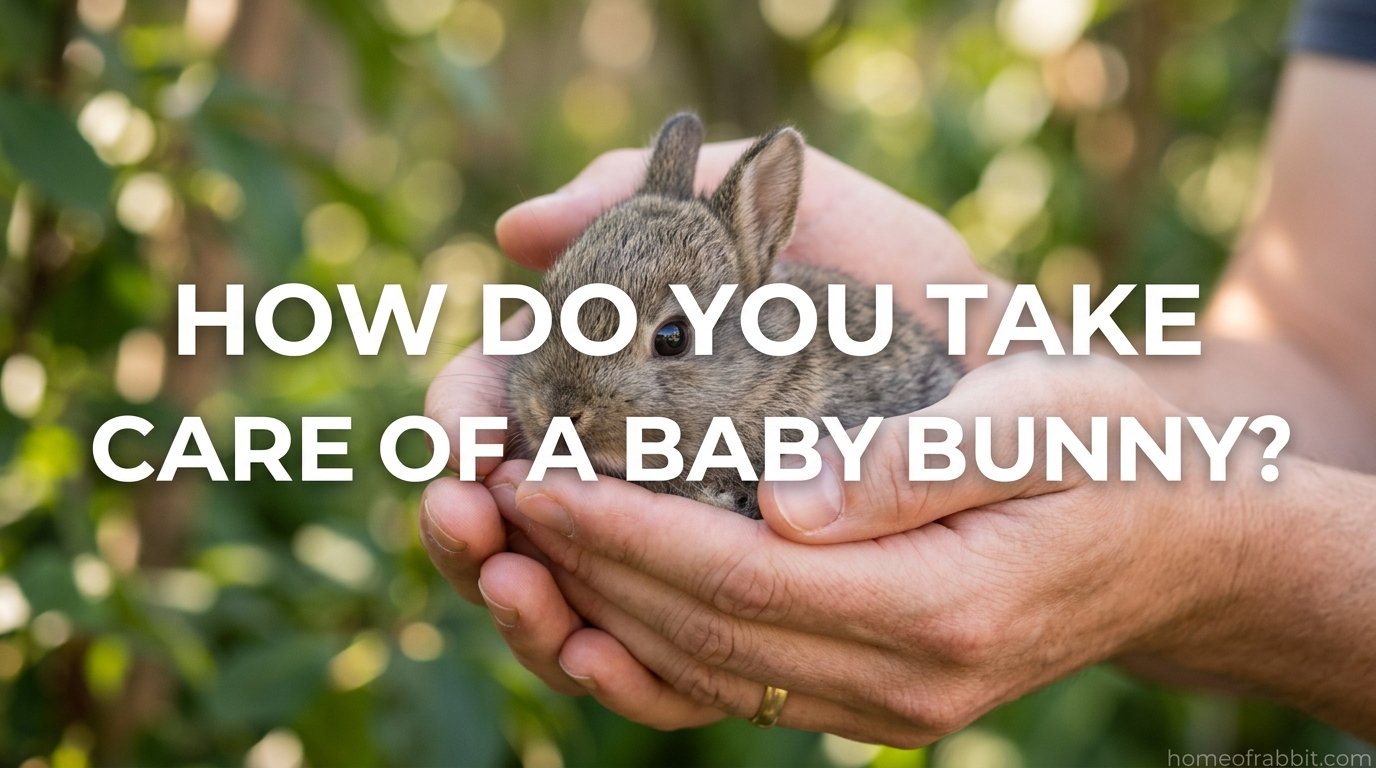
The short answer: it depends on whether the bunny is wild or domestic. A wild baby bunny almost always needs to be left alone, not rescued. A domestic baby bunny (born to a pet rabbit) needs a warm nest, a calm environment, and time for its mother to nurse it — with human intervention only if something has clearly gone wrong.
Getting this distinction right matters more than any other single piece of advice in this guide, so that’s where we’ll start.
First, Figure Out: Wild Bunny or Domestic Bunny?
| Wild baby bunny (cottontail) | Domestic baby bunny (kit) | |
|---|---|---|
| Where found | Outdoors — lawn, garden, brush pile, shallow grass nest | Indoors or in a hutch, born to an owned pet rabbit |
| Fur at birth | No fur; develops a full coat within about a week | Varies by breed, but also mostly hairless at birth |
| Ear position | Ears lie flat/back when very young | Same, but you already know the parents |
| Best first move | Leave it alone unless it’s clearly injured or the nest is destroyed | Let the mother nurse; intervene only if there’s a problem |
If you’re not sure, treat it as wild until you know otherwise — that’s the safer default, since taking a healthy wild animal into your home can do real harm and, in many U.S. states, is illegal without a wildlife rehabilitation permit.
You Found a Wild Baby Bunny — What to Do
Wild rabbits (cottontails are the species most commonly encountered in U.S. yards) are, according to the House Rabbit Society, one of the most frequently “kidnapped” species — people find a nest, assume the babies are abandoned, and remove them with good intentions. <span>Fewer than 10% of rabbits removed from the wild for home “rehabilitation” survive even a week</span>, so the single most important thing you can do is confirm the bunny actually needs help before doing anything else.
Step 1: Don’t Assume It’s Abandoned
Mother cottontails do not stay in the nest with their young the way cats or dogs do. Staying nearby would draw predators straight to the nest, so instead she visits briefly — nursing for only a few minutes, typically once in the early morning and once at dusk — then stays away the rest of the day. A nest with no mother in sight during the day is completely normal, not a sign of abandonment.
If a nest has been disturbed by you, a pet, or lawn equipment, the right move is almost always to rebuild it in place rather than bring the babies inside.
Step 2: Check Whether the Mother Is Still Coming Back
If you’re unsure whether the mother is still visiting, lay two small twigs across the nest in an X or tic-tac-toe pattern and leave the area alone for 24 hours. If the twigs have been moved or knocked aside (not necessarily removed entirely) rather than left untouched, she’s still coming back. A phone camera or doorbell camera aimed at the nest overnight works even better if you have one.
Step 3: Signs a Wild Bunny Genuinely Needs Help
Look for these before intervening:
- Cold, thin, or listless rather than warm and alert
- Visibly injured, or was caught in a cat’s or dog’s mouth (even if the skin looks intact — internal injuries are common and not visible)
- Skin “tents” when gently pinched at the back of the neck and doesn’t spring back — a sign of significant dehydration
- The mother is confirmed dead near the nest
- Crying continuously, sluggish, or bluish in color
Older bunnies found hopping around outside the nest with eyes open and a full coat are usually not in trouble — cottontail kits leave the nest to explore at around three weeks old and are commonly (and mistakenly) “rescued” by well-meaning people at this stage.
Step 4: If It Truly Needs Help
- Do not feed it anything — not cow’s milk, not water, not a homemade formula. An improperly fed or fed-too-late wild bunny can bloat, aspirate fluid into its lungs, or go into shock, and a wildlife rehabilitator will also need to know the animal’s stomach is empty before assessing it.
- Keep it warm, dark, and quiet in a covered box lined with a soft cloth, away from pets, children, and noise, while you arrange help.
- Contact a licensed wildlife rehabilitator immediately. Search “wildlife rehabilitator near me,” check the National Wildlife Rehabilitators Association directory, or call a local humane society or emergency vet clinic — many will either take the animal or point you to someone who will.
- Don’t try to raise it yourself long-term. Wild rabbits have specialized dietary and behavioral needs, keeping native wildlife is restricted or illegal in many states without a permit, and survival rates for home-raised wild kits are very low even with the best intentions.
Caring for a Domestic Mother Rabbit and Her Litter
If your own pet rabbit has just given birth (kindled), most of the work belongs to her — but a few things are genuinely your job.
Separate the Male Immediately
If a male was housed with the mother, remove him now. Female rabbits can conceive again within minutes of giving birth, and a male will also mate with his own daughters as soon as they’re old enough. This is also a reasonable time to schedule his neuter.
Set Up a Proper Nest Box
The mother needs a box just slightly larger than her own body — too large and the kits can scatter and miss a feeding. Cut a doorway on one side with a small lip (about an inch) to keep babies from tumbling out before they’re ready to explore. Line it with hay or straw (not fabric scraps, burlap, or anything with loose threads a kit could get tangled in), placed in a corner away from where she toilets. Refresh the bedding every few days, since it will get soiled.
Let the Mother Do the Work — Don’t Over-Handle
This is the part new owners get wrong most often: you do not need to hover. Domestic mother rabbits, like their wild relatives, only nurse once or twice a day, usually near dawn or dusk, and deliberately stay away from the nest the rest of the time. This is instinctive behavior, not neglect. Constant checking, especially with children gathered around the cage, can stress the mother enough that she avoids nursing.
The old myth that a mother will reject babies a human has touched isn’t true for domestic rabbits — they’re already used to your scent — but minimizing handling to what’s necessary still reduces stress for everyone involved.
How to Tell If the Babies Are Being Fed
Check tummies once a day, gently. A nursing kit has a visibly round, full belly. If the bellies look sunken and the skin looks wrinkled or loose, or the kits feel weak and unresponsive when handled, they likely haven’t been fed and you should act the same day.
If the Mother Isn’t Nursing Them
First, look for evidence she’s tried: did she pull fur from her chest and belly, or gather hay/bedding into a nest? That’s a strong sign her hormones and instincts are engaged, even if you haven’t personally seen her nurse.
Next, gently check her for signs of milk: hold her upright or turn her gently onto her back and check the nipples for slight swelling, and see if light pressure releases a small amount of milk or clear fluid.
If she seems to be lactating, return the babies and give her space — check again the next day. If she shows no signs of milk and hasn’t attempted to build a nest, or if two days have passed with no confirmed feeding, see a rabbit-experienced veterinarian the same day. A vet can administer oxytocin to stimulate milk letdown, but this generally only works within about 48 hours of birth — after that, the window closes and hand-rearing becomes the only option.
Baby Bunny Development, Week by Week
This timeline reflects typical domestic rabbit development (wild cottontail kits follow a similar but slightly faster schedule, weaning by about three weeks and leaving the nest area by four to five weeks).
| Age | What’s happening | What you should do |
|---|---|---|
| Birth | Blind, hairless, fully dependent on mother’s milk | Leave the nest alone; check tummies daily for feeding |
| ~10 days | Eyes open; fur has come in; kits start eating the mother’s cecotropes (soft nutrient-rich droppings) alongside milk | Keep the nest clean; don’t over-handle |
| 3–4 weeks | Begin exploring outside the nest box; start nibbling hay and pellets | Make sure hay and a small amount of pellets are accessible nearby |
| 4–7 weeks | Still nursing, but eating more solid food each week; digestive system is transitioning and fragile during this stage | Watch stool closely — any sudden softness is worth noting |
| 8 weeks | Fully weaned; ready to be separated from the mother | Separate males from females now; this is the earliest age to rehome a kit |
| 10–12 weeks | Males can become sexually mature | Neuter males as soon as testicles have descended if you’re not planning to breed |
Hand-Raising an Orphaned Domestic Kit (Last Resort)
If the mother has died or definitively cannot nurse, hand-rearing is possible but genuinely difficult — there is no commercial milk replacer that fully matches rabbit milk, and hand-fed kits face a real risk of a bacterial gut condition called mucoid enteritis, which shows up as diarrhea, bloating, and refusal to eat. Before starting, it’s worth calling a rabbit-experienced breeder or rescue to ask about a foster mother: a nursing doe of similar litter age will often accept and feed another rabbit’s kits, and this gives orphaned kits a meaningfully better chance than a bottle ever will.
If hand-rearing is the only option:
- Warm the kit first, before anything else. No baby mammal can digest food if its body temperature is too low. Use a hot water bottle (warm, not hot) wrapped in a towel underneath — never in direct contact with the skin.
- Call a rabbit-savvy veterinarian the same day for guidance on an appropriate milk replacer and feeding amounts for the kit’s age and weight — this isn’t a place to guess, since both underfeeding and overfeeding (leading to bloat) carry real risk.
- Feed in the correct position. Hold the kit upright, the way it would nurse naturally, rather than on its back, to reduce the risk of formula being inhaled into the lungs.
- Reintroduce cecotropes after the eyes open (around 10 days). These soft droppings, normally eaten straight from the mother, seed the kit’s gut with the bacteria it needs to digest solid food later. A vet or experienced rescuer can advise on how to do this safely if the kit doesn’t do it on its own.
- Watch stool daily. Any sign of diarrhea, mucus, or blood is an emergency — contact your vet immediately rather than waiting to see if it resolves.
- Don’t add fruit juice, honey, or sugar water as a general practice. These are sometimes used as a single emergency measure for a severely weak newborn under guidance from a vet, but they are not a substitute for proper formula or veterinary care.
Realistically, even with excellent care, hand-raised infant rabbits have a lower survival rate than mother-raised kits, and survivors are more prone to digestive issues later in life. This isn’t a reason not to try — it’s a reason to get professional help involved from day one rather than treating it as something to handle entirely alone.
What to Feed a Baby Bunny, by Age
This schedule follows widely used House Rabbit Society feeding guidance for young domestic rabbits:
| Age | Diet |
|---|---|
| Birth – 3 weeks | Mother’s milk only |
| 3–7 weeks | Mother’s milk, plus small nibbles of alfalfa hay and alfalfa-based pellets |
| 7 weeks – 7 months | Unlimited alfalfa hay and alfalfa-based pellets (young, growing rabbits need the extra calcium and protein) |
| 12 weeks | Begin introducing vegetables one at a time, in small amounts (under half an ounce), watching stool for a few days before adding the next one |
| 7 months+ | Gradually shift from alfalfa to timothy/grass hay, reduce pellet quantity, and continue increasing vegetable variety |
Don’t feed a baby bunny of any age:
- Cow’s milk or goat’s milk — rabbits can’t digest lactose properly, and it causes diarrhea
- Fruit or sugary treats before around 12 weeks — their digestive systems can’t handle it yet
- Iceberg lettuce (low nutritional value, can cause digestive upset)
- Anything from a shared plate that hasn’t been checked as rabbit-safe
Setting Up a Safe Space as They Grow
Once kits are weaned and moving around independently:
- Give them a pen or enclosure with room to hop and stretch — cramped housing is a common long-term mistake, not just a baby-stage issue.
- Keep unlimited grass hay available at all times; it’s the foundation of a healthy digestive system for life.
- Introduce a litter box lined with hay early — young rabbits pick up litter habits quickly once they choose a “bathroom corner.”
- Avoid pine or cedar shavings as bedding or litter — the aromatic oils can affect liver enzymes and irritate the respiratory tract.
- Keep the space away from extreme heat, direct sun, and drafts; rabbits are prone to heat stress and don’t tolerate high temperatures well.
- Rabbit-proof any area with cords or baseboards the kit can reach, since chewing starts early.
How to Handle a Baby Bunny Safely
- Always support both the front end and the hindquarters at once — an unsupported back end can lead to a rabbit kicking out and injuring its own spine.
- Never lift a rabbit by the ears.
- If a rabbit struggles while being held, lower yourself (and the rabbit) toward the ground rather than holding on tighter — a struggling rabbit can break its own back trying to escape.
- For wild bunnies, minimize handling to the minimum necessary; frequent contact adds stress without benefit and can interfere with the mother’s natural feeding pattern.
When to Call a Vet Immediately
Treat any of the following as same-day, not “wait and see”:
- No eating or no bowel movements for 12 hours or more
- Watery diarrhea, especially with mucus or blood
- Labored breathing, or fluid coming from the nose after a feeding (possible aspiration)
- A “tented” pinch test on the skin (sign of dehydration)
- Sudden lethargy or unresponsiveness in a kit that was previously active
Spaying, Neutering, and Separating by Sex
- Separate male and female kits at 8 weeks — males can become fertile as early as 10 weeks old.
- Males can typically be neutered once the testicles have descended.
- Females are generally spayed after four months of age but before their first year — this also greatly reduces the risk of uterine cancer later in life, which becomes common in unspayed females as they age.
- Use a veterinarian experienced specifically with rabbit surgery; rabbit anesthesia and post-op care differ meaningfully from cats and dogs.
Common Mistakes People Make With Baby Bunnies
- Assuming a wild nest with no mother in sight is abandoned — it almost never is.
- Feeding cow’s milk to an orphaned kit of either species.
- Handling a domestic litter constantly out of excitement, adding stress that can suppress nursing.
- Removing kits from their mother before 8 weeks because they “look ready” — their gut flora isn’t mature enough yet, and early removal is linked to a higher risk of fatal digestive illness.
- Introducing vegetables too early, before around 12 weeks, which can trigger serious digestive upset.
- Keeping a rescued wild bunny as a pet — beyond the welfare concerns, this is against wildlife regulations in many U.S. states without a rehabilitation permit.
- Waiting too long to call a vet when a kit stops eating — in rabbits, this can turn fatal within a day.
Baby Bunny Care Checklist
- Confirmed whether the bunny is wild or domestic
- (Wild) Checked for signs of injury or true abandonment before intervening
- (Wild) Contacted a licensed wildlife rehabilitator if help is genuinely needed
- (Domestic) Separated any adult male from the nursing mother
- Set up or checked a proper, appropriately sized nest box
- Checked kits’ bellies for signs of feeding
- Confirmed a feeding/weaning timeline appropriate to the kit’s age
- Kept hay available and introduced pellets/vegetables at the right ages
- Identified warning signs that mean “call the vet today”
- Planned for spay/neuter and separation by sex around 8 weeks
Conclusion
The single most useful thing to take from this guide is the branch at the very top: wild bunnies almost always need to be left alone, and domestic bunnies almost always need less hands-on help than new owners expect. Beyond that, most of the actual work is about patience and watching for a short list of clear warning signs — a full belly versus a sunken one, normal stool versus diarrhea, a mother building a nest versus showing no interest at all. When those signs point to a real problem, the right next call is a rabbit-savvy vet or a licensed wildlife rehabilitator, not a home remedy.
FAQ
Will a mother rabbit reject her babies if I touch them? For domestic rabbits, no — this is a persistent myth. Pet mother rabbits are already used to human scent and won’t abandon kits because a person has handled them. For wild rabbits, it’s still best to minimize handling, not because of scent rejection, but simply to reduce stress and avoid disturbing the nest more than necessary.
How long can a baby bunny go without eating? Not long. Domestic mother rabbits only nurse once or twice a day, so short gaps are completely normal. But if you’ve confirmed a kit hasn’t fed in roughly 24–48 hours, or an adult rabbit of any age stops eating for 12 hours or more, that’s an emergency — rabbit digestive systems can shut down (a condition called GI stasis) quickly.
Can I keep a wild baby bunny I found as a pet? Generally no. Beyond the welfare risks — wild rabbits have very specific dietary and behavioral needs that are hard to replicate at home — keeping native wildlife without a permit is restricted or illegal in many U.S. states. A licensed wildlife rehabilitator is the right resource if a wild bunny genuinely needs help.
What do I feed a baby bunny if the mother has died? Contact a rabbit-experienced veterinarian the same day for guidance on an appropriate milk replacer, since there’s no commercial formula that perfectly matches rabbit milk, and correct amounts depend on the kit’s age and weight. If possible, ask about finding a nursing foster mother first — a doe with a similar-aged litter will often successfully nurse orphaned kits, which tends to work better than hand-feeding.
When can baby bunnies leave their mother? Domestic kits should stay with their mother until at least 8 weeks old — removing them earlier is linked to a higher risk of fatal digestive illness because their gut bacteria aren’t fully established. Wild cottontails are typically weaned by about three weeks and independent of the family group by four to five weeks.

3 Comments
Pingback: Do Bunnies Sleep at Night? What Rabbit Sleep Really Looks Like - homeofrabbit
Pingback: Can Rabbits Eat Olives? Why It's Best to Skip Them - homeofrabbit
Pingback: Do Rabbits Eat Their Babies? Why It Happens and How to Prevent It - homeofrabbit