
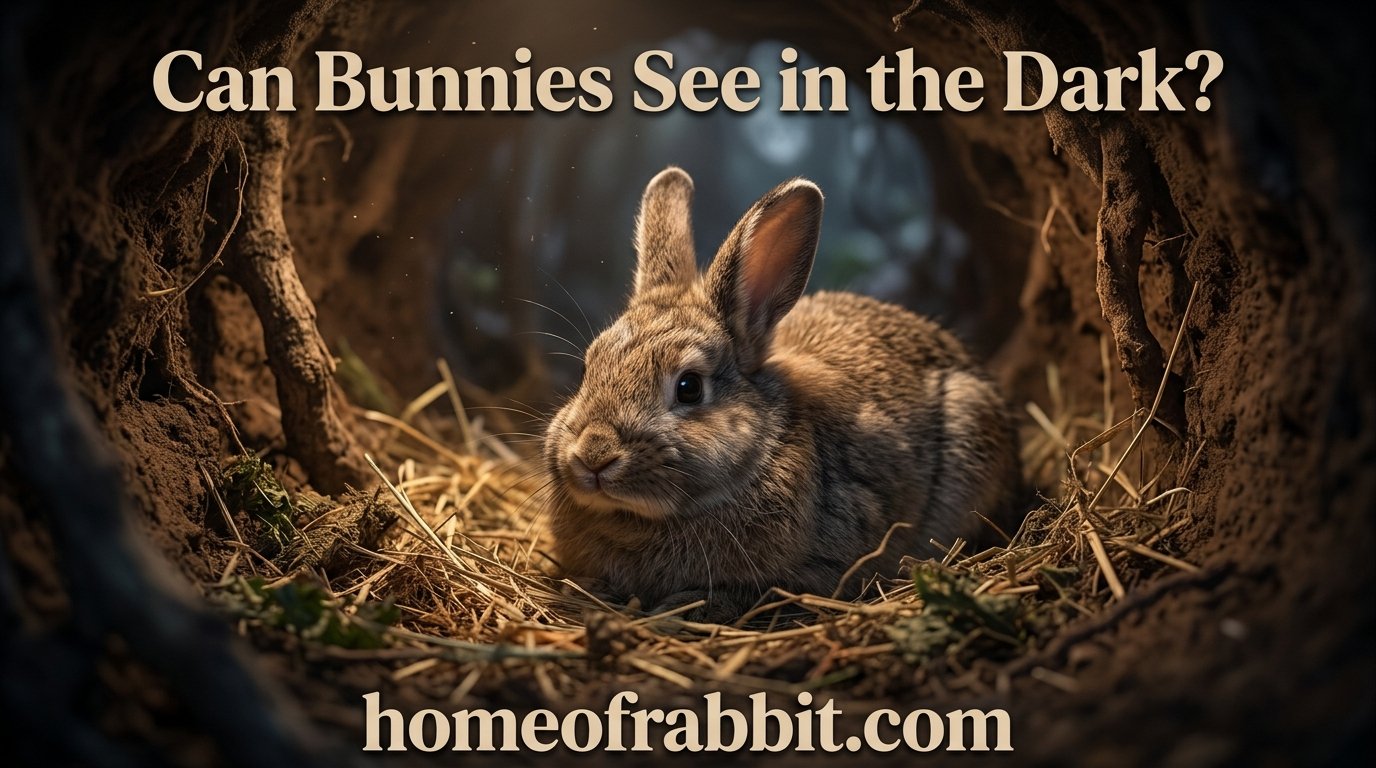
Bunnies can see well in dim light, but they cannot see in total darkness. A rabbit can move around a room lit by moonlight, a hallway glow, or a faint window light. Put that same rabbit in a sealed room with no light at all, and it is effectively blind and will rely on memory, whiskers, hearing, and smell instead.
That difference matters if you share your home with a bunny. Here is how rabbit eyes handle low light, where they fall short, and what to do at night.
The short answer: dim light yes, total darkness no
Think of a rabbit’s vision as built for twilight, not for pitch black.
| Light level | Can a rabbit see? |
|---|---|
| Bright daylight | Yes, though color range is limited |
| Dusk, dawn, moonlit room | Yes, this is where rabbit eyes work best |
| Very dim room with a little ambient light | Usually yes, with less detail |
| Complete darkness (no light at all) | No, rabbits rely on other senses |
You may see articles claiming rabbits have excellent night vision, and others saying they are blind in the dark. Both are partly right. “Night vision” in the everyday sense means seeing with almost no light, which rabbits cannot do. What they do have is good low-light vision.
Why rabbits see well in low light
Eyes built for twilight
Rabbit eyes are large for their body size and sit high on the sides of the head. That placement gives them a view that covers nearly 360 degrees, which helps them spot predators from almost any direction. Large eyes also gather more of whatever light is available.
Rods, cones, and a missing mirror layer
The retina has two kinds of light-sensing cells:
- Rods work in dim light and are good at picking up movement.
- Cones handle color and work best in brighter light.
Rabbit retinas are generally described as rod-rich, which is why they cope well at dawn and dusk.
What rabbits do not have, according to most veterinary and rabbit-care sources, is a tapetum lucidum. This is the reflective layer behind the retina in cats and many nocturnal animals that bounces light back for a second pass. Without it, a rabbit’s eye gets one chance at the available light. That is the main reason rabbits fall short of true nocturnal animals in near-total darkness.
Are rabbits nocturnal? Why dawn and dusk matter
No. Rabbits are crepuscular, meaning they are most active around dawn and dusk. Wild rabbits use that window to feed while it is dark enough to avoid many daytime predators but light enough to see approaching nighttime ones.
Pet rabbits keep the same rhythm. Many are lively in the early morning (sometimes earlier than you would like) and again in the evening, and nap through much of the day and deep night. So a rabbit being awake in a dim house is normal. A rabbit expected to roam freely in a pitch-black one is not.
What rabbits see in the dark: strengths and blind spots
Even in good light, rabbit vision is very different from yours:
- Wide field of view. Nearly all the way around, which is great for spotting threats.
- A blind spot in front. Directly in front of the nose, and just behind, rabbits cannot see well. That is why they may sniff or touch a treat before nibbling it.
- Limited depth perception. Side-set eyes overlap little, so judging distance is harder.
- Better at distance than up close. Rabbits are generally described as nearsighted for close objects being blurry, with strength at spotting far-off movement.
- Two color types. Rabbits have dichromatic vision, mostly blue and green, so reds likely look different than they do to you.
In dim light, expect even less detail. Rabbits compensate with sharp hearing and smell, plus whiskers that help them judge tight spaces.
Should you leave a light on for your rabbit?
Usually no. If your home has some ambient light, such as a window, a hallway glow, or a small standby light, your rabbit can see well enough to move safely. Constant bright light can disrupt the day-night pattern animals rely on, and rabbits also need a dark, quiet place to rest.
A dim, indirect light makes sense only in specific cases, such as a room that becomes truly pitch black, a free-roam rabbit in an unfamiliar space, or a senior rabbit with weak vision.
How to make nighttime safe for your bunny
Use this checklist:
- Keep the layout familiar. Rabbits navigate by memory in low light. Avoid rearranging furniture, litter boxes, or hideouts without warning.
- Avoid total blackout during free-roam time. Leave a window shade partly open or use a very dim, indirect light.
- Provide a dark hideout. A covered box or hide gives your bunny a place to sleep in darkness.
- Block hazards. Cover or tuck away cords, and gate off stairs or gaps where a rabbit could slip.
- Don’t approach suddenly from the front. Move toward your rabbit from the side and speak softly. Startling a rabbit in the dark can cause panicked bolting.
- Keep the enclosure clean. Ammonia from dirty bedding can irritate the eyes and airways. See our guide on keeping a rabbit hutch clean.
- Supply a consistent schedule. Regular day-night light helps keep sleep and feeding patterns steady.
Signs of a possible vision problem
Some rabbits have trouble with eyesight because of age or illness. A rabbit-savvy vet should check any of these:
- Bumping into familiar objects, even in good light
- Cloudy or hazy eyes
- Eyes that look swollen, painful, or are kept shut
- Frequent wet discharge or crusty buildup
- A sudden change in how confidently your rabbit moves
The House Rabbit Society’s guide to the rabbit eye covers common eye problems, and notes that eye changes warrant a visit to a rabbit-savvy vet. Do not wait on swollen or painful eyes.
Conclusion
So, can bunnies see in the dark? In dim light, yes, and quite well. In complete darkness, no. Their large, side-set, rod-rich eyes are tuned for dawn and dusk, but without a reflective layer behind the retina they still need some light. Keep nighttime familiar, safe, and not totally black when your rabbit is roaming, and give it a dark, calm space to sleep.
FAQ
Do rabbit eyes glow in the dark?
Not the way cat eyes do. Rabbits lack the tapetum lucidum that creates that bright glow, according to most rabbit-care sources. Verify before publishing: eyeshine in flash photos can vary, so confirm wording with a veterinary source if you plan to expand on this.
Do rabbits sleep in the dark?
Rabbits tend to rest through the day and deep night, and many prefer a dark, quiet spot to do it.
Can rabbits see in the dark better than humans?
In dim light, generally yes. In complete darkness, neither can see.
Do rabbits need a night light?
Usually not. A little ambient light is enough. Consider a dim light only for free-roaming, anxious, or visually impaired rabbits.
Can rabbits see color?
Some. They have two cone types, tuned mostly to blue and green.
