
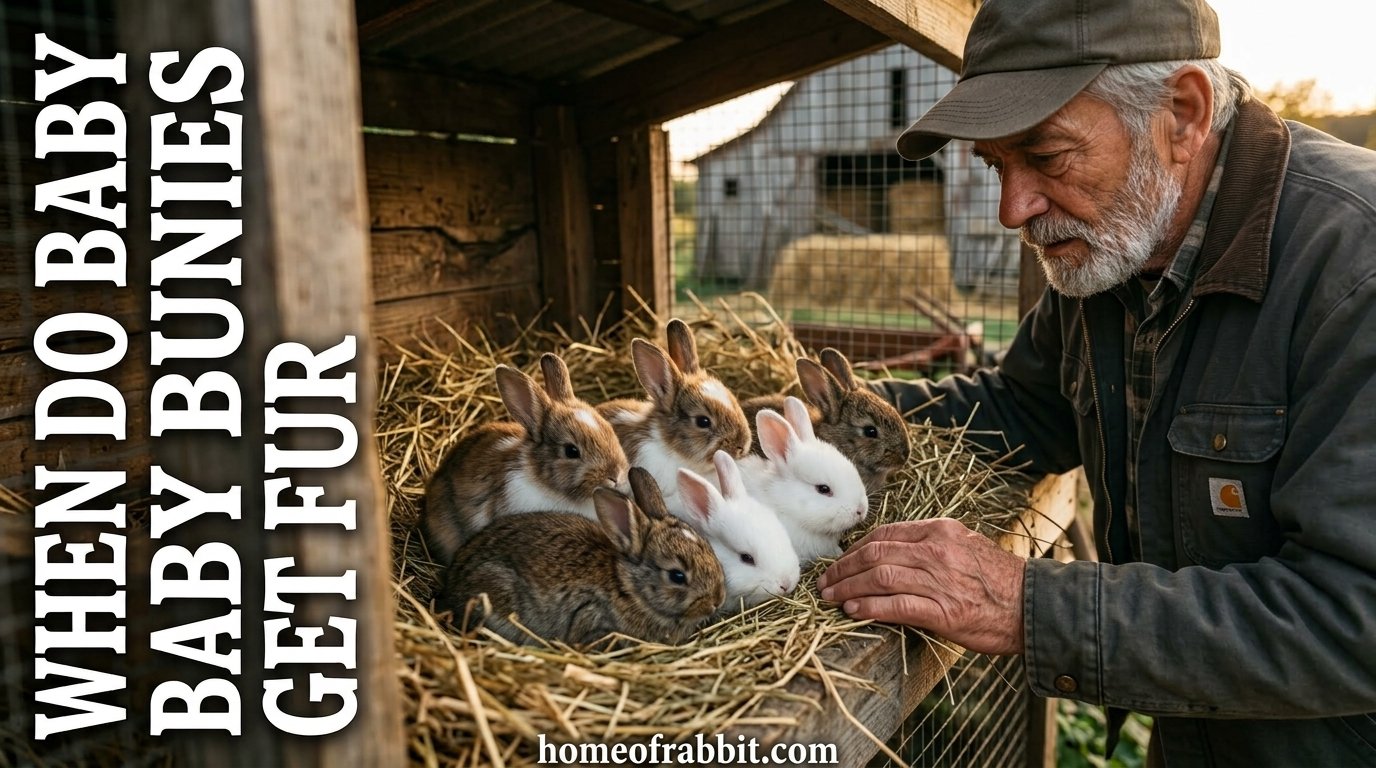
Baby bunnies are born with no fur at all. Fine fuzz usually becomes visible within the first few days, and most kits have a thick, warm coat by about two weeks of age. Exact timing varies from litter to litter, so treat the numbers below as typical ranges, not deadlines.
Are baby bunnies born with fur?
No. Rabbits are born completely hairless regardless of breed. Newborn kits (the proper name for baby rabbits) are also deaf and blind, and they can do little more than wriggle at first. rabbitcaretipsWikipedia
Their bare skin can hint at their future color. Kits that will be light-colored tend to have pink skin, while those destined to be brown or black may have dark skin, and mottled skin can point to multicolored fur. rabbitcaretips
In the wild, and in well-set-up hutches, the doe handles the warmth problem. She pulls fur from her abdomen and dewlap and mixes it with hay or other material to build a nest. That fur lining is the kits’ only insulation until their own coat arrives. Wikipedia
Baby bunny fur growth timeline
| Age | What you’ll see |
|---|---|
| Day 0 | Hairless, pink or dark skin, eyes and ears closed |
| Days 2–5 | Fine, short fuzz appears, often first noticed as a slight sheen or shadow on the skin |
| Days 7–10 | Fur visibly thicker; eyes begin to open |
| Days 10–14 | Fuller coat, eyes and ears open, kits start moving around more |
| Weeks 4–6 | Baby coat gives way to an intermediate coat |
| Weeks 6–8 | Kits look much closer to small adults |
Days 0–3: bare skin
Expect no visible fur. The kits should look plump and stay huddled together in the nest. Sources differ slightly on when growth begins: hair starts growing at around 2–3 days old, while other sources place the first fur around days 3 to 5. Both fit within normal variation. hepperWikipedia
Days 3–7: the fuzz phase
The kits start to look velvety. The fur is short and soft, and it doesn’t yet insulate well, so they still depend on the nest lining and each other for warmth.
Days 10–14: the coat fills in
Eyes typically open at 7 to 10 days, and by roughly day 12 kits generally have a full coat thick enough to keep them warm. Feet, belly, nose, and ears may still look pinkish. This is also when the litter starts to move around. By 2 weeks they may begin exploring and sampling outside food. New Zealand rabbit +2
Weeks 4–6: baby coat to intermediate coat
Fur keeps growing daily until about 4 weeks, and between 4 and 6 weeks the baby coat is replaced by an intermediate coat of downy hairs and longer guard hairs. Color can shift during this stage, so don’t assume a kit’s day-14 color is final. rabbitcaretips
Breed note: long-haired breeds (like Angoras) and rex-type coats may look different during these stages. I couldn’t verify breed-specific timelines from reliable sources, so check with a breeder or exotics vet if you have one of these breeds.
How to tell if development is on track
A healthy litter generally looks like this:
- Round, full bellies (a “milk belly” that looks tight and rounded)
- Warm to the touch, huddled together
- Quiet and still between feedings
- Fur appearing gradually over the first week, then thickening
Things worth attention:
- No fuzz at all by day 7 to 10. Check the kit’s warmth and weight, and ask a vet who treats rabbits.
- Kits scattered outside the nest, cold, or crying constantly. This can mean they aren’t being fed or kept warm.
- Wrinkled, loose skin or a thin, sunken look. This suggests dehydration or underfeeding.
Keeping hairless and newly furred kits warm
Newborns can’t regulate temperature well. The doe’s fur-lined nest does most of the work, so your job is to support it, not replace it.
- Provide a nest box with plenty of clean hay or straw. A nest box should be offered two to five days before the expected kindling date. Wikipedia
- Keep the space draft-free, with no direct wind or damp bedding.
- Don’t strip the nest to “clean” it. The fur lining is the kits’ heating system.
- Add extra bedding gradually if the room is cold, without burying the kits.
- Handle as little as possible. Check on them briefly and quietly, ideally when the doe is out of the box.
If you’re building a box, our guide on how to make a nesting box for rabbits covers dimensions and materials.
Found a nest of baby bunnies? Read this first
Many people find a fur-lined nest in the yard and assume the mother has abandoned it. She almost certainly hasn’t. Mother rabbits visit their young only about twice a day, around dawn and dusk, to avoid drawing predators to the nest. Seeing no adult in daylight is normal. wihumane
The Virginia Department of Wildlife Resources gives a useful rule of thumb: if a rabbit is fully furred with open eyes and is bigger than a baseball, weighing over about 4 ounces, it is on its own and doesn’t need help. For kits that are still hairless or barely furred, put them back in the nest, check once a day, and leave them alone if they look plump and healthy. If they look thin, weak, or have wrinkled skin, contact a licensed rehabilitator right away. You can read their full guidance on the Virginia DWR rabbit page. virginiavirginia
To check whether the mother is still returning, use the twig or string test: lay twigs or string in a criss-cross pattern over the nest and check the next morning to see if they’ve been disturbed. wihumane
Two myths to drop:
- Touching the kits does not make the mother reject them. A mother will not reject babies because humans have touched them, though you should still handle them as little as possible. wihumane
- Don’t try to raise wild kits yourself. Wildlife rehabilitators report that fewer than 10% of orphaned rabbits survive a week when people try to care for them at home. If they are truly orphaned or injured, call a licensed wildlife rehabilitator in your state. spcatampabay
Common mistakes
- Expecting fur on day 1 and assuming something is wrong.
- Disturbing or “tidying” the nest, especially removing the doe’s fur lining.
- Handling kits often, which stresses the doe and the litter.
- Removing wild kits from a nest that isn’t actually abandoned.
- Assuming a kit’s early color will match its adult color.
Quick checklist
- Nest box in place before the due date
- Draft-free, quiet, warm location
- Doe has constant hay, food, and fresh water
- Kits checked briefly once or twice daily
- Fuzz visible by about day 3–7, thicker coat by about day 10–14
- Kits plump, warm, and quiet
- Vet contacted quickly if kits look thin, cold, or have no fuzz well past a week
Conclusion
To answer the question directly: baby bunnies get fur gradually. It starts as fine fuzz within the first few days and becomes a full coat by about two weeks. A slow start, a wide range across breeds, and differences between litters are all normal. What matters most is that the kits stay warm, fed, and mostly undisturbed. Once you know the timeline, you can tell a healthy litter from one that needs help. For what comes after the fur, see our guide on how to take care of a baby bunny.
FAQ
Do baby bunnies have fur when they’re born?
No. All kits are born hairless, whatever the breed.
How long does it take for baby bunnies to grow fur?
Fuzz usually appears in the first several days, and most kits have a full coat by roughly 12 to 14 days.
When do baby bunnies open their eyes?
Usually around 7 to 10 days, though some sources say up to 10–14 days. Kits sometimes have crusty or irritated eyes as they open, so ask a vet if this looks like more than mild crustiness.
Why is the mother rabbit pulling out her own fur?
She’s lining the nest. This is normal, and it can happen shortly before or right after birth.
When can baby bunnies leave the nest?
Wild cottontails generally leave the nest and are independent by about 4 to 5 weeks. Pet kits often stay with the doe longer. Ask a rabbit-savvy vet about weaning and rehoming ages for your situation.
