
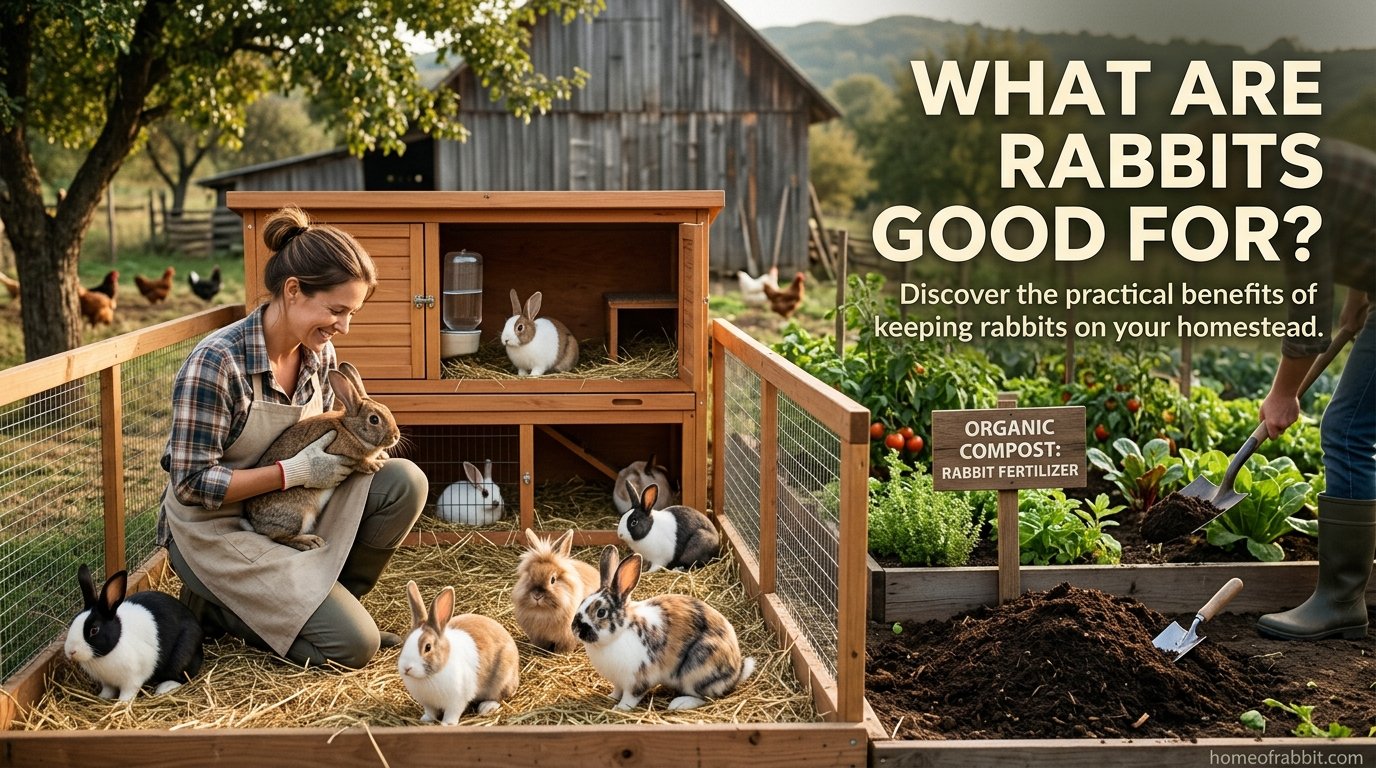
Rabbits are good for far more than sitting in a hutch looking cute. Around the world, people keep them as companion pets, a source of lean meat, fiber for wool and fur, garden fertilizer, 4-H and show projects, and even biomedical research subjects. Which of these actually applies to you depends entirely on your goals — a family wanting a house pet and a homesteader wanting food security are looking for completely different rabbits and completely different care setups.
Here’s a breakdown of what rabbits are genuinely used for, what each use actually involves, and how to figure out which one fits your situation.
1. Companionship — Rabbits as Pets
For most people, this is the answer: rabbits are pets. Rabbits are the third most popular pet after cats and dogs, and they’re the most popular exotic pet in the US, with nearly half of all small pets owned being rabbits. hepperpangovet
A few things worth knowing before you write “pet” as the answer for your household:
- They live longer than people expect. Domestic rabbits generally live 8–12 years, depending on the breed — closer to a dog’s lifespan than a hamster’s. forestvets
- They’re social. Rabbits are social animals that are happiest in the company of other rabbits, so a single, isolated hutch rabbit is often a lonely rabbit. forestvets
- They’re not naturally cuddly. As prey animals, many rabbits fear being handled, and they can become harder to manage once hormones kick in around 3 to 6 months of age unless spayed or neutered. ufhealthufhealth
- The sad side of the statistic: rabbits are also the third most abandoned pet in the US, largely because people underestimate the years-long commitment and space/diet needs involved. pangovet
If you want a rabbit specifically as a house pet, breeds selected for temperament and manageable size (Mini Rex, Netherland Dwarf, Holland Lop) are the common starting points, though any rabbit can become a great companion with patient handling.
2. Food — Rabbit Meat
Rabbit is a working food source in many parts of the world (France, Italy, Spain, China, and parts of Africa in particular) and a growing niche interest for backyard producers in North America, where consumption is much lower than in Europe, partly because many people see rabbits more as pets than as food. elespanol
Nutritionally, rabbit meat earns its reputation:
- Rabbit meat is lean, easily digestible, and contains 18.6 to 22.4 grams of protein alongside only 0.5 to 6.3 grams of total fat per 100 grams — figures that vary by cut and source but consistently land on the lean side. fukashere
- It’s a lean meat with a high content of easily digestible protein, low fat and cholesterol compared to other meat types, plus a notable B-vitamin content. vuzv
How rabbit meat compares nutritionally
Based on USDA figures cited in nutrition comparisons, a roughly 3-ounce (85g) raw serving stacks up like this:
| Meat | Calories | Protein | Fat |
|---|---|---|---|
| Rabbit (wild, raw) | 96 kcal | ~18 g | under 2 g |
| Chicken (raw) | 94 kcal | 17 g | 2.3 g |
| Ground beef | 210 kcal | 15 g | 15 g |
Exact numbers shift depending on whether the rabbit is farm-raised or wild, and which cut is measured — treat this as a general comparison, not a lab-certified label.
Common meat breeds: New Zealand and Californian rabbits are the standard commercial choices because of their commercial body type, mature size, and long track record in meat programs. Other options in the mix include Champagne d’Argent, American Chinchilla, Silver Fox, and Rex. EverbreedEverbreed
Practical note on efficiency: rabbits reproduce and grow fast relative to their size. Kits are typically ready for market at 4 to 5 pounds, often by 8 weeks old with proper care, and a single doe can produce up to 10 times her own body weight in offspring per year, which is part of why small-scale rabbit farming appeals to people focused on food security or self-sufficiency. hubbardfeedshubbardfeeds
3. Fur and Pelts
If you’re raising rabbits for meat, the pelt is often the natural byproduct — many small producers use both. Rex rabbits, in particular, are commonly raised for their fur, thanks to a plush, dense coat with very short, upright hair and few guard hairs. WikipediaEverbreed
Tanned pelts get used for practical, low-waste projects: lining boots, cuffs, and hoods, plus mittens, hats, moccasins, blankets, and craft pompoms. Frozen raw pelts can typically be stored for up to a year before tanning, so producers don’t need to process them immediately. Homestead RabbitsHomestead Rabbits
Breeds specifically valued for pelt quality include Rex, Silver Fox, Chinchilla, and New Zealand White rabbits, chosen for their plush feel, dense coat, and workable hide. Everbreed
4. Wool — Angora and Fiber Rabbits
Rabbit wool is a real, if niche, fiber industry. The Angora is the most commonly used breed for wool production, prized for fur that’s exceptionally fine, soft, warm, and fluffy. Fiber-focused sub-breeds include English, French, German, Giant, and Satin Angora, each producing wool with a different guard-hair ratio. Chelsea Green PublishingEverbreed
Smaller wool breeds — Jersey Woolies, Lionheads, and American Fuzzy Lops — grow soft coats too, but their small size means they’re typically kept as pets and show animals rather than serious fiber producers. In fact, Jersey Woolies usually weigh only 1 to 3 pounds, making them uneconomical as a dedicated fiber operation — the wool is a bonus on top of a pet, not the main event. Staying Warm with Rabbit Wool | Chelsea Green Publishing +2
Fair warning if you’re considering this route: wool breeds need real upkeep. Ear mites are one of the most common health issues in fiber rabbits, and regular grooming is non-negotiable to prevent matting. Morning Chores
5. Garden Fertilizer — “Black Gold” Manure
This is the use people are most surprised by, and it’s one of the best-supported ones. Rabbit droppings are what gardeners call a “cold” manure.
- Rabbit manure isn’t hot manure, meaning you can add it straight to garden soil without composting first, since it won’t burn plant roots. rabbitcaretips
- According to Washington State University, rabbit manure contains roughly four times more nutrients than cow or horse manure and about twice as much as chicken manure. echopress
- On NPK (nitrogen-phosphorus-potassium) ratings specifically, rabbit manure runs about 2.4% nitrogen, 1.4% phosphorus, and 0.6% potassium, compared to chicken manure at roughly 1.1% N, 0.8% P, and 0.5% K — noticeably richer per pound. adn
- It also breaks down slowly and adds structural lignins to soil, which helps with long-term soil conditioning rather than just a quick nutrient hit. northernhomesteading
- Bonus: it doesn’t have the strong odor associated with other livestock manures. echopress
Practically, this means even a couple of pet rabbits can supply a meaningful amount of free, ready-to-use garden fertilizer, and a small rabbitry can produce a genuinely large volume — a single doe and her litter can generate over a ton of manure in a year. insteading
6. Showing, 4-H, and Youth Education
Beyond the practical outputs, rabbits are a major part of the exhibition world. Aside from commercial or pet use, rabbits are commonly raised for exhibition at shows, judged against breed standards for body type, coat, and condition. In the US, this world is organized largely around the American Rabbit Breeders Association (ARBA), and 4-H rabbit projects are a common entry point for kids learning animal husbandry, record-keeping, and responsibility. This use overlaps heavily with the pet and pedigree-breeding world — show rabbits are usually not raised for meat or fur. Wikipedia
7. Scientific and Medical Research
This is a less visible but genuinely significant use. One of the most common research uses of rabbits is producing polyclonal antibodies, and rabbits are preferred over some other lab species for a specific set of biological reasons: nih
- Rabbits’ immune systems can recognize a broader diversity of antigens compared to rodents like mice and rats. understandinganimalresearch
- Their larger body size and blood volume, easy vascular access, and a long history of immunoglobulin purification research make them the preferred choice over other common lab species for antibody production. nih
- Rabbits were also the first animal models used to study atherosclerosis — the buildup of fats and cholesterol in artery walls — and remain used in research on eye, skin, heart, and immune-system conditions. understandinganimalresearch
- One concrete medical product traces directly back to rabbits: the polyclonal antibody thymoglobulin, derived from rabbit serum, is used to protect against immune rejection in organ transplants. eara
This is a specialized, regulated field governed by animal welfare oversight and isn’t something a hobbyist or pet owner needs to think about — it’s included here for completeness, since “what are rabbits good for” legitimately includes this application in biomedical science.
8. Small-Scale Utility Uses
A handful of smaller, more regional uses round out the list, mostly connected to rural and homesteading life:
- Bait: rabbit heads and fur are sometimes used in fishing and crab traps, and fur is used in fly-tying. AT HOME PETS
- Pet and animal food: rabbit meat is a valued protein source for carnivorous and omnivorous pets like dogs, cats, ferrets, and snakes. AT HOME PETS
- Craft materials: everything from ears used as novelty headbands to tails used for hand-pollinating fruit trees, per homesteading write-ups on using the whole animal without waste.
These are niche uses rather than reasons to get a rabbit on their own, but they’re part of why traditional small farms treat rabbits as a genuinely multi-purpose animal.
9. Emotional Comfort and Bonding
Plenty of owners describe their rabbits as calming, low-key company — quiet, routine-driven animals that can be soothing to be around. That’s a real, commonly reported benefit of rabbit ownership, but it’s worth being precise: a pet rabbit is not automatically a registered emotional support or therapy animal, and formal ESA or therapy-animal status involves specific documentation and, in some cases, training requirements that vary by country and organization. If you’re looking into that path specifically, check the current requirements with a licensed mental health professional or a recognized therapy-animal organization rather than assuming a pet rabbit qualifies by default.
Which Purpose Fits You? A Decision Guide
| If your priority is… | Look at… | Watch out for… |
|---|---|---|
| A house companion | Mini Rex, Holland Lop, Netherland Dwarf | 8–12 year commitment, litter-box training, rabbit-proofing |
| Meat/self-sufficiency | New Zealand, Californian | Requires humane processing knowledge and space for hutches |
| Fur/pelts | Rex, Silver Fox, New Zealand White | Usually paired with a meat operation, not standalone |
| Wool/fiber | English/French/Satin Angora | Heavy grooming commitment, mite risk |
| Garden fertilizer | Any breed, even pets | Collect manure trays consistently; keep dry before use |
| Showing/4-H | Breed-standard ARBA breeds | Time-intensive conditioning and travel to shows |
Common Mistakes People Make
- Assuming “pet” and “meat” breeds are interchangeable. Wool and show breeds are usually poor meat producers, and vice versa — breeds developed for fur quality aren’t a sensible pick if meat production is the primary goal. Chelsea Green Publishing
- Underestimating lifespan. Getting a rabbit as a “starter pet” for a child without planning for a potential decade of care is one of the leading causes of rehoming.
- Skipping spay/neuter. Unaltered rabbits are harder to handle once hormonal and can breed prolifically if housed together.
- Composting manure that doesn’t need it. Unlike hot manures, fresh rabbit droppings can generally go straight into the garden — composting isn’t required, though it’s still an option if you prefer it.
- Treating antibody-production breeds as a hobbyist option. Research-use rabbits are part of regulated laboratory programs, not something to replicate at home.
Quick Checklist Before You Get Rabbits
- Decide your primary purpose (pet, meat, fiber, fertilizer, show)
- Match the breed to that purpose
- Plan for 8–12 years if it’s a pet
- Budget for hutch/housing, hay, pellets, and vet care
- Learn manure collection if you want the garden benefit
- Research spay/neuter and social housing needs
- If breeding, understand litter sizes and space requirements before you start
Conclusion
So, what are rabbits good for? In short: companionship, lean meat, fur and pelts, wool, some of the best fertilizer available for a home garden, exhibition and youth education, and a specialized but genuine role in medical research. Most people only need one of these — usually companionship — but knowing the full picture helps explain why rabbits have stayed a mainstay of small farms and homes for centuries, worldwide. The right rabbit for you comes down to matching the breed and setup to the one or two purposes that actually matter for your life, rather than assuming every rabbit fits every role equally well.
9. FAQ
Are rabbits good for anything besides being pets?
Yes. Beyond companionship, rabbits are commonly raised for meat, fur, wool (mainly Angora breeds), garden fertilizer, show/4-H projects, and biomedical antibody research.
Is rabbit manure really good fertilizer?
Yes — it’s considered a “cold” manure, so it can usually be applied to soil without composting first, and it’s notably richer in nitrogen and phosphorus than cow, horse, or chicken manure.
Is rabbit meat healthy?
It’s generally lean and high in protein compared to many common meats, with relatively low fat, though exact nutrition varies by cut and whether the rabbit is farm-raised or wild.
Which rabbit breed is best for meat?
New Zealand and Californian rabbits are the standard commercial meat breeds due to their size, growth rate, and meat-to-bone ratio.
Which rabbit breed is best for wool?
Angora rabbits (English, French, German, Giant, and Satin varieties) are the primary wool breeds, prized for their soft, fine coats.
Do all rabbits make good pets?
Most rabbits can become good companions with patient handling, but they’re social, prey animals that generally do better with a bonded partner and don’t always enjoy being picked up — it’s worth researching temperament by breed before choosing.
