
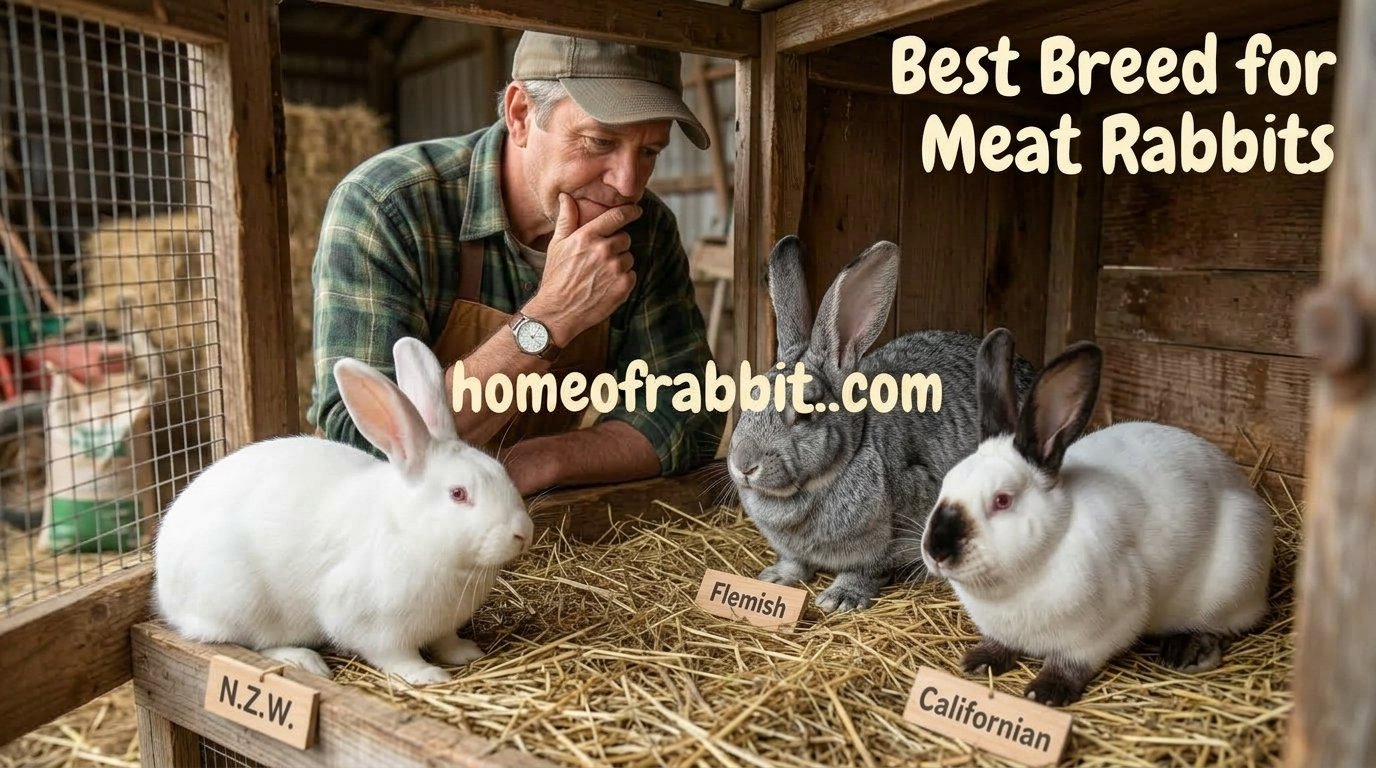
For most people in the U.S., the best breed for meat rabbits is the New Zealand White, followed closely by the Californian. Both grow fast, reach market weight young, carry a lot of meat for their size, and are easy to find. If you want just one recommendation, start there.
That said, the “best” breed depends on what you’re optimizing for: speed, hardiness, small space, or preserving a heritage line. This guide compares the main options so you can match a breed to your situation. If you’re still deciding whether meat rabbits suit your homestead at all, our overview of what rabbits are good for is a useful place to start.
Quick answer: top picks by goal
| Your goal | Best pick |
|---|---|
| Overall best for meat | New Zealand White |
| Best for beginners | New Zealand White or Californian |
| Fast growth with good meat-to-bone | Californian |
| Heritage breed with a strong meat reputation | Champagne d’Argent or American Chinchilla |
| Good all-rounder with a dense pelt | Silver Fox or Satin |
| Maximum size (with trade-offs) | Flemish Giant |
What makes a good meat rabbit
Breed matters, but four traits decide whether a rabbit is worth raising for meat.
Growth rate and market weight
Meat rabbits are typically processed as fryers, young rabbits around 8 to 12 weeks old and roughly 4 to 5.5 pounds live weight [verify against ARBA class definitions]. A breed that reaches that weight sooner uses less feed and less of your time.
Dressing percentage
This is the share of the live weight that ends up as usable carcass. Commercial-type breeds generally dress out better than very large or very light breeds. Figures vary by rabbit, feed, and processing method, so treat any single percentage you read online as an estimate [verify with extension sources].
Litter size and mothering
A doe that produces large litters and raises them well matters as much as fast growth. Look for does with good milk production, calm nest behavior, and a record of raising most of their kits. A well-built nesting box helps every breed, and you can plan your breeding schedule with the rabbit pregnancy calculator. To set expectations on output, see how many kits a rabbit can have.
Temperament and hardiness
Docile rabbits are easier to handle daily and less likely to injure themselves or you. Hardiness matters too. Fast-growing commercial breeds do best with good ventilation, clean housing, and consistent feed.
Meat rabbit breeds compared
Weights below are approximate adult breed-standard ranges from ARBA. [Verify against the current ARBA Standard of Perfection before publishing.]
| Breed | Approx. adult weight | Strengths | Trade-offs |
|---|---|---|---|
| New Zealand White | 9–12 lb | Fast growth, large litters, widely available | White pelt has less value; can be sensitive to heat |
| Californian | 8–10.5 lb | Good meat-to-bone, calm, widely available | Slightly smaller litters than NZW in some lines |
| Champagne d’Argent | 9–12 lb | Heritage breed, good meat, calm | Slower to mature; harder to source |
| American Chinchilla | 9–12 lb | Dual-purpose, meat and pelt | Threatened heritage breed; fewer breeders |
| Silver Fox | 9–12 lb | Calm, good mothers, striking pelt | Slower growth; limited availability |
| Satin | 8.5–11 lb | Good meat, fine pelt | Fewer meat-focused lines |
| Flemish Giant | 13–15+ lb | Very large frame | Slow growth, high feed use, lower dressing percentage |
Breed-by-breed profiles
New Zealand White
This is the standard against which other meat breeds are measured. NZWs grow quickly, have large litters, and are available from breeders in nearly every state. That availability also means you can find quality stock at reasonable prices.
Pros: fast growth, strong mothers, easy to source, plentiful information and support.
Cons: less tolerant of extreme heat than some breeds, and the white pelt is less prized.
Californian
Californians were developed with meat production in mind and carry a lot of meat on a compact frame. They’re usually calm and handle well, which makes them a good fit for first-time keepers.
Pros: good meat-to-bone ratio, docile, fast-maturing.
Cons: litter sizes can vary by line, so ask breeders for records.
Champagne d’Argent
One of the oldest recognized meat breeds. Champagnes are known for calm temperaments and quality meat, and they’re often chosen by homesteaders who want a heritage breed. They mature more slowly, which means more feed per pound of finished meat.
Pros: heritage value, calm, good meat quality.
Cons: slower growth, harder to find.
American Chinchilla
A dual-purpose heritage breed. Its conservation status is a real consideration: buying and breeding it helps keep the line alive [verify current Livestock Conservancy status]. Growth is decent but not as quick as NZW.
Pros: meat and pelt, conservation value, hardy.
Cons: limited breeder pool.
Silver Fox
Silver Foxes are calm and known for being good mothers. They’re a reasonable meat breed but grow more slowly than NZWs and Californians.
Pros: docile, good mothers.
Cons: slower growth, limited availability.
Satin
Satins have a fine, glossy coat and decent meat production. Meat performance varies more between lines than in NZW or Californian, so buy from a breeder who selects for production.
Pros: good dual-purpose potential.
Cons: less consistent meat-focused lines.
Flemish Giant
Flemish Giants are very large, but bigger is not better for meat. They grow slowly, eat a lot, and carry more frame relative to meat. They’re wonderful animals and make good pets or show rabbits (see our Flemish Giant care guide), but they are rarely the most efficient choice for meat production.
Purebred, crossbred, or heritage: which fits you?
- Purebred NZW or Californian if you want predictable, well-documented performance.
- A NZW × Californian cross is a popular commercial-style cross because it combines the strengths of both parents. Crossbreds can show hybrid vigor, though you can’t reliably breed the offspring for consistent traits.
- Heritage breeds (Champagne d’Argent, American Chinchilla) if preserving a breed matters to you and you can accept slower growth.
How to choose based on your situation
You’re a beginner: Start with New Zealand Whites or Californians. They’re forgiving, easy to source, and well documented.
You have limited space: Housing needs depend on the size of the rabbit and how many you keep. Use the rabbit cage size calculator to plan, and the rabbit farm calculator to estimate how many breeders you need for a target output.
You live in a hot climate: Heat is a serious risk for all rabbits, especially heavy commercial breeds. Prioritize shade, airflow, and possibly lighter or acclimated lines. Ask local breeders what performs in your area.
You want the lowest feed cost: Faster-growing breeds generally convert feed to meat more efficiently. Estimate costs with the rabbit feeding calculator.
You want to preserve a heritage breed: Choose a Livestock Conservancy-listed breed such as the American Chinchilla, and buy from established breeders.
You have specific dietary or religious requirements: Meat preparation rules vary by tradition. See our guide on whether rabbit meat is halal.
Common mistakes when choosing a breed
- Choosing by size alone. The biggest breed isn’t the most efficient. Growth speed and feed use matter more.
- Buying from a pet source. Pet-line rabbits may not be selected for meat traits. Buy from meat-focused breeders.
- Ignoring the doe. A great buck can’t make up for a doe with small litters or poor mothering.
- Skipping breeder records. Ask about litter sizes, kit survival, and growth data.
- Underestimating heat and housing. Even the best breed underperforms in poor conditions.
- Starting with too many rabbits. Begin with a small trio and learn the process before scaling up.
Buying checklist
- Buyer-visit or video of the breeder’s herd and housing
- Records for litter size and growth
- Healthy signs: clear eyes, clean nose, no ear or fur problems
- Proper age (young breeding stock at appropriate age, not too young)
- Pedigree if you plan to breed long term
- Clear health guarantee or return policy
- Quarantine plan for new arrivals
Conclusion
The best breed for meat rabbits for most people is the New Zealand White, with the Californian a close second. Both are efficient, widely available, and beginner-friendly. If preserving a heritage line matters to you, consider a Champagne d’Argent or American Chinchilla, and accept slower growth in exchange. Whatever you choose, buy from a breeder who selects for meat traits, and match your housing and climate to the breed.
9. FAQ
What is the most popular meat rabbit breed?
The New Zealand White is the most widely used meat breed in the U.S., valued for fast growth and large litters.
Which meat rabbit breed grows the fastest?
New Zealand Whites and Californians are generally the fastest-growing common breeds. Actual rates vary by line and feed.
Are Flemish Giants good for meat?
They can be eaten, but they grow slowly and use more feed relative to their meat yield, so they’re rarely efficient for production.
Can I raise a mixed-breed rabbit for meat?
Yes. Crossbreds, particularly NZW × Californian, are common and can perform very well.
At what age are meat rabbits processed?
Fryers are typically around 8 to 12 weeks old [verify against ARBA class definitions and your local extension office].
Which meat breed is best for beginners?
New Zealand White or Californian, thanks to availability, temperament, and reliable performance.
