
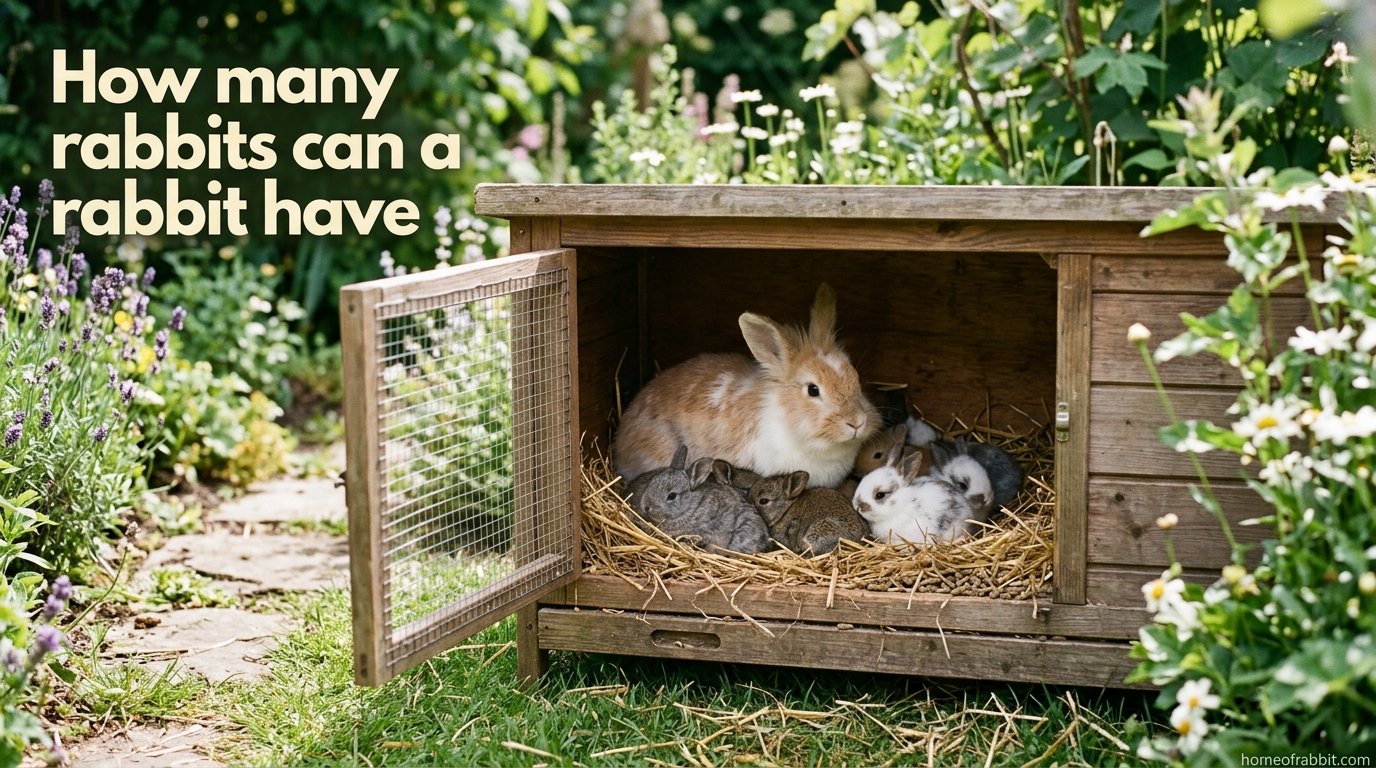
A single rabbit litter usually has 4 to 12 kits (baby rabbits), though anywhere from 1 to 14 is possible depending on the breed and the mother’s age and health. A doe (female rabbit) can also have multiple litters in a year — commonly 4 to 6 litters, and in intensive breeding setups, more — because rabbits can become pregnant again almost immediately after giving birth.
That combination is exactly why rabbits have a reputation for reproducing fast. It’s not one oversized litter that causes problems — it’s the frequency.
How Many Babies Are in One Rabbit Litter?
Most domestic rabbit litters land somewhere between 4 and 12 kits, with 6 being a fairly typical average. Litters as small as 1 or as large as 14 do happen, but they’re the exception rather than the rule.
What Affects Litter Size
A few factors consistently influence how many kits a doe has:
- Breed size. Larger breeds tend to have bigger litters, smaller breeds have fewer kits per litter.
- Age of the doe. First litters are often smaller. Litter size typically increases through a doe’s prime breeding years, then declines again as she gets older.
- Health and nutrition. A well-fed, healthy doe is more likely to carry and deliver a full-sized litter than one that’s underweight, stressed, or unwell.
- Litter order. A doe’s second and third litters are often larger than her first.
It’s worth noting that not every kit born survives. Stillbirths happen, and first-time mothers sometimes struggle with nesting or nursing, especially without a calm, draft-free space to give birth in.
How Many Litters Can a Rabbit Have in a Year?
This is where the numbers become significant. A rabbit’s gestation period is short — typically around 28 to 31 days — and because rabbits are what’s called “induced ovulators” (more on that below), a doe can conceive again almost right after giving birth.
In practice:
- Backyard or hobbyist breeding: 4 to 6 litters per year is common and considered more sustainable for the doe’s health.
- Commercial or intensive breeding: does can be bred closer to every month, though this puts real strain on the doe’s body and isn’t considered good practice by most rabbit-care organizations.
- Unmanaged situations (an unneutered male and female simply living together): litters can happen essentially back-to-back, since nothing is regulating the pairing.
Most responsible breeders deliberately space out litters to protect the doe’s health, even though biologically she could carry more.
Why Rabbits Reproduce So Quickly
Two biological quirks explain the “breeding like rabbits” reputation:
- Induced ovulation. Unlike many mammals that ovulate on a fixed cycle, a female rabbit releases eggs in response to mating itself. This means there isn’t a narrow fertile window to miss — she can become pregnant essentially any time she’s paired with an intact male.
- Short gestation. At roughly a month long, rabbit pregnancies are quick compared to most household pets. A cat or dog’s gestation runs closer to two months.
Put those two traits together, and you get an animal that can go from birth to pregnant again within days if a male is present.
A Realistic Look at How Fast Numbers Add Up
To put the scale in perspective: if you started with just one breeding pair and let reproduction go unchecked, the math compounds fast, since each litter of females is also capable of reproducing within months. This is a mathematical illustration of potential growth under ideal breeding conditions — not a guarantee, since survival rates, health issues, and lack of available mates all reduce real-world numbers. Still, it’s the reason wildlife agencies and rabbit rescues treat unmanaged rabbit populations as a serious concern, not an exaggeration.
This is also the practical reason shelters overflow with rabbits: two unaltered rabbits housed together can produce far more offspring, far faster, than most people expect.
Litter Size by Breed Size
| Breed size | Example breeds | Typical litter size |
|---|---|---|
| Giant | Flemish Giant, Checkered Giant | 7–12 kits |
| Medium/large | New Zealand White, Californian | 6–10 kits |
| Small/dwarf | Netherland Dwarf, Holland Lop | 2–4 kits |
| Wild cottontail (for comparison) | Eastern cottontail | 2–6 kits |
Ranges are general tendencies, not guarantees — individual litters vary.
Signs Your Rabbit Might Be Pregnant
If you suspect an accidental pairing, watch for:
- Nesting behavior — pulling fur to line a nest, especially in the last week
- Increased appetite
- Weight gain in the belly area
- Increased protectiveness or mild aggression
- A gentle belly check around day 10–12 by a vet or experienced handler can sometimes confirm pregnancy (gently — rough handling can harm the pregnancy)
If you’re not sure, a veterinary exam is the most reliable way to confirm pregnancy rather than guessing from behavior alone.
If You Don’t Want More Rabbits: Spaying and Neutering
If your goal is simply to stop reproduction rather than manage it, separating an intact male and female is only a partial fix — rabbits can breed through cage bars in some setups, and even brief unsupervised contact is enough. Spaying (females) or neutering (males) is the standard long-term solution, and it also reduces territorial aggression and, in does, lowers the risk of uterine cancer later in life, which is common in unspayed female rabbits. Talk to an exotics-experienced veterinarian about timing and cost, since this varies by region and provider.
Common Mistakes Rabbit Owners Make
- Assuming rabbits of the same sex can’t accidentally end up together. Sexing young rabbits is genuinely difficult, and “two females” sometimes turn out to be a male and a female.
- Housing an unaltered pair “just for company.” This is the single most common cause of unplanned litters.
- Waiting to separate a mother and her growing kits. Young rabbits can reach sexual maturity within a few months, sometimes before they’re even fully weaned from their mother — meaning siblings can breed with each other or with a parent if not separated in time.
- Not preparing a nesting box in advance. If you do have a doe due to give birth, having a quiet, draft-free nesting area ready beforehand reduces stress and stillbirth risk.
A Simple Checklist If You Suspect a Pregnancy or Unplanned Litter
- Confirm pregnancy with a vet if possible, rather than guessing
- Separate the doe from any other rabbits, especially males
- Set up a quiet, draft-free nesting box with soft bedding
- Avoid excessive handling in the final week before birth
- Plan ahead for where kits will go once weaned (around 8 weeks)
- Schedule spay/neuter for adult rabbits once the doe has recovered, to prevent repeat litters
Conclusion
So, how many rabbits can a rabbit have? A single litter typically brings 4 to 12 kits, and a doe can have several litters — often 4 to 6 — in a single year, thanks to a short gestation period and a reproductive system that doesn’t wait for a fixed fertility window. Those two facts together explain why unmanaged rabbit populations grow so quickly, and why anyone keeping rabbits together who isn’t intentionally breeding them should consider spaying or neutering sooner rather than later.
FAQ
How many babies can a rabbit have at once?
Typically 4 to 12 in a single litter, with an upper range of around 14 in larger breeds.
Can two rabbits from the same litter breed with each other?
Yes. Siblings can reach sexual maturity within a few months and will breed with each other if not separated, regardless of relation.
How soon after giving birth can a rabbit get pregnant again?
Almost immediately, biologically speaking, since rabbits ovulate in response to mating rather than on a set cycle. Responsible breeders wait considerably longer to protect the doe’s health.
Do wild rabbits have as many babies as pet rabbits?
Wild rabbits, like cottontails, tend to have smaller litters (roughly 2 to 6 kits) compared to many domestic breeds, though they can still have multiple litters per year during breeding season.

2 Comments
Pingback: Best Breed for Meat Rabbits: How to Choose the Right One - homeofrabbit
Pingback: How Profitable Is Rabbit Farming? Real Numbers for U.S. Small-Scale Producers - homeofrabbit