
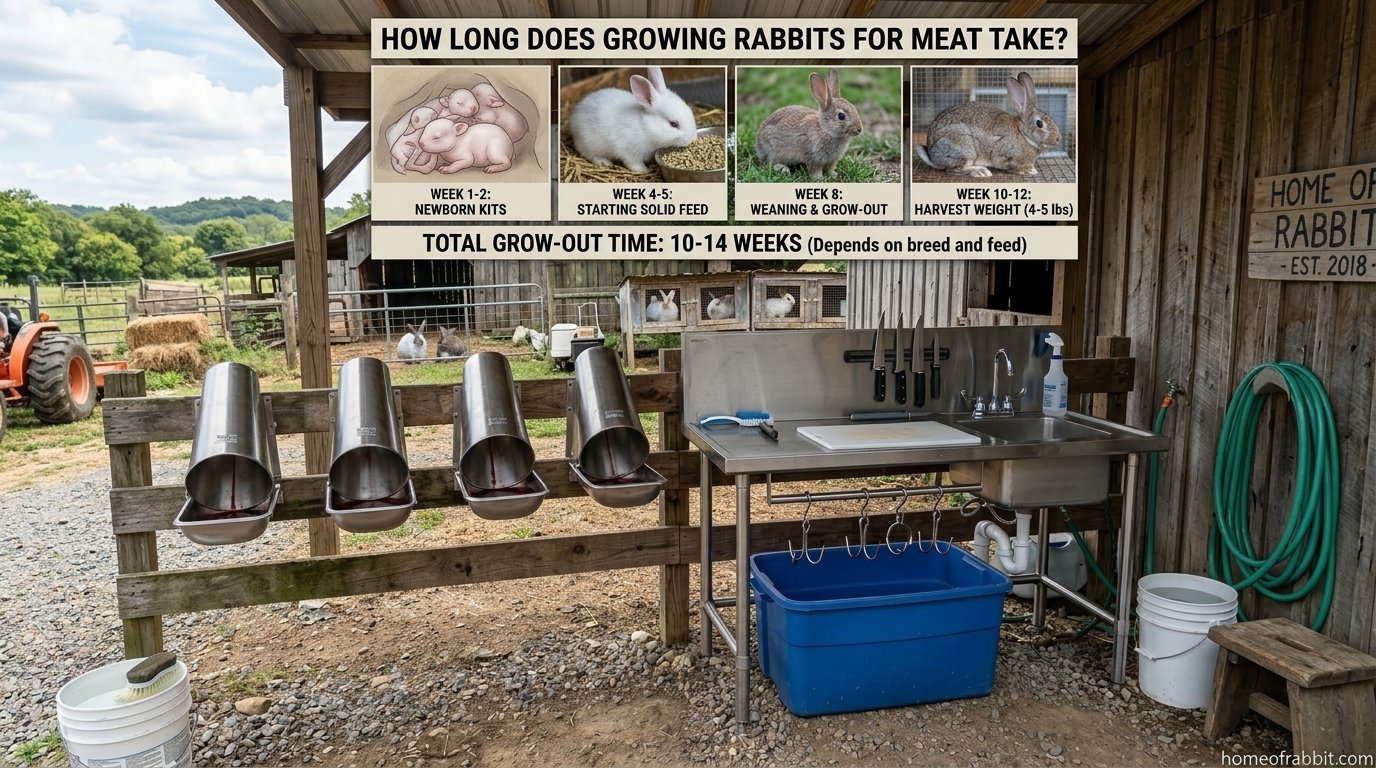
Most meat rabbits are ready to butcher at 8 to 12 weeks of age. Most meat rabbits reach butcher weight in about 8 to 12 weeks. But that clock doesn’t start at birth for the whole operation. Add roughly a month of gestation, and a few months of waiting if you’re starting with young breeding stock. farmkeep
Below is the full timeline, what “ready” actually means, and the factors that can add weeks to your schedule.
The Short Answer: Timeline at a Glance
| Stage | Typical time | Notes |
|---|---|---|
| Gestation | About 31 days | Range is roughly 28–33 days |
| Nest box to weaning | About 4–8 weeks | Meat breeders often wean on the earlier side |
| Total age at butchering (fryer) | 8–12 weeks | Faster in fast-growing lines, slower in many other breeds |
| Breeding to freezer (mature does) | About 14–16 weeks | Gestation plus grow-out; my estimate from the figures above |
| Slow-growing breeds or forage-fed | 12–20 weeks | Varies a lot |
The one-month gestation is well established. After a successful breeding, the gestation period averages 31 days. uaf
Stage by Stage: What Happens and When
Breeding and gestation (about 1 month)
The doe is bred, then kindles (gives birth) about 31 days later. Mark the date on your calendar, and put the nest box in a few days before she is due. Most does kindle between days 28 and 33, so don’t panic if it isn’t exactly day 31.
Nest box to weaning (4–8 weeks)
Kits are born hairless with their eyes closed. Their eyes open around day 10. They live on the doe’s milk first and start nibbling solid feed by about the third week. uaf
Weaning age varies by operation. Cooperative extension guidance says rabbits may be weaned at six to eight weeks, while some meat breeders wean earlier so the doe can be rebred sooner. If you’re new to this, the longer end of that range is the safer choice. uaf
Grow-out (weaning until butchering)
This is the stage most people mean when they ask how long it takes. Growth is fastest here. Kits are eating pellets, hay and water on their own, and you’re mainly watching weight gain.
Rough live-weight benchmarks reported by breeders for commercial-type rabbits:
- Around 8 weeks: roughly 4 to 4.5 lb in well-selected fast lines
- Around 10 weeks: roughly 5 lb
- Around 12 weeks: roughly 5 to 6 lb or more
These are breeder-reported figures, not guarantees. Individual litters vary, so weigh your own kits.
What Age and Weight Is “Ready”?
There’s no single correct butcher date. It depends on what you want on the plate and what your buyer wants.
| Class | Typical age | Typical use |
|---|---|---|
| Fryer | Up to about 10–12 weeks | Tender meat, fast cooking |
| Roaster | About 12 weeks to 6 months | Slower cooking, more muscle |
| Stewer | Older than about 6 months | Stewing and braising, smaller market |
Oregon State University Extension notes that most rabbits are butchered by 10 weeks, which falls in the fryer class, and that older rabbits become a niche product because the meat toughens with age. oregonstate
In terms of weight, one breeder resource puts commercial-breed butcher weight at 3.5 to 5.5 pounds live weight, depending on the breed. A common beginner target is about 5 lb live, which dresses out to a smaller carcass. rabbittalk
How to decide:
- Selling to a processor or buyer? Ask their age and weight requirements first. Some want 12 weeks, others a specific weight.
- Raising for your own table? Butchering at 8 to 10 weeks saves feed and cage space. Waiting to 12 weeks gives a heavier carcass.
- Feed cost matters to you? Every extra week costs feed, water and cage space, so don’t hold rabbits past the point where they’re gaining usefully.
What Speeds Up or Slows Down Growth
Breed
This is the biggest factor. Oregon State University Extension calls Californians and New Zealands by far the leading breeds for meat because of their consistent color and growth rate. Both commonly reach butcher weight in the 8 to 12 week window. oregonstate
Bigger isn’t automatically better. A breeder guide warns that rabbits grow bone before they grow meat, which is why giant breeds like Flemish Giants are a poor meat choice despite their size. Some other breeds take considerably longer. One homesteader raising Rex rabbits reports 12 to 15 weeks to reach fryer size. homesteadrabbitsmotherearthnews
Feed and water
Pellets formulated for growing rabbits and constant clean water are the baseline. Underfeeding stretches the timeline. Feeding mostly forage can work, but it’s slower: one breeder who relies on grazing reports around 16 to 20 weeks to reach a decent weight. That is one person’s experience, not a standard, but it shows the trade-off. rabbittalk
Genetics and the doe
A good mother with a good milk supply gives kits a head start. A breeder who selected for growth reports moving from 4 to 5 pound rabbits at 12 weeks to that weight in 8 to 9 weeks. Keeping weights and records, and breeding from your fastest-growing litters, shortens your timeline over a few generations. rabbittalk
Housing and stress
Heat stress, crowding and illness all slow growth. Rabbits in poorly ventilated or overheated housing eat less and gain slower. Keep grow-outs in a cool, dry, well-ventilated space, and watch for sick kits early.
How Long If You’re Starting From Scratch?
If you’re buying breeding stock rather than starting with a pair that’s ready to breed, your first harvest is a lot further out. These are my estimates from the figures above, and your actual schedule may differ.
- Buy breeding stock. Younger rabbits are cheaper but need time to mature.
- Wait for sexual maturity. Sources vary widely by breed size. One extension publication says four to six months for small breeds, seven to nine months for medium breeds and nine to 11 months for large breeds. Other breeder sources give shorter figures for medium commercial breeds, so check with the breeder you buy from. uaf
- Breed, then wait about a month for the litter.
- Raise the kits to weaning, then through grow-out to butcher age.
In practice, if you start with mature breeding stock, expect your first fryers roughly 3.5 to 4 months after the first breeding. If you start with young stock, add the maturity wait, which can push the first harvest to 8 months or more.
Common Mistakes That Add Weeks
- Choosing breed by looks or size. A big, pretty rabbit isn’t necessarily fast-growing.
- Not tracking dates and weights. Without birth and weaning dates, you’re guessing when a litter is ready.
- Weaning too early without good feed. Kits that are pulled before they eat well can stall.
- Holding rabbits “a little longer” repeatedly. You pay in feed and the meat gets tougher.
- Skipping buyer requirements. Raising 12-week rabbits for a buyer who wants a specific weight wastes time.
- Ignoring heat. Summer slowdowns are common, so plan for shade and airflow.
Simple Grow-Out Checklist
- Record birth date, litter size and weaning date
- Wean when kits are eating and drinking well on their own
- Offer growing-rabbit pellets and fresh water at all times
- Weigh kits every week or two from about 6 weeks
- Check for diarrhea, runny eyes and weight loss
- Decide your target age and weight before the litter is born
- Plan butchering before rabbits become unmanageably large for your cages
Conclusion
So, how long does growing rabbits for meat take? Plan on 8 to 12 weeks for the grow-out itself, about 14 to 16 weeks from breeding to freezer if your does are already mature, and much longer if you’re starting with young stock. Breed, feed and record-keeping have the biggest effect, and you can shorten your timeline by choosing fast-growing lines and butchering as soon as rabbits hit your target weight.
If you’re weighing the time against the return, our breakdown of how profitable rabbit farming is shows how grow-out time feeds into your costs. For standards on age classes and breeds, Oregon State University Extension’s meat rabbit guide is a solid reference.
FAQ
What is the fastest-growing meat rabbit?
Californians are generally reported as the fastest, with New Zealands close behind. Individual lines vary a lot, so growth records matter more than breed name.
Can I butcher rabbits at 8 weeks?
Yes, if they’ve reached your target weight. Some breeders prefer 8 to 9 weeks for tenderness and lower feed cost, and others wait for 10 to 12 weeks for a bigger carcass.
How much meat does one rabbit give?
It depends on breed and age. A 5 lb live fryer yields a smaller dressed carcass. Dressing percentages vary by breed, and some sources cite roughly 65 percent for specific breeds. Check your own numbers on a few rabbits before relying on any figure.
Do bucks and does need to be separated?
Breeders commonly separate them if rabbits are kept past about 10 to 12 weeks, because sexual maturity can arrive early in some lines. Check your breed’s timing.
Is 12 weeks too old for fryer meat?
Not necessarily. Many commercial operations and processors use 12 weeks, though some breeders find the meat less tender by then. Age and weight are both worth watching.
