
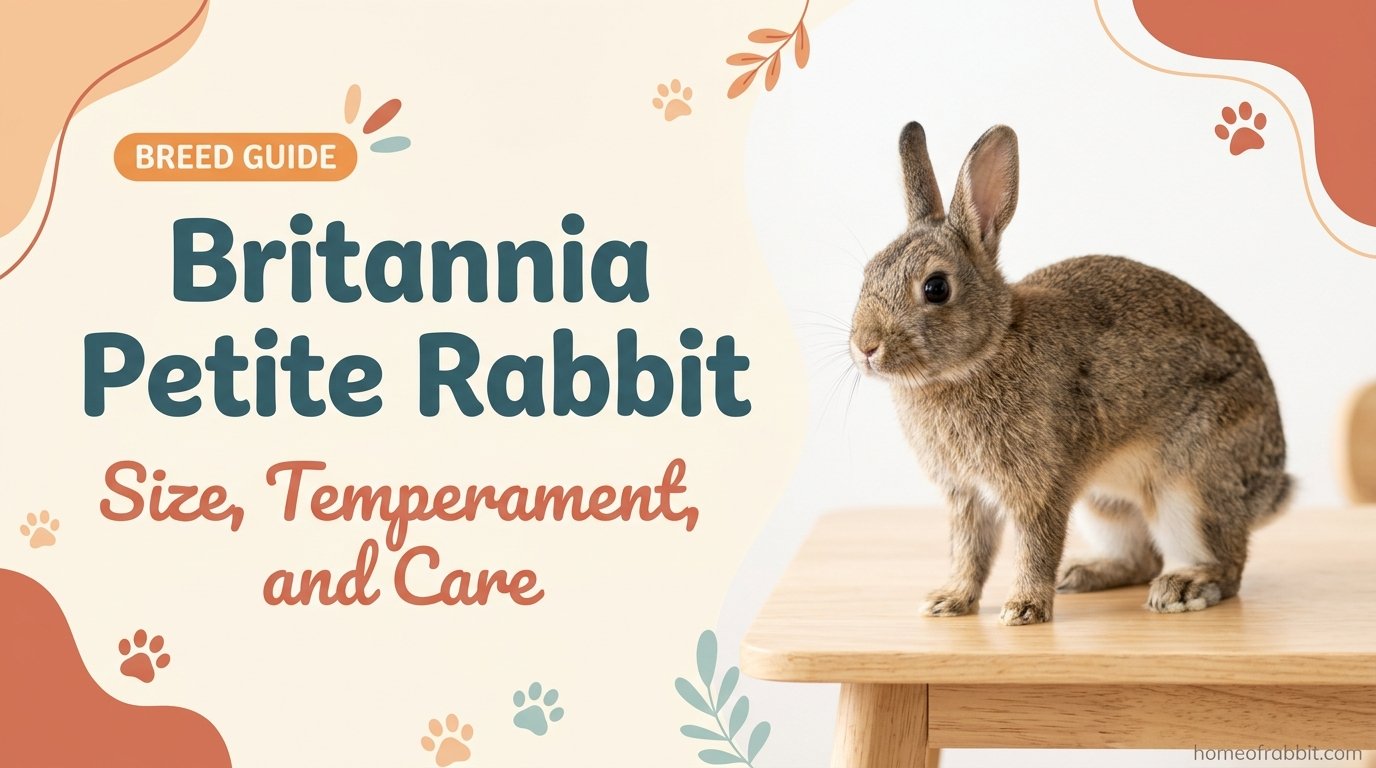
The Britannia Petite is one of the smallest rabbit breeds recognized by the American Rabbit Breeders Association (ARBA), with a maximum weight of 2.5 pounds. It is also slim, upright, and hare-like, not the round, teddy-bear shape most people picture when they hear “small rabbit.”
Here is the part to know before the size wins you over. ARBA describes the breed as active, energetic, and more high-strung than other breeds. A Britannia Petite takes patience to handle. If you want a calm lap rabbit, this is probably not it. If you like a quick, alert rabbit with real personality, read on.
Britannia Petite rabbit at a glance
| Trait | What to know |
|---|---|
| Maximum weight | 2.5 lb (ARBA). Commonly listed range: 1.5 to 2.5 lb |
| Body type | Full arch: a slim, lifted body that curves from neck to tail |
| Ears | Erect |
| Coat | Short, fine, dense flyback fur that lies close to the body |
| Recognized varieties | 10 on ARBA’s December 2024 list |
| Other name | “Polish” in Britain |
| Temperament | Active, energetic, easily startled |
| Dwarfing gene | No |
What a Britannia Petite looks like
The full arch. Seen from the side, a Britannia Petite forms one continuous curve from the nape of the neck to the base of the tail. The body is fine-boned and slender, and the rabbit stands high on its front legs rather than sitting low and compact. The head is wedge-shaped, not round. That arch is why the breed looks like a miniature hare, and it is the feature judges care about most.
Size and weight. ARBA lists 2.5 pounds as the maximum. Many pet-oriented sources describe adults as a little over 2 pounds. That is very light for a rabbit, and it matters in practice: a bad grip or a short fall is far more dangerous for a rabbit this size than for a larger breed.
Coat and varieties. The fur is short and sleek. ARBA’s recognized-breeds list (updated December 2024) names ten varieties:
- Black
- Blue-Eyed White
- Broken
- Chestnut Agouti
- Himalayan
- Otter
- Ruby-Eyed White
- Sable Marten
- Siamese Sable
- Tortoise Shell
Varieties can be added or revised. Check the current ARBA Standard of Perfection before you buy for a specific color.
Britannia Petite vs. Polish vs. Netherland Dwarf
The name causes real confusion. In Britain, this rabbit is called the Polish. When it came to the United States, American breeders named it the Britannia Petite because a separate American Polish breed already existed. The two are not the same rabbit.
| Britannia Petite | American Polish | Netherland Dwarf | |
|---|---|---|---|
| Body shape | Slim, full arch, stands high | Compact and rounded | Compact and rounded |
| Maximum weight | 2.5 lb | About 3.5 lb (verify in the Standard of Perfection) | About 2.5 lb |
| Dwarfing gene | No | No | Yes |
| Overall look | Hare-like | Rounded, with large eyes | Short face, very compact |
If you want the smallest rabbit with a classic cute, round look, a Netherland Dwarf or Polish is the closer match. The Britannia Petite is a different animal: leaner and more athletic.
Temperament: what living with one is really like
Britannia Petites are quick. They notice everything, react fast, and can bolt at a sudden movement. ARBA’s breed page says they take perseverance and patience to handle, and also calls them one of the showiest breeds to exhibit. Both statements come from the same trait: an alert, springy rabbit.
That does not mean every Petite is aggressive or unfriendly. ARBA’s standard notes that most will pose readily with proper handling, which suggests that early, calm, consistent handling pays off. But temperament varies by line, and many lines are bred mainly for the show table.
What this looks like day to day:
- Expect it to startle at loud noises, fast hands, and unfamiliar rooms.
- Approach low and slowly. Let the rabbit come to your hand instead of swooping in.
- Expect more play and movement than cuddling.
- Expect handling skills to matter more than they would with a larger, calmer breed.
Is a Britannia Petite right for you?
A Britannia Petite is a good match if you:
- Enjoy watching an active, athletic rabbit and don’t need a cuddly one
- Have the patience for short, regular handling sessions
- Live in a fairly calm household
- Are interested in showing, or want to learn rabbit conformation
It is probably a poor match if you:
- Want a rabbit that sits on your lap
- Have young children who will want to carry it
- Live in a noisy, unpredictable environment
- Are getting your first rabbit and want the easiest possible start
One breeder interviewed in a Philippines-based pet magazine put it bluntly: Britannia Petites are not for beginners. Not everyone agrees, but it is worth taking seriously if you have never kept a rabbit.
How to care for a Britannia Petite
Basic rabbit care applies. The adjustments come from the breed’s size and energy.
Housing and exercise. The House Rabbit Society recommends that rabbits live indoors and get at least four hours of exercise time a day. For an active breed like this, treat that as a minimum. Practical points:
- Give it a roomy pen it can run in, with a solid surface to rest on rather than bare wire.
- Add a hideaway. A startle-prone rabbit needs a place to retreat.
- Put rugs or mats on slick floors, because a fine-boned rabbit can slip and strain itself.
- Rabbit-proof any room it plays in: cords, baseboards, and gaps small enough for a 2-pound rabbit to squeeze through.
Diet, scaled to a 2.5 lb rabbit. The House Rabbit Society’s adult guidance is unlimited grass hay, about 1/4 to 1/2 cup of plain pellets per 6 pounds of body weight, and at least 2 cups of chopped vegetables per 6 pounds, with at least three kinds of leafy greens. Scaling that down proportionally for a 2.5-pound rabbit gives roughly:
| Food | Approximate daily amount for 2.5 lb |
|---|---|
| Grass hay | Unlimited, available at all times |
| Plain pellets | About 1.5 to 3 tablespoons |
| Chopped vegetables | About 3/4 to 1 cup, in 3 or more leafy varieties |
These are my proportional calculations from the per-6-pound guidance, not figures the House Rabbit Society publishes for this breed. Confirm amounts with a rabbit-savvy vet, and adjust if your rabbit gains or loses weight. To estimate how much hay to buy, try our rabbit hay calculator.
Two more diet notes from the House Rabbit Society: skip pellet mixes with seeds, nuts, corn, or fruit pieces, and wash fresh vegetables thoroughly (they advise at least two minutes in a bowl, changing the water several times) because of the spread of RHDV2.
Handling a very small rabbit safely. There is little margin for error at 2 pounds.
- Handle the rabbit low, over a soft surface, until it is calm.
- Support the chest and the hindquarters together. Never grab it by the ears.
- Keep it held close to your body so it cannot kick off.
- Keep sessions short and frequent rather than long and stressful.
- Put it down before it starts to struggle, not after.
Health basics. Find a vet who treats rabbits before you bring one home, and ask about their experience with very small rabbits. A rabbit that stops eating or stops producing droppings needs veterinary care the same day. Ask your vet whether an RHDV2 vaccine is available where you live, since availability varies.
How to find a healthy Britannia Petite
Start with a breeder, not a photo. ARBA’s Britannia Petite page links to a breeder finder and the breed club. Visiting a rabbit show is another good option, because you can see adults up close, handle them, and talk with exhibitors.
Questions to ask a breeder:
- How old are the parents, and what do they weigh?
- How often have the babies been handled?
- Are your rabbits bred for showing or for pets, and is the temperament different?
- Can I meet an adult from the same line?
- What health guarantee do you offer?
Signs of a healthy rabbit: bright, clear eyes; a clean nose and bottom; normal droppings; and alert but not frantic behavior.
Common mistakes: buying from a photo alone, assuming a pet-store “dwarf” is a Britannia Petite, and choosing a rabbit for its color before checking its build and temperament. Prices vary widely by breeder and quality, and I have no reliable current figure, so ask for the price up front.
Britannia Petite as a show rabbit
This is where the breed shines. Judges look for the full arch, a fine-boned body, the correct head shape, and sleek flyback fur, and the rabbit must stay within the weight limit. Producing a good one is demanding because the arch and the tiny size are hard to keep together. If you are curious about showing, a local ARBA-sanctioned show is the cheapest way to see what judges reward.
Conclusion
The Britannia Petite rabbit is small, athletic, and spirited: a 2.5-pound, hare-shaped rabbit that rewards patient handling and a calm home. It is less suited to families wanting a cuddly pet or to first-time owners. If the temperament fits, meet adult rabbits through a breeder or a show, plan for daily exercise, and set up a vet before you buy.
FAQ
How big does a Britannia Petite rabbit get?
ARBA lists a maximum weight of 2.5 pounds. Adults are often described as a little over 2 pounds.
Is a Britannia Petite the same as a Polish rabbit?
In Britain, yes: the rabbit called the Polish there is the same type as the US Britannia Petite. In the United States, the Polish is a separate, rounder breed.
Is a Britannia Petite a good pet?
It can be, for a patient owner in a calm home. It is active and easily startled, so it is a poorer fit for people wanting a cuddly lap rabbit or for young children.
How long does a Britannia Petite live?
I could not find an authoritative breed-specific lifespan figure. Ask the breeder about the lifespans of their own lines and confirm with a rabbit-savvy vet.
