
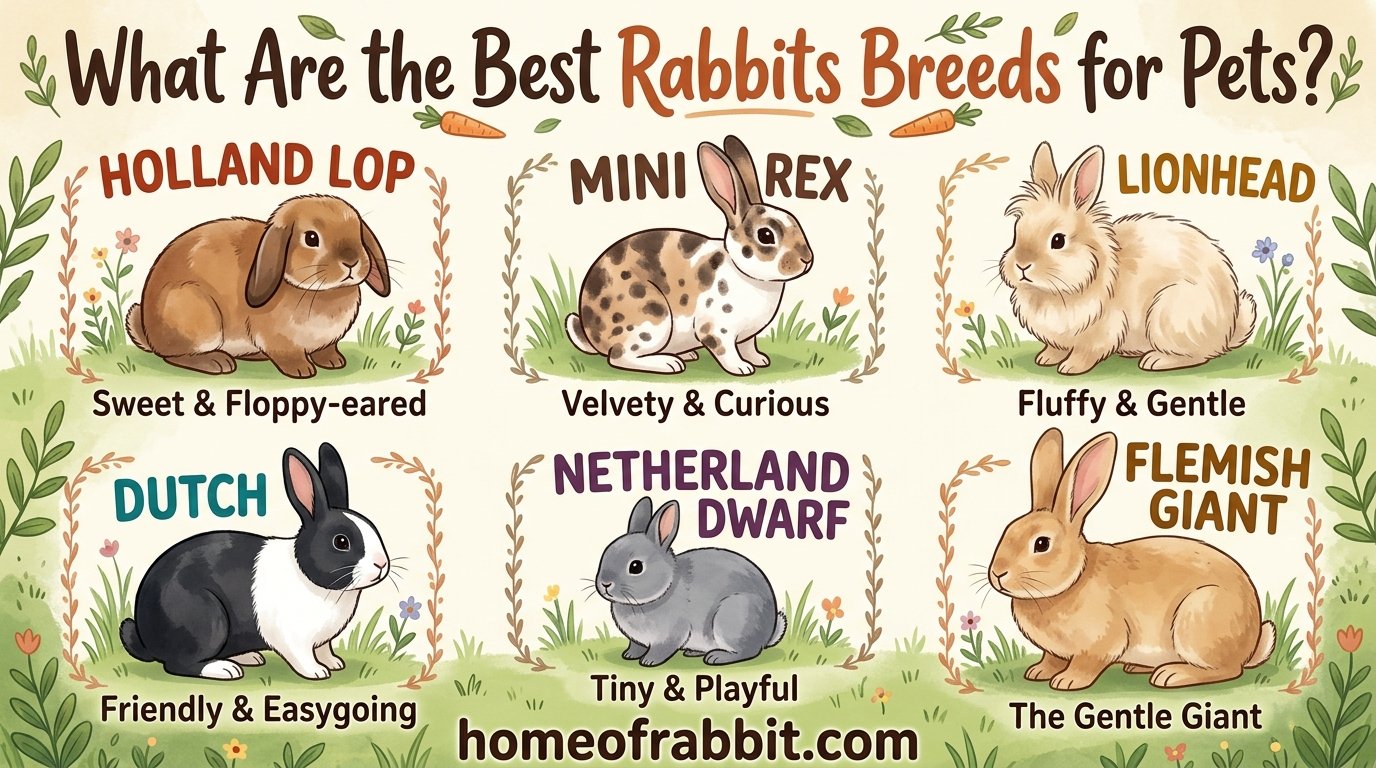
If you want a short answer: Holland Lops, Mini Rexes, Mini Lops, and Dutch rabbits are among the most commonly recommended rabbit breeds for pets, because they stay small to medium in size and are often described as easygoing. Netherland Dwarfs and Lionheads are popular too, but they tend to suit more experienced owners.
Here is the part that matters more than the breed name: individual personality, early handling, and the home you provide shape a rabbit far more than its breed does. Two Holland Lops from the same litter can behave very differently. Use breed as a starting point, not a promise.
Quick Picks: Rabbits Breeds for Pets at a Glance
Weights below are the maximums listed by the American Rabbit Breeders Association (ARBA) for recognized breeds. Pet rabbits often weigh a little less. Temperament notes are general tendencies, not guarantees.
| Breed | ARBA max weight | Typical temperament | Good fit for |
|---|---|---|---|
| Netherland Dwarf | 2.5 lb | Energetic, can be nervous | Experienced owners |
| Lionhead | 3.75 lb | Curious, can be timid | Owners who can groom regularly |
| Holland Lop | 4 lb | Often calm and sociable | First-time owners |
| Mini Rex | 4.5 lb | Often playful and outgoing | Active, hands-on households |
| Mini Lop | 6.5 lb | Often gentle if handled softly | First-time owners |
| Dutch | Verify at arba.net | Often steady and sociable | Families with calm handling |
| Rex | About 9.5–10.5 lb (verify; sources differ) | Often calm and friendly | Owners with space |
| Flemish Giant | Large, well over 10 lb (verify exact figures) | Often laid-back, needs room | Owners with lots of space |
How to Choose a Pet Rabbit Breed
Before you fall for a photo, run through these four questions.
1. How much space do you have? Small breeds still need room to run, stretch, and hop. Giant breeds need considerably more floor space, bigger litter boxes, and sturdier furniture. The House Rabbit Society recommends the idea that bigger is better for housing, with a safe, rabbit-proofed play area for daily exercise.
2. Who will handle the rabbit? Most rabbits are prey animals and do not enjoy being picked up. Many are fragile despite their sturdy look. If young children will be involved, choose a calm adult rabbit and plan for floor-level, supervised interaction.
3. How much grooming can you realistically do? Long-coated breeds like the Lionhead need regular brushing. Short plush coats like the Rex and Mini Rex need much less. Every rabbit sheds, and shedding seasons mean extra brushing for all of them.
4. What kind of vet can you reach? Rabbits are exotic pets. Not every clinic treats them. Find a rabbit-savvy vet before you adopt, and budget for annual checkups. The House Rabbit Society suggests a yearly visit, and twice a year for rabbits over 5.
8 Rabbit Breeds That Often Make Good Pets
Holland Lop
The smallest of the lop-eared breeds, with a maximum ARBA weight of 4 lb. It was recognized by ARBA in 1979 and has stayed among the most popular rabbit breeds in the United States.
- Pros: Compact size, widely available, often calm and social.
- Cons: Its short face can contribute to dental problems in some rabbits, and lop ears need regular checking for wax buildup.
- Best for: First-time owners in apartments.
Mini Lop
A step up in size from the Holland Lop, with an ARBA maximum of 6.5 lb. Mini Lops are usually described as people-oriented when handled gently.
- Pros: Sturdier build than the tiniest dwarfs, friendly reputation.
- Cons: Like other short-faced breeds, can be prone to dental issues. Have teeth checked at routine vet visits.
- Best for: Beginners who want a small-to-medium rabbit.
Mini Rex
Known for a dense, velvety coat and a maximum ARBA weight of 4.5 lb. Many owners describe them as playful and curious.
- Pros: Low-maintenance coat, lively personality.
- Cons: Active rabbits need more daily exercise and enrichment, and they can get into trouble if bored.
- Best for: Owners who enjoy interactive play.
Netherland Dwarf
One of the smallest breeds, with an ARBA maximum of 2.5 lb. Cute, but not always the easiest first rabbit.
- Pros: Very small footprint.
- Cons: Often described as skittish or temperamental, and small size does not mean small needs. Short-faced anatomy can bring dental concerns.
- Best for: Patient, experienced owners who can handle a spirited rabbit.
Lionhead
Recognized by ARBA in 2014, with a maximum weight of 3.75 lb and a distinctive mane around the head.
- Pros: Striking look, small size, often curious.
- Cons: The longer wool needs regular grooming, and some Lionheads are timid.
- Best for: Owners willing to brush consistently and move slowly while the rabbit builds trust.
Dutch
Easy to recognize by its marked coat pattern, and one of the classic pet breeds. ARBA lists a standard weight, so confirm it at arba.net.
- Pros: Medium-small body, short coat, generally steady temperament.
- Cons: Like all rabbits, still needs space, enrichment, and a rabbit-savvy vet.
- Best for: Families who will keep interactions gentle and supervised.
Rex
A medium-to-large breed with a plush, short coat. Sources differ on the exact ARBA maximum (about 9.5 to 10.5 lb), so verify before quoting a number.
- Pros: Low grooming needs, often calm and friendly.
- Cons: Needs more room than the small breeds.
- Best for: Owners with a bigger home and a preference for a more laid-back rabbit.
Flemish Giant
A very large breed. Many owners describe them as gentle and relaxed, but their size changes everything about care.
- Pros: Calm reputation, can be surprisingly affectionate.
- Cons: Needs much more space, food, and a larger litter setup. Giant breeds also tend to have shorter lifespans than small breeds, so plan with your vet.
- Best for: Experienced owners with lots of room.
Are Rabbits Good Pets for Kids?
Sometimes, with caveats. Rabbits are not low-effort starter pets. They need daily care, and many do not like being held. The House Rabbit Society points out that rabbits are delicate despite their hardy look, so a rabbit is usually better suited to a family where an adult is the responsible caretaker and children learn to interact at floor level.
If kids are involved, look for an adult rabbit with a calm, proven temperament rather than a baby chosen on looks. Shelters often know each rabbit’s personality, which makes this easier. Rabbits can also live a long time: the House Rabbit Society puts the typical lifespan of a spayed or neutered house rabbit at 8–12 years, so this is a long commitment, not a short-term pet.
Common Mistakes When Choosing a Rabbit Breed
- Choosing by looks alone. A tiny lop-eared baby is adorable, but temperament only shows with age.
- Assuming small means easy. Dwarf breeds are not automatically beginner-friendly.
- Skipping the vet search. Finding a rabbit-savvy vet after an emergency is stressful.
- Planning outdoor housing. The House Rabbit Society recommends indoor homes, and since rabbit hemorrhagic disease virus (RHDV) emerged in the US, it advises against outdoor play even for vaccinated rabbits. Ask a rabbit-savvy vet about RHDV2 vaccination in your area.
- Forgetting spay or neuter. Fixed rabbits tend to be healthier and easier to litter train.
- Not planning for long-term care. Think about who will care for the rabbit when you travel.
Adopt or Buy?
Purebred breeders are one route, but they are not the only one. Many rabbits in shelters and rescues are mixed or hard to identify by breed, and they can be wonderful pets. Rescues often spay or neuter before adoption and can match you with a rabbit whose personality suits your household. For example, House Rabbit Society’s adoption page lists a fee of $50 for a single rabbit that includes spay/neuter, vaccination, and microchip. Fees and policies change, so check the current page before relying on that number.
If you do buy from a breeder, ask to meet the parents, see how the rabbits are housed, and ask what vet care they provide.
Pet Rabbit Checklist Before You Commit
- I have indoor space for a large enclosure plus daily out-of-pen exercise.
- I have found a rabbit-savvy vet and understand typical costs.
- I can provide unlimited hay, fresh water, and a proper diet every day.
- I am prepared to rabbit-proof cords, baseboards, and furniture.
- I understand that most rabbits dislike being picked up.
- I plan to spay or neuter.
- I have a plan for care when I travel.
- I am ready for an 8–12 year commitment.
Once you have a rabbit at home, one common first-week question is odor. Do rabbits smell? Usually the answer comes down to cleaning routine and litter setup, not the breed.
Conclusion
The best rabbit breeds for pets depend on your space, your experience, and the time you can give. For most first-time owners, a Holland Lop, Mini Lop, Mini Rex, or Dutch is a reasonable place to start, while Netherland Dwarfs, Lionheads, and giant breeds usually suit owners who know what they are signing up for. Whichever you choose, meet the actual rabbit first, check its personality, and put a rabbit-savvy vet and indoor setup in place before you bring it home. For general care guidance, the House Rabbit Society is a good place to continue.
FAQ
What is the friendliest rabbit breed? No breed is guaranteed friendly. Holland Lops, Mini Lops, Rexes, and Flemish Giants are often described as gentle, but individual handling and temperament matter more than breed.
What is the best rabbit breed for a first-time owner? Holland Lops, Mini Lops, Mini Rexes, and Dutch rabbits are commonly suggested for beginners. Meeting the individual rabbit, and choosing an adult with a known temperament, helps more than choosing by breed.
Are dwarf rabbits good pets? They can be, but Netherland Dwarfs in particular are often described as energetic and skittish, so they tend to suit patient, experienced owners better than beginners.
How long do pet rabbits live? The House Rabbit Society gives 8–12 years as the average lifespan of a spayed or neutered house rabbit. Larger breeds tend to live shorter lives on average, so ask your vet about your rabbit’s breed.
Should I get a rescue rabbit instead of a purebred? Often, yes. Rescues usually know the rabbit’s personality, and many spay or neuter before adoption. You may not know the exact breed, but that rarely matters for a pet.
