
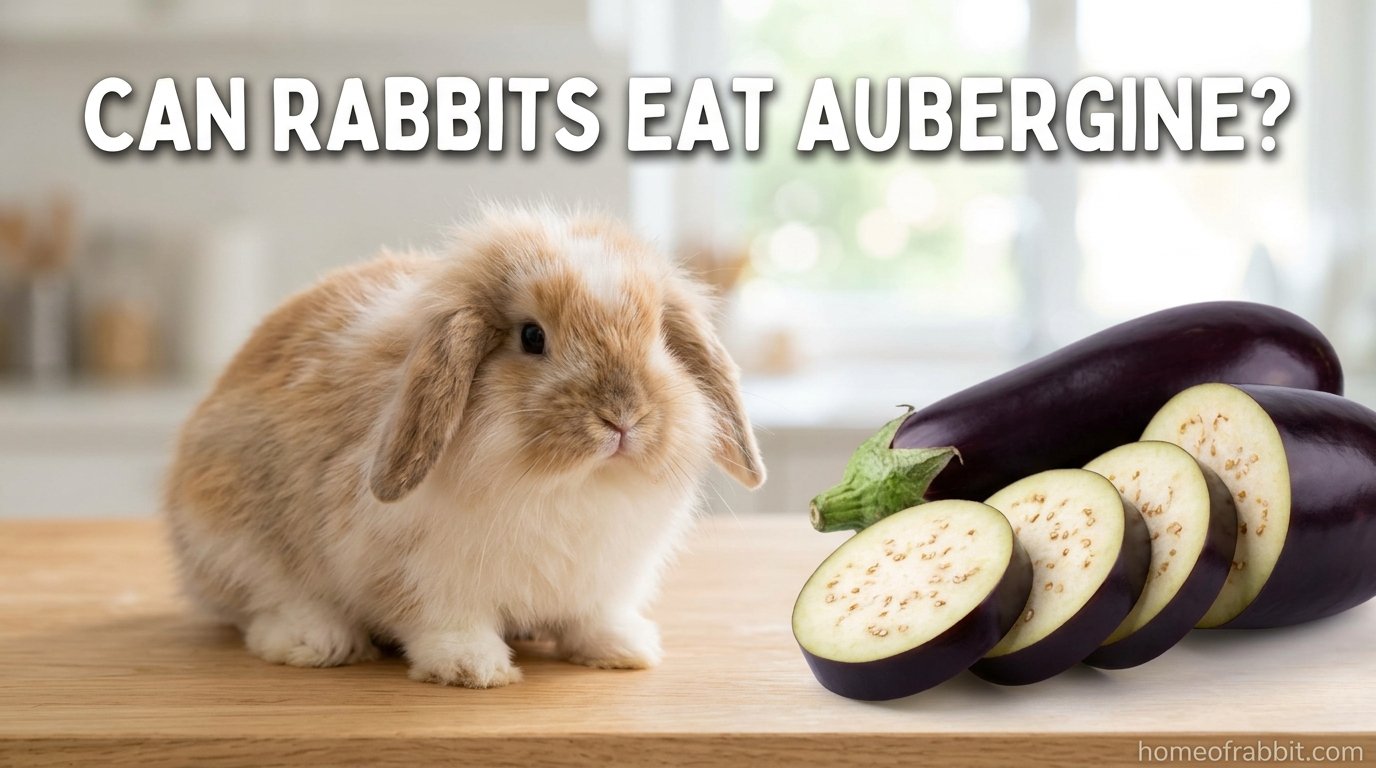
Short answer: a tiny piece of fresh, ripe aubergine flesh is generally considered acceptable as an occasional treat, but it is not a necessary food, and the leaves, stems, flowers and green cap should never be fed. Aubergine, called eggplant in the US, belongs to the nightshade family, which is why many rabbit owners hesitate.
It is also worth knowing that aubergine does not appear on the rabbit-safe vegetable list or the avoid list published by Rabbit.org. Tomatoes (ripe fruit only) are listed, and potatoes are on the avoid list. Because aubergine sits in the middle, the sensible approach is caution: small, rare and plain.
Why aubergine raises questions: the nightshade family
Aubergine is in the Solanaceae family, alongside tomatoes, potatoes and peppers. These plants make natural compounds called glycoalkaloids to defend themselves. In aubergine the main ones are solasonine and solamargine, a different pair from the solanine in potatoes, though people often use “solanine” as shorthand for the whole group.
The amount varies by plant part. In one study of two Iranian eggplant varieties, solasonine was highest in flower buds and leaves and lower in fruit, and lowest in the mature fruit. That fits the usual advice: the fruit flesh is the lowest-risk part, and the green parts of the plant are the ones to keep away from rabbits. This is a single study on two varieties, so treat it as supporting evidence rather than a safety guarantee.
I could not find a published, rabbit-specific toxic dose for aubergine. Anyone who tells you an exact “safe” gram amount is estimating, so a vet who knows rabbits is the best person to ask if your rabbit has health problems.
Which parts of aubergine can rabbits eat?
| Part | Verdict | Notes |
|---|---|---|
| Ripe flesh | Tiny amounts, occasionally | Fresh, firm and raw. Not a staple. |
| Skin | Usually fed with the flesh | Wash thoroughly first. Skip if waxed or heavily treated. |
| Seeds | Unclear | I found no reliable rabbit-specific guidance. If the fruit is overripe with large dark seeds, skip it. |
| Green cap and stem | Avoid | Part of the green plant tissue. |
| Leaves, flowers, vines | Never | Higher in glycoalkaloids than the fruit. |
| Unripe or green-tinged fruit | Avoid | Unripe nightshade fruit tends to be higher in toxins. Rabbit.org makes this point for tomatoes. |
| Cooked, fried, pickled or seasoned | Avoid | See the section on cooked aubergine. |
How much aubergine can a rabbit have?
There is no official serving size for aubergine. What we do have is the general rule from Rabbit.org: fresh vegetables make up about 10% of an adult rabbit’s diet, hay makes up about 80%, and non-leafy vegetables should be roughly 1 tablespoon per 2 pounds of body weight per day, shared across all non-leafy vegetables.
Because aubergine is a nightshade with limited rabbit-specific guidance, I suggest staying well under that ceiling. As a conservative starting point (my practical suggestion, not an established dose):
- Offer a sliver about the size of your thumbnail.
- Give it no more than once or twice a week, and only after your rabbit has shown it tolerates it.
- Count it as part of the non-leafy vegetable allowance, not on top of it.
How to serve it step by step
- Pick a good one. Choose a fresh, firm, glossy aubergine. Avoid soft, wrinkled, bitter-smelling or overripe fruit.
- Wash it. House Rabbit Society recommends washing all vegetables for at least two minutes in a bowl, changing the water several times, because of RHDV2.
- Remove the cap and stem. Cut away every green part.
- Cut a small piece of raw flesh. Plain, with no oil, salt or seasoning.
- Offer it on its own, as the only new food that day. Rabbit.org advises introducing one new vegetable at a time and waiting 24 hours to check for soft stools or gas before adding another.
- Watch the droppings and appetite for a day. If anything looks off, stop and do not offer it again.
Can baby rabbits eat aubergine?
No. Rabbit.org says vegetables should only be introduced after 12 weeks of age, one at a time and in quantities under half an ounce, because a baby’s digestive system is delicate and an upset stomach can become an emergency. A nightshade is not a good first vegetable. Start with a basic leafy green and revisit aubergine, if at all, once the rabbit is a settled adult.
Can rabbits eat cooked aubergine?
Plain raw is the better choice. Some pet websites claim cooking removes the risk entirely, while others say to avoid cooked aubergine altogether. I could not find a reliable source showing cooking makes it safer for rabbits, so I would not rely on that idea.
There is also a practical problem. Cooked aubergine in a typical kitchen comes with oil, salt, butter, sauces, and often garlic or onion. Rabbit.org lists garlic and onions among the foods to avoid. Dishes such as moussaka, baba ganoush or fried slices are not rabbit food.
Signs your rabbit is not tolerating it
Stop feeding it and monitor your rabbit if you notice:
- Soft stools or diarrhea
- Smaller or fewer droppings
- Bloated or gassy behavior, or hunching
- Less interest in hay and food
- Lethargy
- Drooling or difficulty breathing (more typical of larger plant ingestion)
A rabbit that has not eaten or passed droppings for 12 to 24 hours needs a vet quickly. Rabbit digestion can slow down fast, and waiting overnight is risky. If you do not already have a rabbit-savvy vet, finding one before an emergency is worthwhile.
What to do if your rabbit ate aubergine leaves or plants
This is more serious than a nibble of the fruit.
- Remove the plant and any remaining pieces from reach.
- Note roughly how much was eaten and when. Keep a leaf or photo of the plant.
- Call a vet who treats rabbits, or a pet poison helpline, and describe the amount and your rabbit’s size.
- Do not try to make your rabbit vomit. Rabbits cannot vomit.
- Watch for the signs listed above while you wait for advice.
If you grow aubergines, keep rabbits out of the garden bed or fence it. Even if rabbits tend to avoid nightshade foliage, a hungry or curious rabbit may not.
Common mistakes
- Treating “safe in small amounts” as “good to feed daily.” Aubergine adds little your rabbit cannot get from safer greens.
- Feeding the whole slice because the skin looks fine. The green cap and stem are the parts people forget to remove.
- Offering aubergine from last night’s dinner. Seasoned or oily leftovers are the wrong food.
- Introducing several new foods together. If your rabbit gets loose stools, you will not know the cause.
- Relying on forum posts for safety. Owners in forums disagree about aubergine; some avoid it entirely. Use rabbit welfare organizations and your vet as the tie-breaker.
Safer vegetables to offer instead
If the goal is a tasty, crunchy treat, these are on Rabbit.org’s rabbit-safe lists:
| Type | Examples |
|---|---|
| Leafy (about 75% of daily veg) | Romaine, cilantro, parsley, arugula, bok choy, dandelion greens, basil |
| Non-leafy (small portions) | Bell pepper, cucumber, zucchini (courgette), broccoli, pumpkin, okra |
Sugary options such as carrots and beets should stay as occasional treats. For the bigger picture on keeping a rabbit healthy, see our guide to the most common cause of death in rabbits.
Quick checklist
- Is my rabbit an adult, over 12 weeks, and eating hay well?
- Is the aubergine fresh, firm, ripe and washed?
- Have I removed the cap, stem and any green parts?
- Is it raw and completely plain?
- Is the piece about thumbnail size?
- Is it the only new food today?
- Am I ready to watch droppings and appetite for 24 hours?
Conclusion
So, can rabbits eat aubergine? A small raw piece of ripe flesh now and then is generally considered acceptable, but the leaves, stems, flowers and unripe fruit are off the table, and it is not a food any rabbit needs. Because the major rabbit welfare guides do not list it as a recommended vegetable, the safest approach is a tiny taste, rarely, and a quick stop if anything looks wrong. When in doubt, choose a leafy green from the Rabbit.org vegetable guide and ask a rabbit-savvy vet about your individual rabbit.
FAQ
Is aubergine the same as eggplant? Yes. “Aubergine” is the common name in the UK and many other countries, and “eggplant” is the US term. The advice for rabbits is the same.
Is aubergine poisonous to rabbits? The plant contains natural toxins, concentrated more in the leaves, stems and flowers than in the ripe fruit. The leaves should never be fed. The fruit flesh is considered lower risk in tiny amounts, but no rabbit-specific toxic dose is established.
Can rabbits eat aubergine skin? Pet-care sources generally treat the skin as fine alongside the flesh, provided it is washed well. If it has wax or you are unsure how it was grown, peel it.
How often can I give my rabbit aubergine? There is no official schedule. As a cautious approach, no more than once or twice a week in a thumbnail-sized piece, and skipping it entirely is perfectly fine.
