
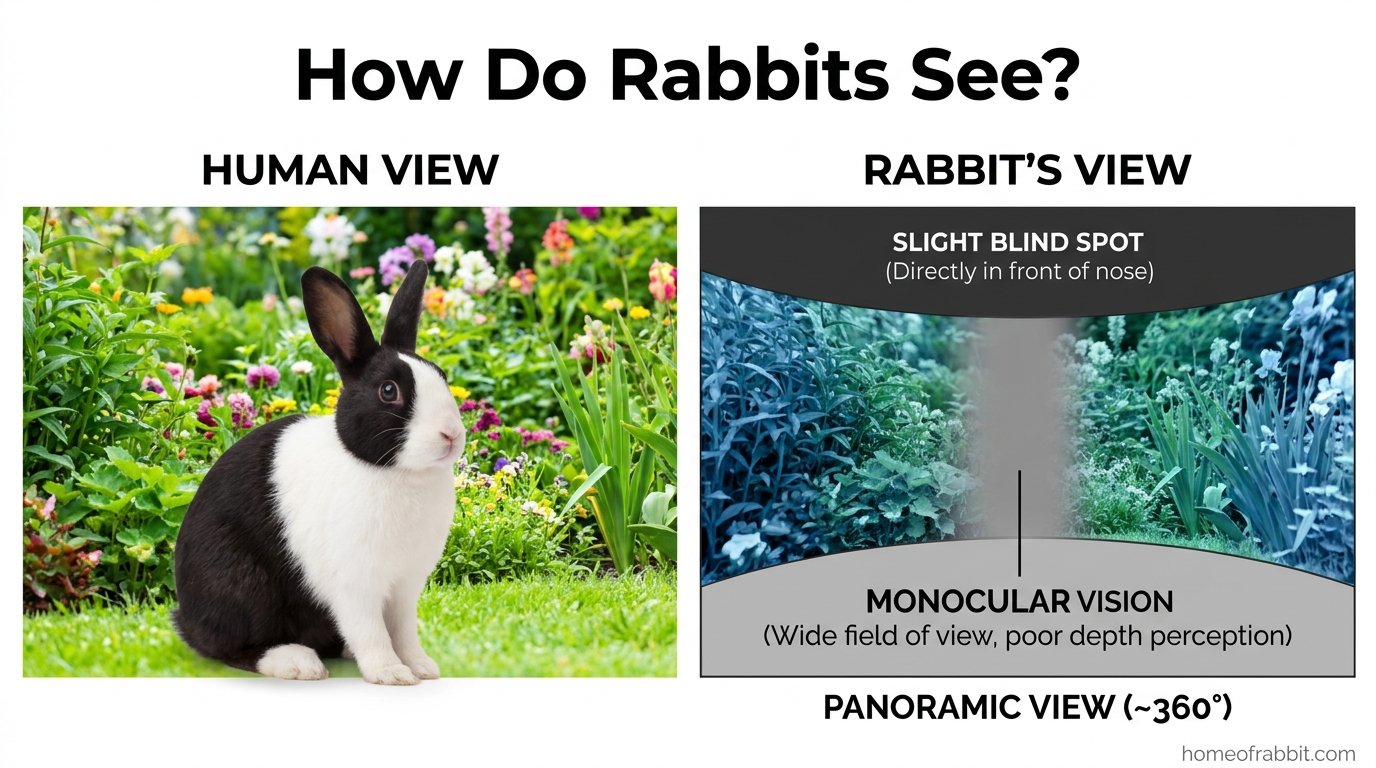
Rabbits see a nearly complete circle around them, spot movement very well, and cope with dim light, but they see fine detail poorly and have a blind spot directly in front of the nose. Those traits suit a prey animal that needs to notice a hawk or fox early. They also explain several things pet owners notice, like a rabbit that “misses” a treat held right in front of its face.
This guide covers how rabbit vision works and what to do about it at home.
How Do Rabbits See the World at a Glance?
| Feature | What rabbits have |
|---|---|
| Field of view | Almost 360° |
| Blind spots | In front of the nose and chin, and directly behind the head |
| Color | Two cone types (blue and green), no red |
| Low light | Strong, with far more rods than cones |
| Detail | Limited close-up sharpness |
| Depth perception | Weaker than ours |
Field of View: Why Rabbits See Almost 360°
A rabbit’s eyes sit high on the sides of its head. A rabbit’s field of vision is close to 360 degrees, and it can see well above and behind itself. That means a rabbit can graze while watching the sky and the ground behind it. rabbit
The Blind Spots
Wide-set eyes come with trade-offs. The area just beneath the mouth is a blind spot, so rabbits rely on their lips and whiskers to judge food there. There is also a second blind spot directly behind the head. wabbitwikibiologyinsights
This is why a rabbit may sniff around for a treat you are holding right under its nose. It isn’t ignoring you. It simply can’t see it.
Depth Perception and Near Vision
Because the eyes point sideways, the views from the two eyes overlap very little, which weakens depth perception. Rabbits tend to struggle with depth perception and close-up objects. A rabbit may hesitate before a jump or misjudge a gap. Some sources also describe the area in front of a rabbit as short-sighted, but the exact figures come from non-scientific sources and should be verified with a veterinary reference before you rely on them. everbreed
Can Rabbits See Color?
Yes, but not the way you do. Rabbit cones respond to green or blue light but not red, which limits rabbits to two-color (dichromatic) vision. By human standards, that is similar to red-green color blindness, not total color blindness. wabbitwiki
In practice, reds and oranges likely look muted or grayish. How a rabbit actually experiences color is not fully known, and rabbits don’t seem to pay much attention to color. Choosing a toy by color matters far less than choosing it by texture, smell, and movement. wabbitwiki
Can Rabbits See in the Dark?
Rabbits can’t see in total darkness, but they see well in dim light. Rabbit retinas contain many more rods than cones, and rods work in low light. This fits their crepuscular lifestyle, being most active at dawn and dusk. wabbitwikibiologyinsights
The trade-off is that rods give less detail and no color, which adds to the soft, low-detail picture rabbits have of the world.
Rabbit Vision vs. Human Vision
| Humans | Rabbits | |
|---|---|---|
| Cone types | 3 (red, green, blue) | 2 (green, blue) |
| Field of view | Roughly 180° | Nearly 360° |
| Best at | Sharp detail, color, depth | Motion, wide coverage, dim light |
| Weakest at | Seeing behind us | Close-up detail, depth |
The takeaway is that rabbits trade sharpness for awareness.
What Rabbit Vision Means for Daily Care
How to Approach and Pick Up Your Rabbit
- Approach from the side, where the rabbit can see you.
- Speak softly first so it knows you are there.
- Let it sniff your hand before touching.
- Pet it on the forehead or cheeks, where it can see and sense you coming.
Avoid reaching down from directly above, or swooping in from behind. A hand arriving from overhead can look like a predator.
How to Offer Treats
Hold the treat a little to the side of the nose and let your rabbit find it with its whiskers and lips. Don’t hold it right under the chin, where the rabbit can’t see it.
Home Setup and Lighting
- Avoid sudden changes in lighting or very harsh lamps.
- Keep the floor plan fairly consistent. Rabbits learn a space by memory and routine.
- Give the rabbit a hiding spot. It reduces stress from things it sees but can’t judge.
- Keep clutter and sharp objects out of the rabbit’s path, since depth perception is limited.
Common Mistakes
- Assuming a rabbit that misses a treat is “dumb” or has bad eyes.
- Startling the rabbit from behind or above.
- Rearranging a room often and then wondering why the rabbit bumps into things.
- Buying toys for their color instead of their texture and chewability.
Baby Rabbits and Red-Eyed Rabbits
Newborn rabbits are born with their eyes closed. They typically open them within about two weeks, but check this against a veterinary or rabbit-rescue source if you are caring for a litter. If you are raising orphaned kits, see our guide on how often baby bunnies eat.
Red-eyed rabbits, such as albino rabbits, aren’t blind. The red appearance is simply a lack of pigment in the iris. They may be more sensitive to bright light, so keep their housing out of harsh direct sun. rabbitholehay
Signs of Eye Problems
Normal rabbit eyes are clear, bright, and free of crust or heavy discharge. Contact an exotic-pet veterinarian if you notice:
- Cloudiness or a change in eye color
- Persistent tearing or discharge
- Squinting, pawing at the eye, or keeping an eye shut
- Redness or swelling
- Bumping into objects far more than usual
Rabbit eye problems can be linked to dental disease and infection, so don’t wait it out.
Quick Checklist
- Approach from the side and speak first
- Offer treats slightly off to the side
- Keep lighting gentle and consistent
- Keep your layout stable
- Check eyes regularly for clarity and discharge
- See a vet promptly if anything looks off
Conclusion
So, how do rabbits see? They see widely, not sharply. Nearly 360° vision, excellent motion detection, and good low-light sight help them survive, while blind spots, limited color, and weak depth perception explain many everyday quirks. Knowing this lets you approach your rabbit more gently, offer treats more effectively, and set up a home that feels safe to a prey animal.
For a deeper anatomy reference, see the House Rabbit Society’s Rabbit Eye guide.
FAQ
Can rabbits see behind them?
Mostly yes. Their field of view is nearly 360°, with small blind spots directly behind the head and in front of the nose.
Are rabbits color blind?
Not completely. They see blues and greens but not red as a distinct color.
Do rabbits see well in the dark?
They see well in dim light, but not in total darkness.
Why can’t my rabbit find the treat in my hand?
The treat is probably in the blind spot beneath its nose. Offer it slightly to the side.
Can rabbits recognize their owners?
Rabbits likely use smell and voice along with sight. I did not verify a specific study on this, so I’d leave the claim out or confirm it before publishing.
