
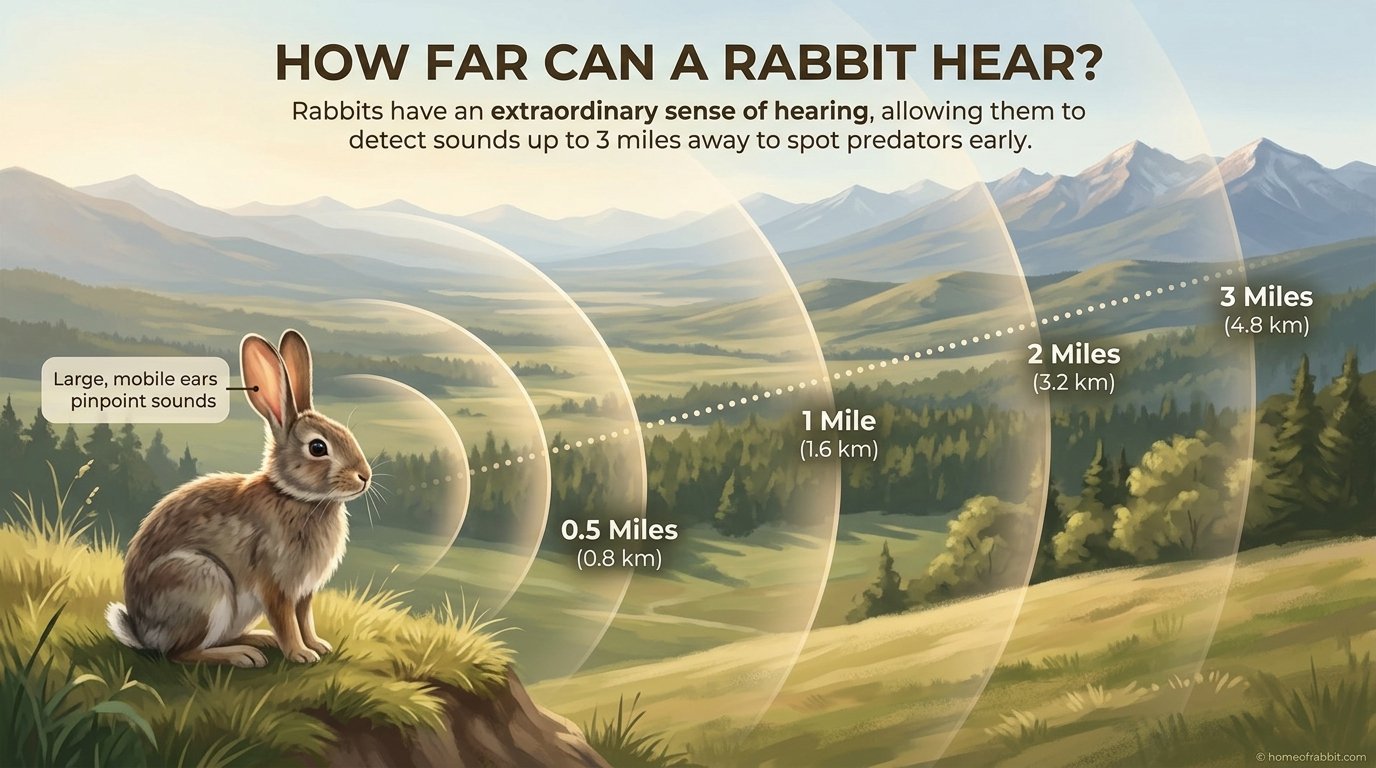
No one can give you a reliable distance in feet or miles. Research on rabbit hearing measures which pitches they hear and how quiet a sound can be before they stop detecting it. How far a sound carries depends on how loud it starts out, its pitch, and what is between the source and the rabbit.
What is well documented is that rabbits hear a much wider range of high pitches than people do, and they detect very quiet sounds in the mid-to-high range. This article explains what that means in real life.
The short answer: why there’s no single distance
A search for how far rabbits can hear usually turns up one confident number. Be cautious with those. A distance only makes sense for a specific sound: a whisper and a lawn mower travel very different distances for any listener, human or rabbit.
What scientists have measured is called an audiogram: the quietest sound a rabbit can detect at each pitch. The standard laboratory work on domestic rabbits (Heffner and Masterton, 1980) tested two rabbits, so treat the figures as a good estimate, not a guarantee for every rabbit.
How well can rabbits hear compared with people?
Hearing range is usually given as the lowest and highest pitches a listener can detect at a set loudness. At a moderate level of 60 decibels (dB SPL), the Heffner data show domestic rabbits hearing from about 96 Hz up to about 49,000 Hz (49 kHz). Humans at the same level hear from roughly 31 Hz to 17.6 kHz, according to a review by the same research group.
| Approximate hearing range | Notes | |
|---|---|---|
| Rabbit | ~96 Hz to ~49 kHz | At 60 dB SPL; two rabbits tested |
| Human | ~31 Hz to ~17.6 kHz | At 60 dB SPL; the “20 Hz to 20 kHz” figure is a common rounded version |
Other sources quote slightly different numbers (for example, LSU’s summary table lists about 360 to 42,000 Hz) because researchers use different loudness cutoffs. The pattern is the same everywhere: rabbits hear far higher pitches than humans, and slightly worse very low pitches.
The Heffner audiogram also shows how the range changes with volume. The louder a sound, the wider the range a rabbit can detect:
| Sound level | Lowest pitch heard | Highest pitch heard |
|---|---|---|
| 30 dB SPL (very quiet) | ~445 Hz | ~35 kHz |
| 50 dB SPL | ~150 Hz | ~46 kHz |
| 70 dB SPL | ~63 Hz | ~51 kHz |
Rabbits are most sensitive somewhere in the mid-to-high range, roughly 2 to 16 kHz in the lab data, where they detected very quiet sounds. That range includes the rustle of grass, a footstep on gravel and the crinkle of a treat bag.
What affects how far a rabbit can hear a sound
Loudness
In open space, sound gets quieter as it travels. A common rule of thumb is a drop of about 6 dB every time the distance doubles. This is a simplified physics rule that ignores wind, air absorption and obstacles, so use it for intuition only.
Example: a sound measuring 60 dB at 1 meter would be about 54 dB at 2 meters, 48 dB at 4 meters and 40 dB at 10 meters. A rabbit’s threshold for mid-pitched sounds is very low, so it may still detect a faint sound from a long way off, while a sound at the edge of its range (very low or very high) needs to be much louder to be noticed.
Pitch
High-pitched sounds fade faster than low ones as they pass through air, and they are blocked more easily by objects. A rabbit may hear a clear mid-pitched noise from farther than an ultrasonic one of the same starting loudness. This is general acoustics, not a rabbit-specific measurement.
Obstacles and surroundings
Walls, closed doors, hedges and even furniture soak up sound. Indoors, a rabbit in a quiet room can pick up a rustling bag in the kitchen. Outdoors, wind direction and background noise decide whether a distant sound registers at all.
Can rabbits hear ultrasound?
Yes. Ultrasound is generally defined as anything above 20 kHz, and the audiogram shows rabbits detecting tones well beyond that, up to roughly 49 kHz at moderate loudness.
In practice, this means some household devices could be audible to your rabbit even though you hear nothing. Possible sources include some ultrasonic pest repellers, certain electronics and some chargers or sensors. I have not found rabbit-specific research on how such devices affect rabbits, so if your rabbit seems agitated near one, simply try moving the rabbit or switching the device off.
What good hearing means for daily care
A sensitive listener lives in a louder world than you do. A few simple habits help:
- Give the rabbit a quiet room or hiding spot. A covered hideout lets a rabbit step away from household noise.
- Keep vacuum cleaners, blenders and TVs away from the enclosure where you can, or warn the rabbit by moving it first.
- Speak softly and approach from the front. Sudden loud sounds and unexpected approaches both startle rabbits. Your voice becomes familiar over time, which is one reason some owners notice their rabbit responding to them. For more on that, see our guide on whether rabbits recognize their owners.
- Watch the ears. Ears turning toward a noise show interest or alertness. Ears pinned flat against the back suggest fear or stress.
- Think about outdoor setups. A rabbit that hears a predator or neighbor’s dog but cannot reach shelter may be stressed, so make sure it has a covered refuge.
Signs a rabbit may be losing its hearing
Rabbits rely on body language, so hearing loss can be easy to miss. Possible signs include:
- No reaction to a rustling bag, door or familiar voice when the rabbit previously responded.
- Being startled easily when touched, because it didn’t hear you approach.
- Ears that no longer swivel toward sounds.
- A head tilt, discharge from an ear or shaking of the head, which can point to an ear infection and needs prompt veterinary attention.
A gentle home test is to stand out of sight and make a quiet sound, such as rustling a food bag, and see whether the ears move. This is only a rough check. If you notice any of the signs above, an exotic-pet veterinarian can examine the ears and advise.
Conclusion
So, how far can rabbits hear? There is no verified distance, because it depends on the sound’s loudness, pitch and the space around it. What research does confirm is that rabbits hear a far wider range of high pitches than people, up to roughly 49 kHz, and detect very quiet sounds in the mid-to-high range. For owners, the useful takeaway is simple: assume your rabbit hears more than you do, and give it a calm place to retreat.
FAQ
Can rabbits hear better than humans? In the high-pitch range, yes: rabbits detect sounds up to about 49 kHz at moderate volume, compared with roughly 17.6 kHz for humans in the same studies. At very low pitches, humans do slightly better.
Can rabbits hear me from another room? Often yes, if the sound is not blocked by closed doors and thick walls. Familiar sounds such as a food bag or your footsteps are the most likely to get a reaction.
Do loud noises hurt rabbits? Very loud or sudden sounds can frighten rabbits. I did not find authoritative thresholds specific to rabbit hearing damage in this research, so ask your veterinarian if you are concerned, for example about a noisy environment.
Can rabbits hear a dog whistle? Most dog whistles produce sound in the high-pitch range that falls within rabbit hearing, so a rabbit can plausibly hear one. The exact pitch varies by whistle, so this should be confirmed for a specific model.
Can a rabbit go deaf? Yes, rabbits can lose hearing, for example from ear infections or age. See an exotic-pet veterinarian if you suspect it.
