
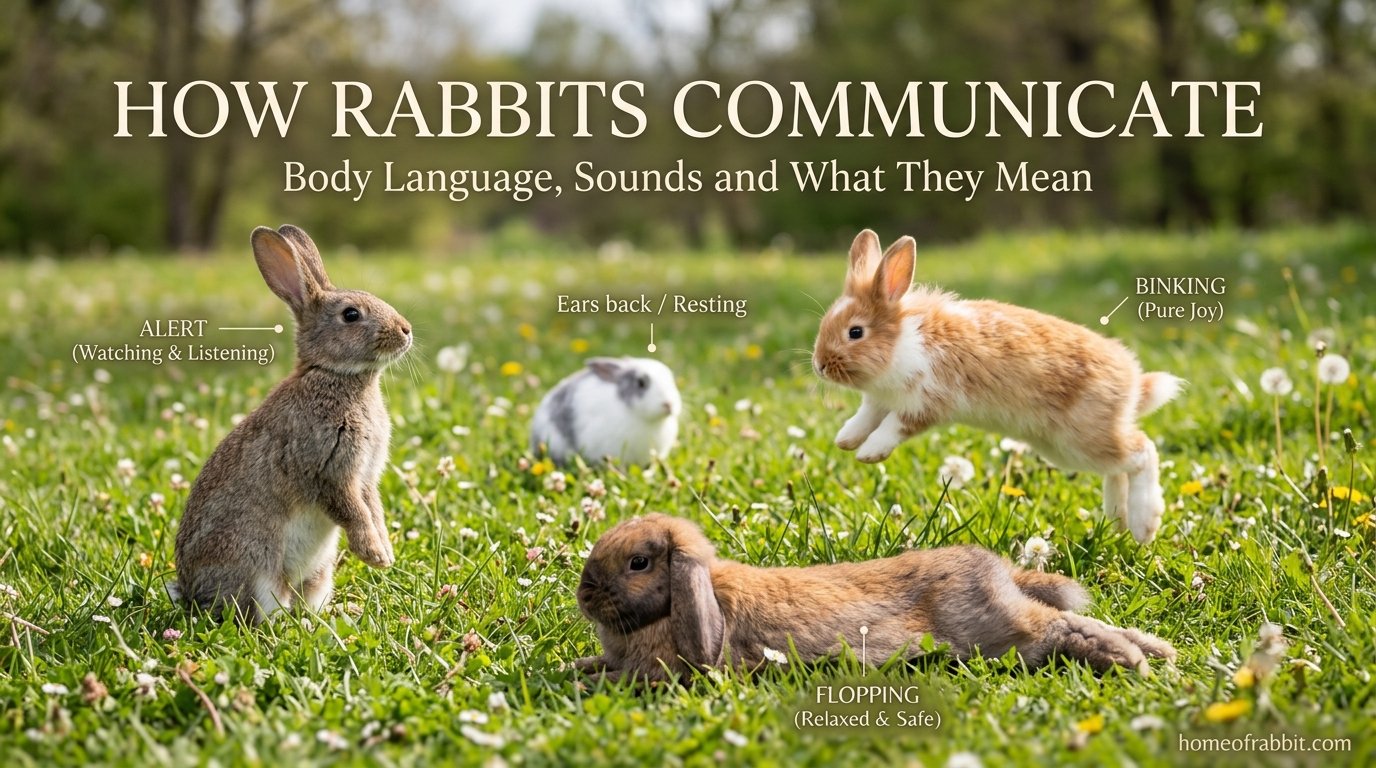
Rabbits communicate mainly through body language, scent and a small set of quiet sounds. Ear position, posture, movement and foot thumps carry most of the meaning, while sounds like grunts, honks and teeth purring add detail. Once you learn these signals, your rabbit’s behavior stops being a mystery.
Rabbits are prey animals, so they tend to be subtle. A rabbit that is scared or unwell may hide it, and a rabbit that is happy may express it in ways that look alarming to a beginner (a sudden “collapse” onto their side is a good example). This guide explains what the common signals mean, how to read them together, and when a behavior is a reason to call a vet.
The Short Answer: Body, Scent and Sound
- Body language is the main channel: ears, posture, tail, nose, and how the rabbit moves.
- Scent is used for marking territory and belongings, mostly invisible to us.
- Sound is quieter and less varied than a dog’s or cat’s, but it matters, especially high-pitched noises, which usually signal pain or terror.
Experienced rabbit organizations stress that you learn your own rabbit’s habits through patient observation, and that your rabbit’s reaction to your body language is part of the conversation. The House Rabbit Society’s guide to reading rabbit behavior describes these signals as a basic vocabulary, with your own rabbit’s “dialect” learned over time. rabbit
Reading Rabbit Body Language
Ears
Ears are among the most expressive parts of a rabbit. As a general guide:
- Ears upright and forward: the rabbit is alert and has noticed something. Something has caught the rabbit’s attention. rabbit
- Ears relaxed, loosely to the side or back: usually calm, especially if the body is also loose.
- Ears pinned flat against the back: can mean fear or tension, but can also be a relaxed “flattened” position. This is why you must read the whole rabbit. Ears-back posture shows the importance of context and of reading the whole animal. rabbit
If the ears are back and the body is stretched out and loose, the rabbit is most likely relaxed. If the ears are back and the body is hunched, tense or frozen, treat it as fear.
Posture and Movement
Loafing. A rabbit lying with its paws tucked under its body is usually settled and comfortable. The harder it would be to spring up and run, the more relaxed the rabbit is likely to be feeling. potterleague
Periscoping. A rabbit standing on its hind legs is usually curious and trying to see better. It’s similar to a person standing on tiptoe. thinkingoutsidethecage
The flop. A rabbit suddenly dropping onto its side can scare new owners, who think the rabbit has collapsed. It’s generally a dramatic way of saying the rabbit feels completely safe. The key difference is that a flopping rabbit relaxes and recovers immediately, and a sick rabbit does not. If your rabbit lies on its side and won’t respond to you or move normally, treat it as an emergency. thinkingoutsidethecage
The binky. A binky is a leap into the air with a twist of the body and head, a sign of intense happiness. Running laps or “zoomies” often goes with it. If you see these, your rabbit is feeling safe, energetic and content. potterleague
Sitting motionless for long periods. A rabbit that sits hunched and unresponsive for a long time is not just “calm.” Rabbit-welfare writers distinguish between a sleepy rabbit and a depressed one that stares at nothing in a fixed position for very long periods. Persistent stillness together with a change in eating or droppings is a vet matter. houserabbitga
Foot Thumping
Thumping is a hard strike of the hind feet on the floor. Depending on context, it can signal danger, nervousness, or “I don’t like what you’re doing.” It is generally either a warning of danger or a sign the rabbit is angry. houserabbitgathinkingoutsidethecage
To work out which one:
- Look at what just happened (a loud noise, a stranger, you entering their space, a change in the room).
- Look at the body. A frozen, alert rabbit is probably warning of danger. A rabbit stamping while turned away from you may be annoyed.
- Remove the likely cause and see whether the thumping stops.
Circling, Nudging and Chin Presenting
- Circling your feet, sometimes with soft honking, usually signals excitement or affection and often happens when the rabbit expects food or a treat. It can also be a courtship behavior, so context matters. thinkingoutsidethecage
- Nudging you with the nose can mean “you’re in my way,” “pay attention to me,” or “move.” Respond to the situation: if you’re standing between a rabbit and its food bowl, you’ve probably got your answer.
- Presenting (head down, chin flat to the floor) is a request to be petted. One common example is a rabbit pushing its nose forward with its chin flat when you reach for it, as if saying “pet me.” Rabbits often like being stroked on the forehead and cheeks, so start there. rabbit
Mounting, Boxing and Lunging
- Mounting (thrusting against a toy, a person’s leg, or another rabbit) can be about dominance, excitement or hormones, not only mating. Spayed and neutered rabbits do it too.
- Boxing and lunging (standing up and punching with front paws, or charging) is a defensive or territorial warning. It may happen when a rabbit is frightened or uncomfortable with someone entering its territory and touching its belongings. thinkingoutsidethecage
If your rabbit lunges when you clean the cage, try placing food in a separate spot first, approaching from the side, and letting the rabbit leave the area on its own terms.
Rabbit Sounds and What They Mean
Rabbits are quiet, but not silent.
| Sound | Usually means | Notes |
|---|---|---|
| Soft teeth purring (gentle chattering while being stroked) | Contentment | Usually quiet and rhythmic; you may feel it more than hear it |
| Low honking or oinking | Excitement, courtship, or happy anticipation | Often heard when circling feet |
| Grunting or growling | Annoyance or a warning to back off | Often paired with lunging or swatting |
| Loud, harsh tooth grinding | Pain or discomfort | Much louder than purring; the rabbit often looks hunched or still |
| Screaming | Extreme fear or pain | Rare and distressing; check for injury or predator stress immediately |
If you aren’t sure whether a tooth sound is happy purring or painful grinding, check the body. A loose, relaxed rabbit that leans into your stroking is probably purring. A hunched, tense rabbit with a loud grinding sound, a lack of appetite, or a bloated belly needs a vet. Low grunting and honking, by contrast, are described in rabbit communities as signs of satisfaction. wabbitwiki
Scent: The Part of Rabbit Communication You Can’t See
Rabbits have scent glands under the chin, and they use them to mark their world. When your rabbit rubs its chin on furniture, a toy or your leg, it is leaving a scent signature that says “this is mine.” It is not a sign of illness or a dirty chin.
Rabbits also use droppings and urine to mark territory. This is one reason an unneutered or unspayed rabbit may spray or leave scattered droppings. Neutering and spaying usually reduce marking, though they don’t always eliminate it. Ask your vet about timing for your rabbit’s age and health.
Quick Reference Table
| Behavior | Likely meaning | What to do |
|---|---|---|
| Ears forward, body still | Alert, something has caught attention | Check surroundings; stay calm |
| Ears back, body loose and stretched out | Relaxed | Nothing |
| Ears back, body tense | Fear or stress | Remove stressor, give space |
| Binky or zoomies | Joy, energy | Enjoy it; make sure the floor isn’t slippery |
| Flop onto side | Feels safe | Leave alone; check it recovers quickly |
| Thump | Danger or annoyance | Look for the cause |
| Chin flat, head pushed toward you | Wants to be petted | Stroke head and cheeks |
| Circling feet and honking | Excitement, food, or courtship | Offer a treat if appropriate |
| Boxing or lunging | Territorial or afraid | Slow down; change how you approach |
| Chin rubbing | Scent marking | Nothing; it’s normal |
| Loud tooth grinding, hunching | Pain | Call your vet |
Signals That May Mean Pain or Illness
Rabbits hide illness well, so changes matter more than any one behavior. Contact an experienced rabbit vet promptly if you notice:
- Not eating or drinking, or no droppings for a significant period
- A hunched, tense posture with loud tooth grinding
- Lethargy, or sitting motionless for far longer than usual
- A swollen or bloated belly
- Lying on the side and not responding normally
- Screaming
Not eating is a particular concern in rabbits because their digestive system relies on continuous food intake. Treat it as urgent rather than waiting a day or two. For exact timeframes and treatment, follow your own vet’s advice.
How to Communicate Back to Your Rabbit
You don’t need to “speak rabbit” perfectly. These habits help:
- Get low. Sit or lie on the floor. Standing over a rabbit looks like a predator.
- Let the rabbit come to you. Avoid grabbing or chasing.
- Move slowly and talk in a quiet voice. Sudden movements and loud noises trigger fear.
- Offer a hand and let the rabbit sniff it before petting.
- Pet the forehead and cheeks, not the belly or back feet, which most rabbits dislike.
- Reward calm behavior with a small, appropriate treat.
- Respect a “no.” A thump, a turn-away or a nip means stop.
Your rabbit learns your signals too, and over time many rabbits come to respond to a person’s voice and routine. If you’re curious about how far this goes, see our article on whether rabbits recognize their owners.
Common Mistakes Owners Make
- Reading one signal alone. Flattened ears can mean fear or relaxation. Check the whole body.
- Assuming a flop is a collapse, or a collapse is a flop. Watch how quickly the rabbit recovers.
- Confusing happy and painful tooth sounds. Gentle purring versus loud grinding is a big difference.
- Punishing thumping or growling. These are warnings. Punishing them teaches a rabbit to skip the warning.
- Picking up a rabbit that is showing fear. Most rabbits dislike being lifted, and a frightened rabbit may kick hard enough to hurt itself.
- Ignoring subtle changes. A rabbit that stops doing its usual happy behaviors may be telling you something is wrong.
Checklist: Reading Your Rabbit Like a Pro
- I check ears, body, and movement together.
- I know my rabbit’s normal routine, so I notice changes.
- I can tell soft purring from loud grinding.
- I respond to thumps by looking for the cause.
- I get on the floor to greet my rabbit.
- I know the emergency signs and have a rabbit-savvy vet’s number.
Conclusion
How rabbits communicate comes down to learning a quiet language: ears, posture, thumps, small sounds and scent. Read these signals together, notice what is normal for your own rabbit, and respond calmly, and you’ll build trust faster and spot problems earlier. When in doubt about a behavior that might signal pain, call your vet rather than waiting.
FAQ
Why does my rabbit thump its foot?
Usually to warn of danger or to show annoyance. Look at what happened just before and at your rabbit’s body posture to tell which.
Do rabbits make sounds?
Yes, but they’re quiet: teeth purring, honking, grunting and growling, and in extreme situations, screaming. High-pitched screaming and loud grinding generally suggest pain or fear.
What is a binky?
A joyful leap with a twist of the body. It usually means the rabbit is happy and feels safe.
Is my rabbit dead or just flopping?
A flopping rabbit is relaxed and responds normally and quickly. If your rabbit doesn’t react to you, call a vet immediately.
How do I know if my rabbit is happy?
Look for binkies, flopping, relaxed loafing with eyes half-closed, soft teeth purring, normal appetite and normal droppings.
Can rabbits understand humans?
Rabbits learn routines, voices and cues. How much they “understand” varies, and strong claims should be treated with caution.
