
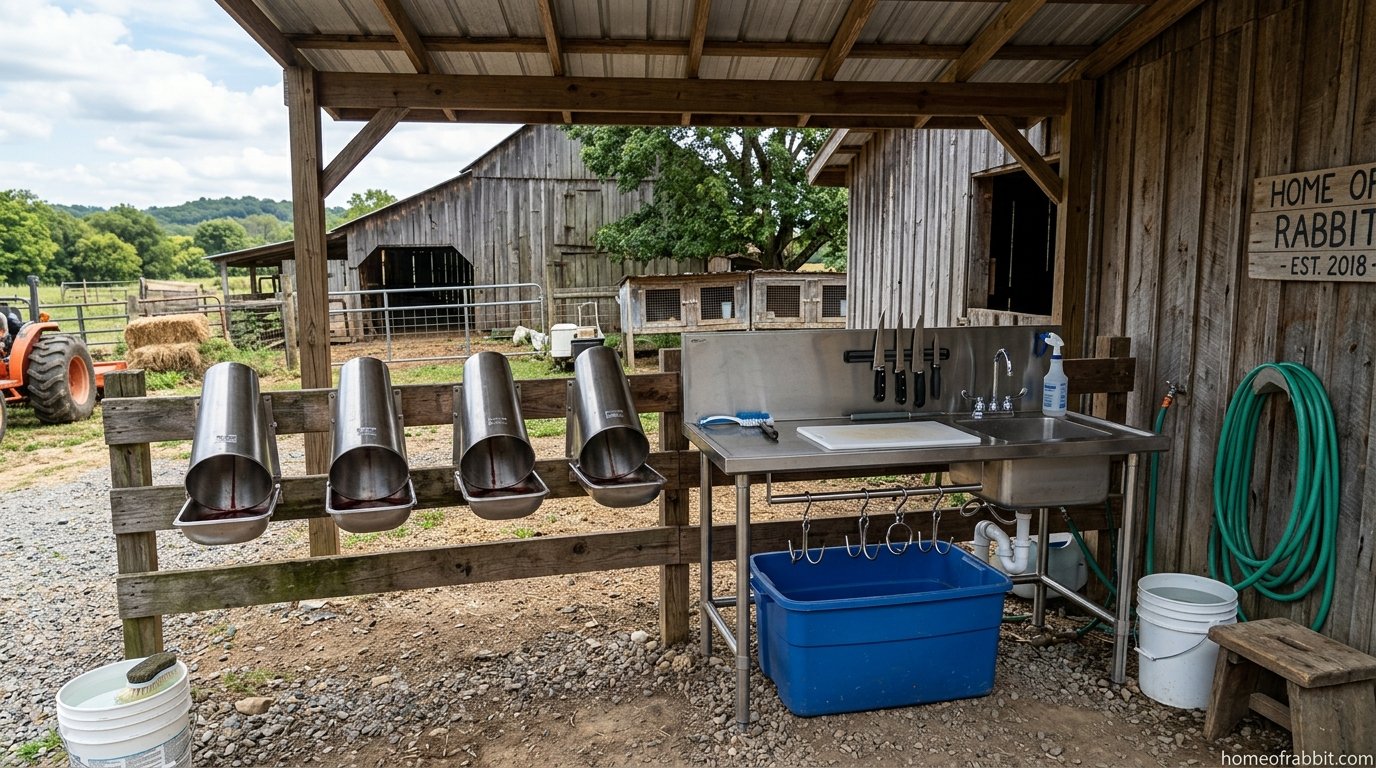
A small farm needs surprisingly little to process rabbits well: a reliable humane dispatch tool, sharp knives and shears, something to hang the carcass from, clean water, a washable work surface, and a way to chill the meat fast. Everything else is a convenience.
Unlike poultry, rabbits are skinned rather than plucked, so you can skip scalders and pluckers entirely. That keeps the startup cost low. If you’re still budgeting the rest of your setup, our guide to how much it costs to build a rabbitry puts processing gear in context.
The essential equipment
Humane dispatch tools
This is the one area where you should not improvise. A European Food Safety Authority scientific opinion on killing rabbits on farms groups the methods into electrical, mechanical, controlled atmosphere, and lethal injection categories, and concludes that staff skill is crucial for preventing welfare problems. europa
For a small farm, that means:
- A purpose-made dispatch tool or method you’ve been properly trained to use. Cervical dislocation devices and percussive (captive bolt-type) tools are commonly used by small producers, but check which methods are legal in your area.
- A calm, quiet place to do it, close to where the rabbits are housed, so there’s less handling and stress.
- A backup plan if your first method fails. Some regulators require backup equipment. In England, for example, small-scale on-farm slaughter guidance requires backup equipment that can be used quickly if the main equipment fails. www
Practice, mentoring from an experienced breeder, or a local extension workshop matters more than the brand of tool.
Knives and shears
You don’t need a drawer full of knives. Start with:
- One sharp, short knife (a boning or small utility knife) for opening the carcass and trimming.
- Poultry shears, game shears, or small loppers for removing feet and head, and for cutting through the joint where the front legs meet the body.
- A sharpening stone or honing steel. A dull knife is slower, messier, and more likely to nick the gut and contaminate the meat.
Hanging and skinning setup
Skinning a rabbit on a flat table works, but it’s slow and tends to leave loose hair on the meat. A hanging setup helps a lot:
- A small gambrel or skinning hook that holds the rabbit by the back legs. A small steel gambrel with hooked ends that slide behind the hock tendons is a common choice for rabbits. farmstandapp
- A rail, hook, or bar at a comfortable working height. A sturdy S-hook on a beam or a stand made from pipe or lumber is enough.
Work surface, water, and containers
- A non-porous table (stainless steel, sealed plastic, or a cutting board over a table) that you can scrub and sanitize.
- Running water. A hose with clean water makes rinsing carcasses and cleaning up much easier. If you only have buckets, use fresh, clean water for rinsing and change it often.
- Three containers: one for clean carcasses, one for offal, and one for hides and waste.
- Disposable gloves and a waterproof apron.
- Sanitizer appropriate for food-contact surfaces. Follow the label.
Chilling and storage
Meat quality and safety depend on cooling quickly.
- A cooler or tub with ice water, or a refrigerator with space for carcasses, to chill them straight after rinsing.
- A thermometer so you know your cold storage is actually cold. Check your local food code for the correct temperature.
- Freezer bags or a vacuum sealer, plus labels and a marker (date and weight at minimum).
- A freezer if you’re processing more than you’ll eat in a few days.
Equipment you don’t need (poultry gear)
A lot of “backyard processing” kits are designed for chickens, and you can safely skip them for rabbits:
- Scalders and pluckers. These are for feathers. Rabbits are skinned.
- Killing cones. One equipment guide notes that restraining cones are built for bird anatomy and aren’t suitable for rabbits. farmstandapp
- Poultry chill tanks are useful if you already own one, but a cooler works fine at small scale.
How to arrange a small processing area
The goal is a one-way flow from dirty to clean, so raw, clean meat never crosses paths with hides and offal.
- Dispatch area: away from the other rabbits’ sight where possible.
- Hanging and skinning point: with a bin directly below for hides and waste.
- Evisceration and rinse station: your washable table and clean water.
- Chill station: ice water or fridge.
- Packaging table: the cleanest spot, used only after hands and tools are washed.
Even a backyard setup benefits from zones. Commercial guidance follows the same logic. For example, an Oregon Department of Agriculture facility guide for rabbit and poultry plants calls for hot and cold water, daily equipment cleaning, and says hides must not be dried in the kill or processing rooms. oregon
Basic kit vs. upgraded kit
| Basic (starter) | Upgraded (higher volume) | |
|---|---|---|
| Dispatch | Approved manual tool | Percussive stunner or similar tool |
| Hanging | S-hook and small gambrel | Wall-mounted rail or stand with multiple hooks |
| Cutting | Knife, shears, sharpening stone | Spare knives, electric knife sharpener |
| Surface | Washable table or board | Stainless steel table with a drain or sink |
| Chilling | Cooler with ice | Dedicated refrigerator or walk-in cooler |
| Packaging | Freezer bags | Vacuum sealer |
| Best for | A few rabbits per session, home use | Regular batches, selling meat |
Prices vary widely by region and supplier, so compare current listings rather than trusting a fixed figure.
Common mistakes
- Buying poultry equipment “just in case.” It usually sits unused.
- Using dull knives. This leads to torn skin, nicked organs, and contamination.
- Skipping the training on humane dispatch. Equipment doesn’t replace skill.
- Slow chilling. Leaving carcasses at room temperature while you work through a batch is a food safety risk.
- Processing too many at once with too little space. Work in small batches until you’ve built a routine.
- Not planning waste disposal for hides, offal, and wash water before you start.
Check the rules before you buy
Regulations vary by country, and by state or region within them, and they change. A few examples:
- United States: Congress hasn’t mandated inspection of rabbits, so USDA inspection is voluntary, and non-inspected rabbit processors fall under FDA oversight. State rules still apply. Oregon State University Extension notes that regulations for selling rabbit meat vary from state to state, and Oregon’s own guidance says a license is required to operate a rabbit and poultry slaughter and processing plant. United States Department of Agriculture +2
- England: government guidance covers small-scale on-farm slaughter of rabbits (under 10,000 animals a year) and sets welfare requirements for equipment and killing, and failure to follow it can cost you your licence or lead to prosecution. www
- Elsewhere: contact your agriculture or food safety authority. Don’t assume home use and sales are treated the same way.
Processing for your own table is usually treated differently from selling meat. Check which one you’re doing before you invest in a setup.
Pre-processing checklist
- Local rules checked (home use vs. sales)
- Humane dispatch method learned and legal in your area, with a backup plan
- Knives sharpened, shears clean
- Gambrel or hanging point set at working height
- Table and tools sanitized
- Clean water available
- Containers ready for carcasses, offal, and hides
- Ice or fridge space ready for chilling
- Packaging, labels, and freezer space ready
- Waste disposal planned
Conclusion
So, what rabbit processing equipment is needed for a small farm? A humane dispatch method you’re trained in, sharp knives and shears, a hanging point, a clean work surface with water, and fast chilling. Skip the poultry-specific gear. Start with the basics, learn the process in small batches, and upgrade only when your volume justifies it. Before you start, check what your local rules require, especially if you plan to sell any meat.
FAQ
Do I need a special table for processing rabbits?
No. You need a surface that’s smooth, non-porous, and easy to sanitize. Stainless steel is ideal, but a sealed board over a sturdy table works for small volumes.
Can I use chicken processing equipment for rabbits?
Some of it, like knives and chilling tubs. Scalders, pluckers, and killing cones aren’t useful for rabbits.
Do I need a license to process rabbits on my farm?
It depends on where you live and whether you’re selling the meat. See the rules section above and contact your local authority.
How many rabbits can I process in one session?
There’s no universal number. Beginners do best with a small batch, so cleanliness and chilling don’t slip.
