
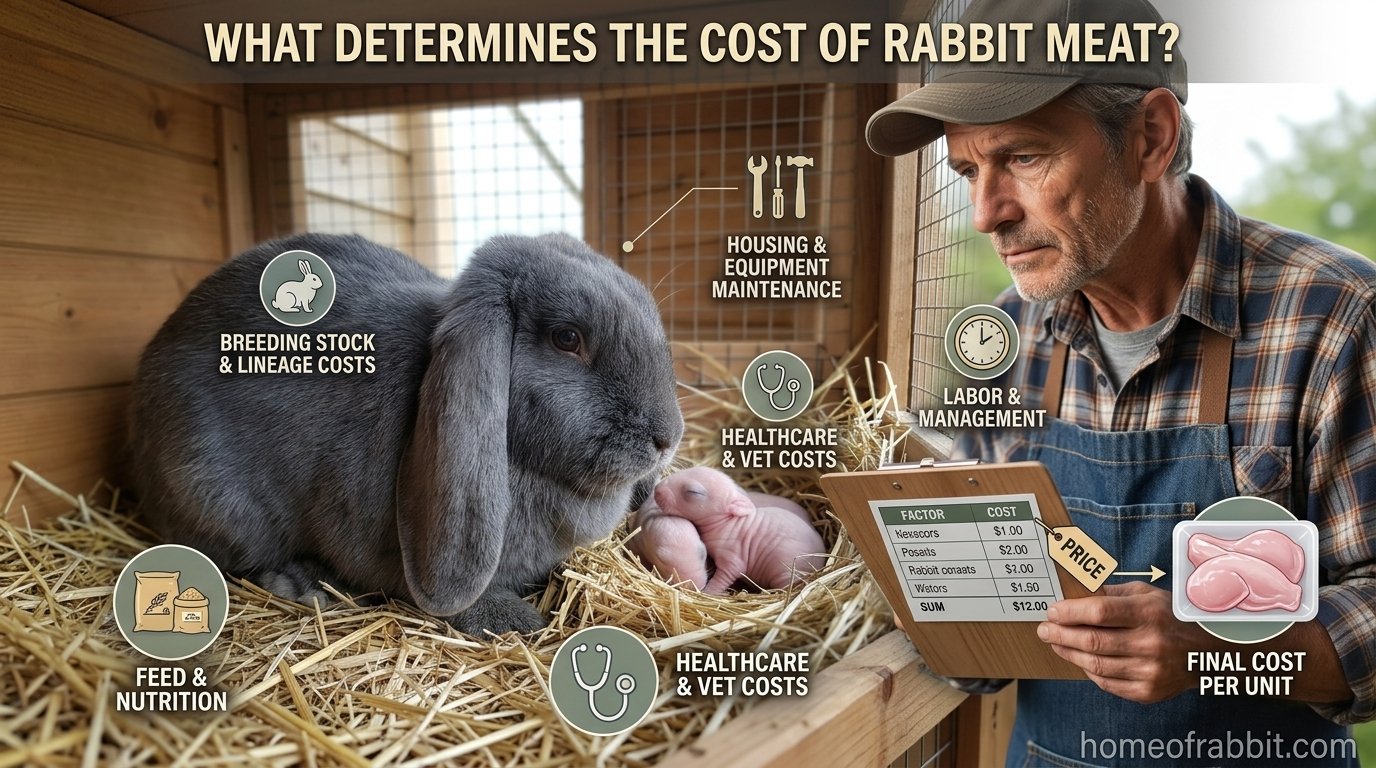
Rabbit meat usually costs more per pound than chicken or pork. The price is set mainly by feed, labor, scale and processing. Most of the money goes into growing the animal, not into the meat itself.
Rabbits are a small-volume product. Rabbit accounted for only 0.45% of world meat production in 2018. Without the huge, efficient supply chains behind chicken and pork, each rabbit carries more of its own cost. Here is where that cost comes from. nih
The short answer
Rabbit meat is expensive because the cost of producing it is high and it is produced at small scale. One review notes that labor costs per rabbit are high, making production costlier than broiler and pig meat and rabbit less competitive. Feed is usually the largest single expense on top of that. nih
8 factors that set the price
1. Feed
Feed is the biggest cost most producers face. A U.S. feasibility study for small producers called it the single highest overhead cost in a rabbitry, and also the most volatile. Research in Nigeria likewise lists high feed cost among farmers’ major constraints. sarefudutsinma
Pellet quality matters too. One U.S. producer reports that a meat-type rabbit fed only pellets costs about 15 times the per-pound feed price to raise to 5 pounds. This is one producer’s rule of thumb, so treat it as an estimate. Check it against your local feed prices before relying on it. familyfarmlivestock
A practical point: if feed prices rise by 20%, the cost of every rabbit goes up with them, and meat prices follow.
2. Labor and management
Rabbits need daily attention: feeding, watering, checking health, breeding and weaning. Few tasks can be automated at small scale, so labor per animal stays high. This is a major reason the price can’t drop to chicken levels.
3. Breed and genetics
Growth rate decides how long you pay for feed before the rabbit reaches market weight. Meat-type breeds selected over generations convert feed to meat faster. Producers warn that poorly selected stock or non-meat breeds grow slowly and cost more to raise. familyfarmlivestock
Small or ornamental breeds are rarely used for meat for the same reason: less meat for the same housing and feed.
4. Scale of production
Large poultry and pig operations lower the cost per animal by raising huge numbers in one building. Rabbits are harder to raise that way. One producer notes that fryers can’t be effectively fed in large groups. Small farms therefore carry higher costs per animal and often can’t match supermarket meat prices. familyfarmlivestock
5. Processing and carcass yield
Rabbits must be slaughtered, skinned, eviscerated and chilled, and in many places this must be done in an inspected facility. Processing costs are higher per pound of meat sold because rabbits are small. A dressed rabbit weighs noticeably less than its live weight, and buyers pay for the dressed weight. familyfarmlivestock
6. Housing, health and mortality
Hutches, cages, ventilation and cleaning all cost money. Disease or deaths raise the cost of every surviving rabbit. Producers in Nigeria cite high mortality rates as a constraint. Good hygiene lowers losses, and our guide on keeping a meat rabbit hutch clean covers the basics. fudutsinma
7. Market demand and availability
Few farmers raise rabbits for sale, and few buyers ask for them. This works against the price in two ways. Low demand means no economies of scale. Low supply means buyers have few sellers to compare. One U.S. grower also notes that few farmers are willing to raise rabbit at the price they can get paid for it, which keeps supply thin. familyfarmlivestock
8. Location and transport
Feed availability, climate, labor costs and distance to customers all vary by region. Areas far from producers pay more because of transport and cold storage. Where feed is imported, rabbit meat tends to cost more.
Price comparison: what to expect by seller type
Exact prices depend on your country and are not listed here. These are general patterns.
| Seller type | Typical price level | Notes |
|---|---|---|
| Small local farm | Mid to high | Often fresh, flexible on size, may sell live or dressed |
| Farmers’ market / specialty butcher | High | Premium for quality, convenience, traceability |
| Supermarket / frozen | Varies | Often imported; check origin and weight |
| Restaurant | Highest | Includes preparation, labor and margin |
How to tell if a price is fair
Ask these questions before buying:
- Is the price per live or dressed weight? Dressed is higher per pound but reflects the meat you actually get.
- Is it a meat breed, and how old was it at slaughter? Fryers are young and tender. Older rabbits are tougher.
- Was it processed hygienically? Ask where.
- What was it fed? Quality feed costs more and affects growth and taste.
- Compare two or three sellers in the same region.
A much lower price than others can mean old stock, poor handling or a live weight price compared to a dressed price. Don’t assume it’s a bargain.
If you sell rabbit meat: how to price it
- Add up your costs per rabbit: feed, bedding, health care, housing share, processing and labor.
- Divide by dressed weight, not live weight.
- Add a margin for losses and your time.
- Compare with local specialty meat prices, not supermarket chicken.
Many small producers underprice because they leave out labor. One feasibility study concluded that at best, a part-time income could be created through a meat rabbitry, so pricing realistically matters. sare
Common mistakes
- Comparing rabbit to cheap factory-farmed chicken instead of specialty meats
- Ignoring the difference between live and dressed weight
- Choosing the cheapest feed, which can slow growth and raise the real cost
- Not counting labor and processing when setting a sale price
- Buying without asking about age, breed or processing
Conclusion
What determines the cost of rabbit meat comes down to a handful of things: expensive feed, high labor per animal, small-scale production, processing costs and limited demand. Understanding them helps buyers judge whether a price is fair and helps sellers price their meat so the work pays off. Before buying or selling, check your local prices, since they differ widely.
For a deeper look at feed costs and alternatives, see this open-access review on reducing rabbit meat production costs.
FAQ
Is rabbit meat more expensive than chicken?
Usually yes, per pound, because of higher labor and feed costs and smaller scale.
Why is dressed rabbit priced higher per pound than live rabbit?
Dressed weight excludes skin, organs and head, so you pay for less weight that is ready to cook.
Does breed affect the price?
Indirectly. Meat breeds grow faster and yield more, which lowers the cost per pound. Small or ornamental breeds cost more per pound of meat.
Is it cheaper to raise your own?
Not always. Feed, housing and time add up, and small operations rarely match supermarket prices. Home raising works best when you value quality and control.
How do I find a fair local price?
Compare several local sellers and ask whether the price is for live or dressed weight. Prices vary by region, so verify locally.
