
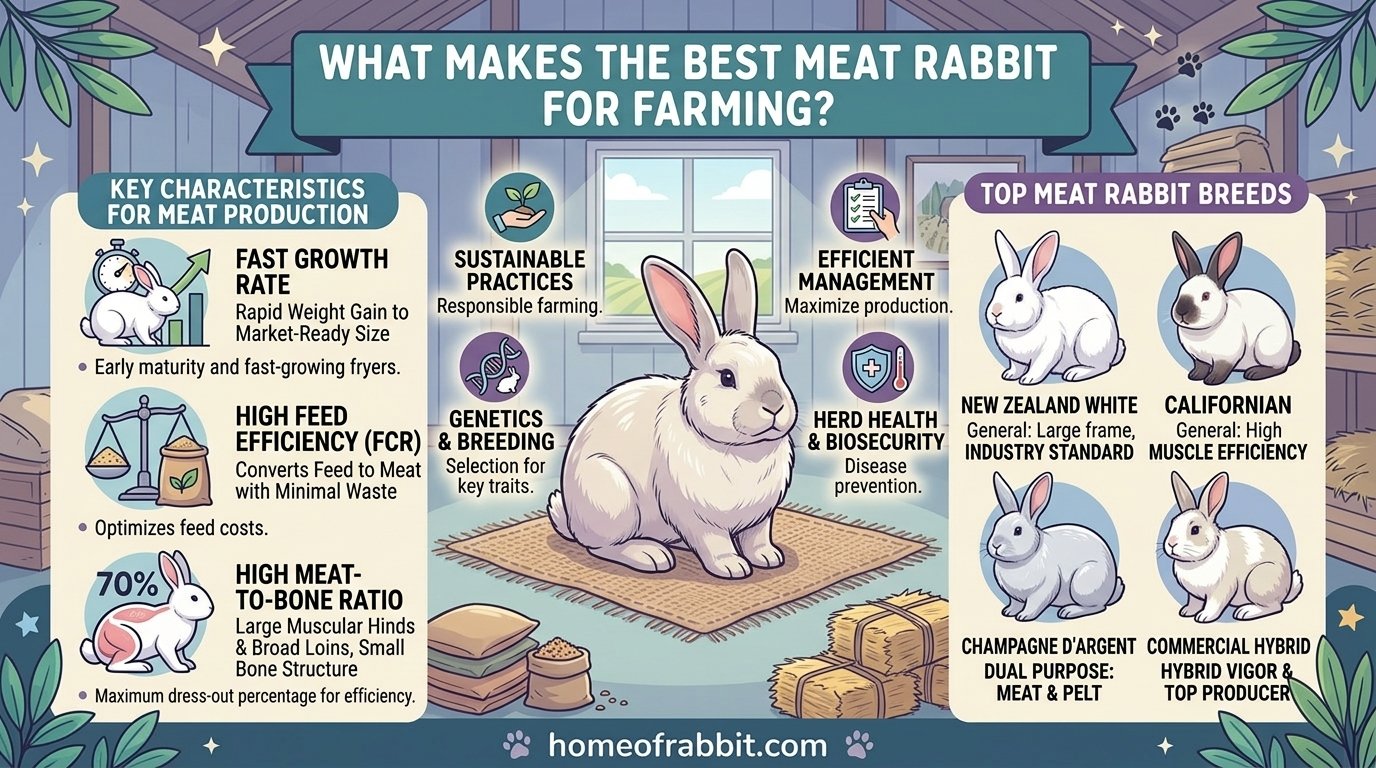
The best meat rabbit for farming is one that reaches market weight quickly on little feed, yields a high share of usable carcass, and comes from does that raise large, healthy litters. For most US farmers that points to the New Zealand White or the Californian, or a cross of the two. But breed is only part of the picture. Genetics, doe productivity, and management decide whether a rabbit is profitable.
The Five Traits That Define a Good Meat Rabbit
1. Growth rate. The standard market animal is the fryer. Rabbits are typically slaughtered as fryers at 5 pounds, about 10 weeks of age. A line that reaches this weight sooner costs less to feed and frees up cage space sooner. psu
2. Feed conversion. This is how many pounds of feed it takes to produce a pound of live rabbit. Lower is better. Feed is usually the biggest ongoing cost, so small differences add up across a herd.
3. Dressing percentage. This is the share of live weight that ends up as carcass. In one controlled comparison of six genotypes, New Zealand Whites dressed at 66.1%, while the other genotypes ranged from 59.6% to 62.8%. Another study of New Zealand White × Californian crosses averaged 59.7% dressing out. Methods vary between studies, so treat these as ballpark figures, not guarantees. unicampuniss
4. Litter size and mothering ability. A fast-growing breed means little if the doe produces small litters or loses kits. Extension sources describe a target of about 50 fryers per doe per year as a good benchmark. Penn State gives a wider range of 25 to 50 live rabbits per doe per year. lincolnupsu
5. Hardiness and temperament. A rabbit that stays healthy and is easy to handle saves labor and losses. This varies more by individual line than by breed, so ask the breeder about their stock’s track record.
How the Main Meat Breeds Compare
| Breed | Typical mature weight | Why farmers choose it |
|---|---|---|
| New Zealand White | 9–12 lb | Most widely recommended meat breed; strong dressing percentage |
| Californian | 8–11 lb | Close second; efficient growth and good meat quality |
| Champagne d’Argent | 9–12 lb | Medium-sized meat breed; less common |
| American Chinchilla | 9–12 lb | Dual-purpose (fur and meat); less common |
| Flemish Giant | 13+ lb | Very large; usually a poor fit for fryer production |
Weights from Penn State Extension.
New Zealand White
Extension guidance is fairly consistent here. Penn State says medium-weight New Zealand Whites are best for meat production, followed by Californians. psu
The one caveat is growth data. In the six-genotype comparison above, the New Zealand Whites had the lowest weight gain (25.4 g/day) and the highest feed use per kilogram of gain (4.56 kg). That was a small study (48 rabbits) with a specific feed and housing setup, so don’t read it as a verdict on the breed. It does show that line quality matters as much as breed name. unicamp
Californian
Californians are a popular alternative or partner to NZWs. In the same study, the Californian White rabbits had the best feed conversion at 2.98 kg of feed per kg of gain. If you’re comparing the two breeds, ask breeders for their own growth and litter records rather than relying on breed reputation. unicamp
Other breeds, and why bigger isn’t better
It’s tempting to choose the biggest rabbit. For meat production that usually backfires. A bigger breed generally takes longer to reach fryer weight, and it eats more while it waits. Giant breeds suit show or specialty purposes better than efficient fryer production. Ask for a breeder’s actual weight-by-age records before buying.
Why Crossbreeding Often Beats Purebreds
Many commercial producers cross breeds because first-generation crosses can outperform both parents (hybrid vigor). In one trial with 120 rabbits, reciprocal New Zealand White × Californian crosses were heavier than the purebreds. The cross with the Californian as the maternal line reached slaughter weight earlier and ate less feed. The six-genotype study also found the NZW × Californian cross gained 34.5 g/day, significantly more than the pure New Zealand Whites. Articles | Volume 52, issue 2 +2
The trade-off is that you need to maintain two pure lines to keep producing crosses, which adds cages and record-keeping. If you’re just starting out, a good purebred trio is simpler.
Which Meat Rabbit Is Right for Your Farm?
- Backyard, a few does: Start with a New Zealand White or Californian trio from a breeder who shares records. Simplicity matters more than squeezing out extra efficiency.
- Small commercial or direct-sale farm: Consider a NZW × Californian cross program once you can manage two lines. Track weights and feed from day one.
- Selling to processors or restaurants: Confirm what carcass size and weight they want before choosing a breed, because buyers’ specifications differ.
- Hot climate: Ask the breeder about heat performance. Rabbits are heat-sensitive, and breed-specific heat tolerance data is something I couldn’t verify, so check with your local extension office.
Before you buy, run your numbers through the rabbit farm calculator to see how litter size and feed costs affect your margins.
Common Mistakes When Choosing Meat Rabbits
- Buying on size alone. Large rabbits take longer and cost more to get to market.
- Ignoring the doe. A great-looking buck from a poor-producing line won’t help you. Ask about the dam’s litter sizes and survival rates.
- Skipping records. Without weights, litter counts, and feed use, you can’t tell which animals are worth keeping.
- Expecting book numbers on day one. Published figures come from controlled conditions, and your results depend on feed, housing, and management.
- Starting with too many animals. Learn on a small herd before scaling up.
Quick Selection Checklist
- Breed is a recognized meat type (NZW, Californian, or a cross)
- Breeder provides litter size, survival, and growth records
- Parents are healthy and calm to handle
- Fryer weight is reached around 10 weeks in the breeder’s herd
- Buyer or processor requirements are confirmed
- You’ve calculated expected feed cost per fryer
Conclusion
What makes the best meat rabbit for farming is a combination of fast growth, efficient feed use, good carcass yield, and productive, healthy does. In practice that usually means a New Zealand White, a Californian, or a cross, from a breeder who can show real production records. Choose your starting stock the way you’d choose any farm animal: by performance data first and breed reputation second.
FAQ
How big is a market-ready meat rabbit?
Fryers are commonly sold at about 5 pounds live weight and around 10 weeks of age. Utah State’s 4-H program defines a single fryer as an animal weighing between 3.5 and 5.5 pounds, not over 12 weeks old. usu
How many litters can a doe have per year?
Penn State says young are weaned in about 30 days, so you can expect an average of five litters annually per doe. Intensive producers may aim for more, but that depends on doe condition and management. psu
Is a bigger breed better for meat?
Usually not for fryer production. Faster growth to 5 pounds matters more than mature size.
