
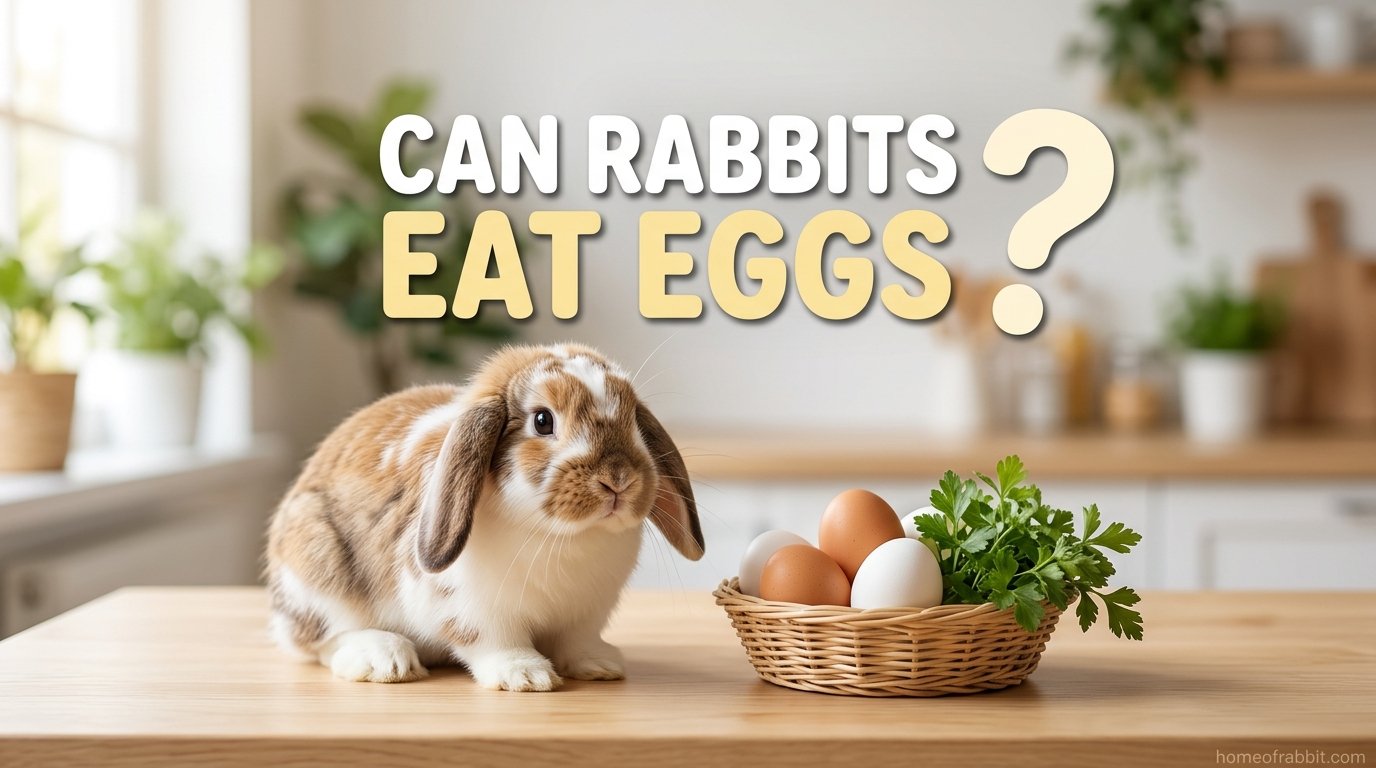
No, you shouldn’t feed eggs to your rabbit. Rabbits are herbivores, and their digestive systems are built for fibrous plants, not animal products. A single bite is unlikely to be a catastrophe for most healthy rabbits, but eggs offer no benefit and carry real risks, so it’s best to leave them out entirely.
If your rabbit just got into some egg, jump to the section “My Rabbit Already Ate Egg. What Now?” below.
Why Eggs Aren’t a Good Food for Rabbits
Rabbits are strict herbivores
Rabbits eat only plants, and their gut depends on a steady supply of fiber. According to the MSD Veterinary Manual, a healthy pet rabbit diet should be roughly 85–90% grass hay, with a smaller amount of pellets that are 15–20% crude fiber. Low-fiber diets raise the risk of serious digestive illness.
Eggs contain no fiber at all. Anything that displaces hay and leafy greens works against the one thing your rabbit’s gut needs most.
Rich, fatty food and a delicate gut
Rabbit digestion relies on constant gut movement and a balanced population of gut bacteria. Rich, high-fat, high-protein foods are not what that system evolved to handle. Rabbits also fall ill quickly when digestion slows, so an unnecessary dietary risk isn’t worth taking. There is no established nutritional gap that eggs would fill: adult rabbits get the protein they need from hay and pellets.
Cooked, Raw, or Eggshells: Does the Form Matter?
| Form | Should you feed it? | Notes |
|---|---|---|
| Boiled or scrambled egg | No | Animal product with no fiber; scrambled egg often includes butter, oil, milk, or salt. |
| Raw egg | No | Same dietary problem, plus the usual food-safety concerns of raw egg. |
| Eggshell | No | Not a needed calcium source. Calcium is already supplied by hay and pellets. |
| Foods containing egg (baked goods, noodles, some treat sticks) | No | These are usually also high in sugar, starch, or fat. |
On eggshells: Some owners wonder if shells can supply calcium. The MSD manual notes that too much calcium over time can contribute to kidney damage and bladder or kidney stones, so extra calcium isn’t something to add casually.
My Rabbit Already Ate Egg. What Now?
- Stay calm and remove any remaining egg. Check the floor and enclosure.
- Note how much and what kind. A crumb of plain egg is different from scrambled egg cooked in butter, or a baked item with sugar.
- Make sure hay and water are available. Hay keeps the gut moving.
- Do not force-feed or give home remedies. Leave medical decisions to a vet.
- Watch closely for the next 24 hours. Check appetite, droppings, belly comfort, and energy.
- Call an exotic-savvy vet if you see warning signs:
- No eating or no droppings for 12 hours or more
- Soft or liquid stools or diarrhea
- A hunched posture, tooth grinding, or lethargy
- A bloated or hard belly
Rabbit rescues commonly advise treating a rabbit that hasn’t eaten or pooped in 12–24 hours as an emergency (the Bunny 911 notice on BinkyBunny says this). Gut slowdown can become serious quickly, so don’t wait it out.
Common Mistakes With Egg Products
- Assuming “treat sticks” are safe. Some commercial rabbit treats list egg, seeds, or corn as ingredients. Check labels. Many rabbit keepers advise skipping seed and corn-heavy treats.
- Sharing breakfast. Scrambled eggs, omelets, and egg sandwiches come with oil, salt, cheese, and bread.
- Treating protein as a cure-all. A rabbit that seems thin or low-energy needs a vet check and a diet review, not extra protein from animal foods.
- Changing diet suddenly. Even safe foods should be introduced slowly, one at a time.
Safe Treats to Offer Instead
If you want to share something, choose plants. Always introduce new foods in small amounts.
| Instead of… | Try | How much |
|---|---|---|
| Egg as a “protein treat” | Extra timothy or orchard grass hay | Unlimited, always available |
| A salty or rich snack | A small handful of mixed leafy greens | Introduced gradually |
| Something sweet | A thin slice of fruit, such as banana | Only occasionally |
| Crunchy treat sticks | A few dandelion leaves or an herb sprig | A few leaves |
Fruit and starchy vegetables like carrots are high in sugar and should be occasional. Our guide to whether rabbits can eat bananas covers one popular fruit treat.
What a Healthy Rabbit Diet Looks Like
A simple daily framework, based on veterinary guidance:
- Hay (the bulk): unlimited grass hay such as timothy, orchard, or oat hay
- Leafy greens: a daily portion of fresh, washed greens
- Pellets: a limited amount of plain, high-fiber pellets without added dried fruit or nuts
- Treats: small and occasional
- Water: fresh, always available
Young growing rabbits have different needs (alfalfa hay and alfalfa-based pellets are used during growth, then gradually switched), so check with your vet for baby or pregnant rabbits.
Conclusion
So, can rabbits eat eggs? They shouldn’t. Eggs give a rabbit nothing it can’t get from hay, greens, and pellets, and they don’t suit a fiber-dependent digestive system. If your rabbit snagged a bite, remove the food, provide hay and water, and watch closely. Call a vet if appetite or droppings change. For future treats, stick to plant-based options in small portions.
FAQ
Can rabbits eat boiled eggs? No. Boiling doesn’t change the fact that eggs are an animal product with no fiber.
Can rabbits eat eggshells for calcium? It isn’t recommended. Rabbits get calcium from hay and pellets, and excess calcium is linked to urinary and kidney problems.
Will one bite of egg kill my rabbit? A tiny taste is unlikely to be deadly for a healthy rabbit, but it can upset digestion, and the risk rises if the egg was cooked with fats, salt, or dairy. Monitor and contact a vet if anything seems off.
Can baby rabbits have eggs? No. Young rabbits are especially vulnerable to digestive upset, and low-fiber diets are particularly risky for them.
