
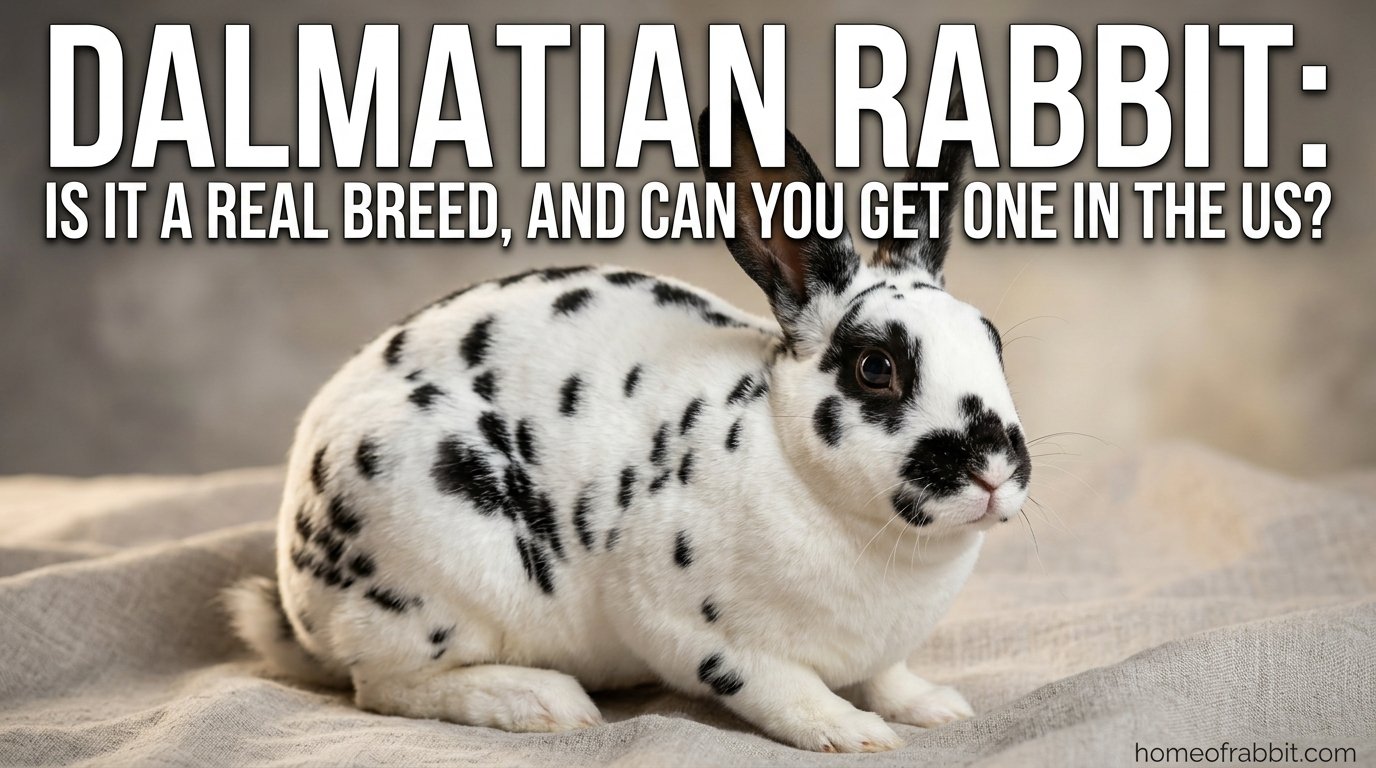
Yes, the Dalmatian rabbit is real, but it’s rare, and it isn’t recognized in the United States. The American Rabbit Breeders Association (ARBA) doesn’t recognize it, while the British Rabbit Council and a few specialist clubs do. So if you’re hoping to buy one from a US breeder or pet store, expect a hard search. The good news is that a few recognized US breeds, and plenty of rescue rabbits, have the same spotted look. Wikipedia
What Is a Dalmatian Rabbit?
The Dalmatian rabbit is also called the Dalmatian Rex. It’s a medium-sized rabbit weighing 6 to 8 pounds, with a mostly white coat and patches of black, blue, brown, orange, or fawn. The name comes from the spotted dog, though the markings and color range vary from rabbit to rabbit. Wikipedia
| Quick fact | What sources say |
|---|---|
| Also known as | Dalmatian Rex |
| Size | Medium, 6–8 lbs |
| Coat | Mostly white with colored patches |
| Origin | Germany and France |
| ARBA recognized? | No |
| Recognized in the UK? | Yes, by the British Rabbit Council |
| Rarity | Described as rare and declining in Europe Dalmatian (rabbit) +6 |
A note on naming: UK listings use both “Dalmatian Rex” and “Dalmatian Mini Rex.” That suggests sellers don’t always mean the same size or type. Before you buy, ask exactly what the seller means and what the parents weigh.
What Does a Dalmatian Rabbit Look Like?
Picture a white rabbit with scattered colored patches. Descriptions mention black, blue, brown, orange, and fawn markings. The “Rex” in the alternate name points to Rex-type fur, which is often described as plush and velvety, but check that with a breeder or breed club. I couldn’t find a detailed US-accessible written standard to verify exact fur and marking requirements.
Two rabbits sold as Dalmatians can look quite different. Without an ARBA standard, “Dalmatian” can mean anything from a carefully bred rabbit to a spotted mix.
Why Is It Hard to Find a Dalmatian Rabbit in the US?
The breed has no ARBA recognition. That means:
- It can’t be entered in ARBA-sanctioned shows as its own breed.
- It has no ARBA breed standard that US breeders work toward.
- Reliable US breeder networks are thin or absent. I couldn’t verify any US breeders, so confirm this yourself.
Importing live rabbits is a separate, regulated process. Check current USDA and state rules before pursuing it. I haven’t verified the requirements.
How to Spot a Mislabeled “Dalmatian” Rabbit
Classified ads sometimes use “Dalmatian” loosely for any white rabbit with dark spots. Before paying a deposit, ask:
- Can I see the parents, or a pedigree?
- What do the parents weigh?
- Which recognized breed or club does this lineage belong to?
- Can I visit in person and see how the rabbits are kept?
Vague answers are a warning sign. A spotted coat alone doesn’t make a rabbit a Dalmatian.
Spotted Rabbits You Can Realistically Get in the US
If you love the look, these are your best options.
English Spot. It’s the closest recognized match. It’s a medium-sized breed averaging 5 to 8 pounds, known for a butterfly nose marking, eye circles, cheek spots, a herringbone line, colored ears, and a chain of spots. ARBA lists English Spots in black, blue, chocolate, gold, gray, lilac, and tortoise. ARBA describes it as a running breed, exhibited by moving around the show table, with a maximum weight of 8 pounds. English Spot +2
Spotted or “broken” rescue rabbits. Many shelter and rescue rabbits have white coats with colored patches. They won’t have a pedigree, but they cost less to adopt and give a home to a rabbit that needs one. Ask local rescues or House Rabbit Society chapters.
| Dalmatian rabbit | English Spot | |
|---|---|---|
| Typical weight | 6–8 lbs | 5–8 lbs |
| ARBA recognized | No | Yes |
| Marking style | Irregular patches | Defined pattern (butterfly, eye circles, chain of spots) |
| Availability in the US | Hard to verify | Established breed with a US club English Spot +2 |
Temperament: What We Know (and Don’t)
Dalmatian rabbits are described as active and friendly. That description rests on thin sources, mostly breeder and classified-ad comments, so treat it as a rough guide. Individual personality depends heavily on handling, early socialization, and whether the rabbit is spayed or neutered. Meet any rabbit before committing. Wikipedia
Caring for a Spotted, Medium-Sized Rabbit
Dalmatian rabbits have no verified breed-specific care requirements, so the standard guidelines for pet rabbits apply. The House Rabbit Society is the most widely used US source.
Daily diet, scaled to a 6–8 lb rabbit
For adult rabbits aged 1–5 years, the House Rabbit Society recommends unlimited hay, at least 2 cups of chopped vegetables per 6 pounds of body weight, and 1/4 cup of pellets per 6 pounds. Scaled up for an 8-pound rabbit, that works out to roughly 2⅔ cups of vegetables and ⅓ cup of pellets. Those are my proportional estimates, not published figures. houserabbit
- Hay: Rabbits need unlimited hay, and eating it helps wear down their continuously growing teeth. houserabbit
- Greens: Offer at least three types of leafy greens daily. The House Rabbit Society recommends a minimum of three different types of leafy greens each day. houserabbit
- Washing: Because of RHDV2, the House Rabbit Society recommends washing vegetables for at least two minutes in a bowl, changing the water several times. houserabbit
- Fruit and sugary veg: Keep these small. Fruit shouldn’t exceed 10% of the diet, about 1 teaspoon per 2 pounds of body weight per day. houserabbit
If you’d rather not do the math by hand, a rabbit feeding calculator can scale portions to your rabbit’s weight. For full food lists and life-stage changes, see the House Rabbit Society’s diet guide.
Housing, exercise, and vet care
- Indoors: The House Rabbit Society recommends keeping rabbits indoors with at least four hours of quality running and playing time per day. houserabbitga
- Vet: Find a rabbit-savvy or exotics vet before you bring a rabbit home, not after something goes wrong.
- RHDV2: Ask that vet whether vaccination is available and advised in your area.
- Lifespan and enclosure size: I haven’t verified breed-specific figures for either. Ask your vet and use a reputable rabbit organization’s housing guidelines.
Checklist Before You Commit
- I know whether I want the Dalmatian look or a true Dalmatian rabbit.
- I’ve asked the seller for parentage, weights, and in-person viewing.
- I’ve looked at English Spots and rescue rabbits as alternatives.
- I have a rabbit-savvy vet lined up.
- I can provide unlimited hay, daily greens, and several hours of exercise.
- I’ve checked current import and state rules if buying from abroad.
Conclusion
The Dalmatian rabbit is a real but rare breed, recognized in the UK and not by ARBA in the US. If you can’t find one, you haven’t missed something obvious. You can still get a spotted rabbit by choosing an English Spot or adopting a patched rescue. Whichever you pick, ask careful questions about where the rabbit came from, and plan the diet and vet care before it arrives.
FAQ
Is the Dalmatian rabbit a real breed?
Yes. It’s recognized by the British Rabbit Council and some specialist clubs, though not by ARBA. Wikipedia
How big do Dalmatian rabbits get?
Sources list them at 6 to 8 pounds. Listings for “Dalmatian Mini Rex” suggest some are smaller, so ask for parent weights. Wikipedia
Can I buy a Dalmatian rabbit in the US?
I couldn’t verify any US breeders. Treat “Dalmatian” ads with caution and ask for pedigree and parent information.
What’s the closest recognized breed to a Dalmatian rabbit?
The English Spot, which is a medium-sized breed with defined spotted markings. Wikipedia
Do Dalmatian rabbits need special care?
No breed-specific requirements were found. General rabbit care applies: hay, greens, exercise, and a good vet.
