
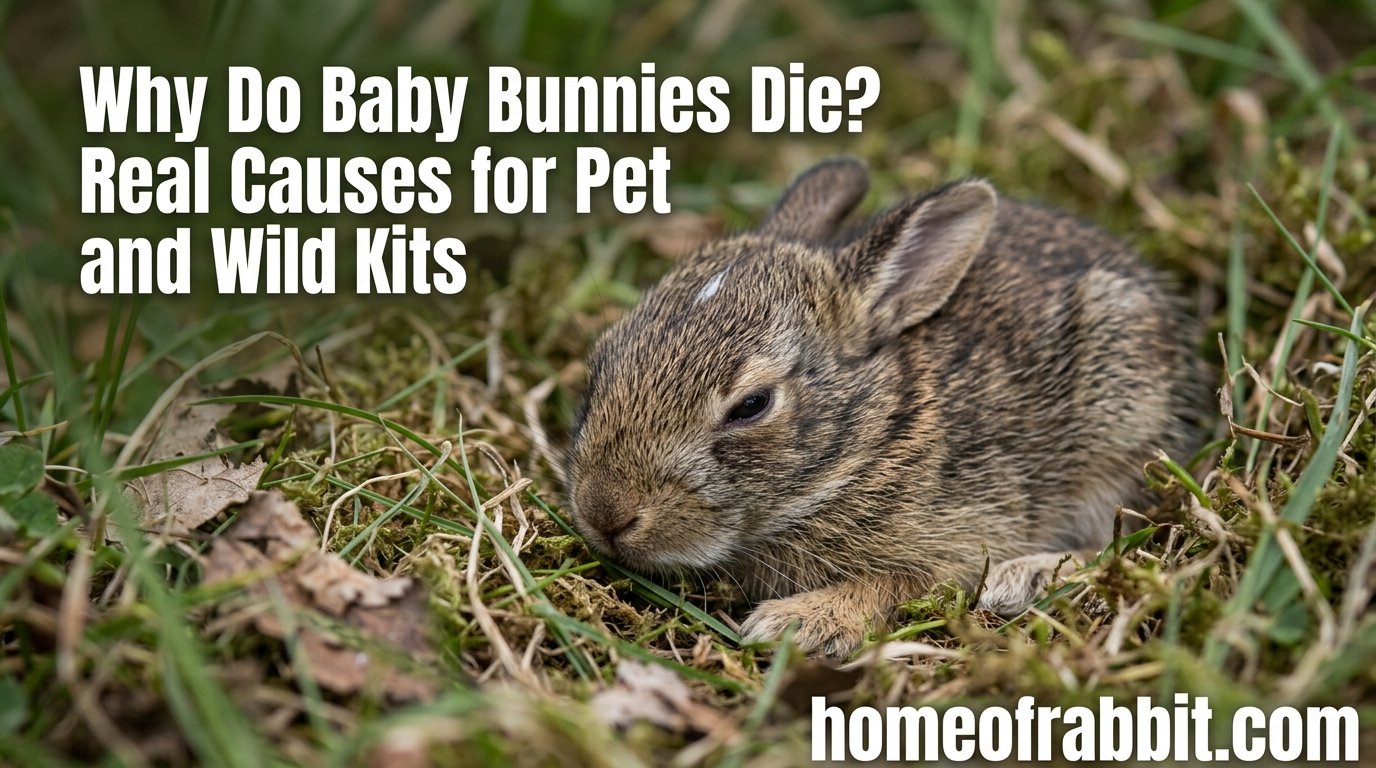
Most baby bunnies that die in their first few weeks die from one of a small number of causes: getting too cold, not getting enough milk, being injured by a stressed mother, catching an infection, or — more than people expect — dying from fear itself, since rabbits are prey animals whose bodies react to stress as if a predator has already caught them.
But there’s a bigger fork in the road that decides which of those causes actually applies to you: is this a domestic rabbit’s litter (a pet or breeding doe that had kits), or a wild cottontail bunny you found outside? The two situations share some causes but call for very different responses, and confusing them is one of the most common ways a healthy baby bunny ends up dying unnecessarily. This article covers both.
The short list: most common reasons baby bunnies die
- Chilling (hypothermia) — newborns can’t regulate their own body temperature
- Starvation — not enough milk, a large litter, or a mother that isn’t nursing properly
- Injury from the mother — accidental trampling, claw wounds, or rough handling in the nest
- Cannibalism or nest abandonment — almost always a stress or nutrition response, not “bad mothering” in the way people assume
- Congenital defects — often linked to inbreeding
- Infection — bacterial illness, gut infections, and digestive disease
- Fright-induced death — literal stress-related shock, especially in wild cottontails
- For wild bunnies specifically: unnecessary human intervention, which wildlife rehabilitators consistently point to as the single biggest threat to bunnies that were never actually in danger
First, which kind of baby bunny are you dealing with?
This matters because the fix is different:
- A domestic kit (from a pet or breeding rabbit) is born hairless, blind, and completely helpless in a nest box or burrow the mother built. If something is wrong, you may need to intervene — but carefully.
- A wild cottontail found in a yard is, in the vast majority of cases, not abandoned. Mother cottontails only visit the nest once or twice every 24 hours (usually around dawn and dusk) to avoid drawing predators to it. A nest with no mother in sight during the day is completely normal, not a sign she’s gone.
If you’re not sure which situation you’re in: if the bunny came from a rabbit you own or someone else’s pet rabbit, treat it as domestic. If you found it outdoors in a nest, garden, or yard with no known owner, treat it as wild — and read the wild-bunny section before doing anything else.
Why domestic (pet or breeder) baby rabbits die
Chilling and hypothermia
Newborn rabbit kits are born naked, blind, and unable to generate their own body heat for the first week or so of life. If they’re born outside the nest box, if the nest isn’t lined with enough of the mother’s pulled fur, or if a first-time mother builds a poor nest, the kits can chill quickly — and chilling is one of the biggest killers in the first days of life.
This lines up with research on commercial rabbitries in Spain and Portugal, which found that roughly half of all pre-weaning deaths happen in just the first five to seven days of life, and that starvation and hypothermia together are the leading non-infectious causes during that window.
Not enough milk, or a mother that isn’t nursing
Rabbits nurse differently than most mammals: a doe typically feeds her litter only once or twice a day, often in the very early morning, and spends the rest of the time away from the nest. That’s normal behavior, not neglect. But real problems do happen:
- The doe may have too little milk (agalactia), sometimes linked to poor nutrition, dehydration, obesity, or stress.
- Mastitis (a painful udder infection) can make nursing difficult or impossible.
- A very young or first-time mother may not yet “know” what to do, especially if she’s under about six months old.
- In unusually large litters, weaker kits or runts may simply get out-competed for milk.
Litter size itself is a factor worth knowing about. A typical domestic rabbit litter is around 4–6 kits. Some rabbit-health resources report that as litter size climbs into double digits, the share of kits lost also climbs — for example, litters of 10 have been associated with mortality rates in the range of 20%, and litters of 12 or more closer to 30% — though exact figures vary by breed, breeder, and study, so treat these as general patterns rather than fixed numbers.
How to check if kits are being fed: Look at their bellies once a day, ideally in the evening. A well-fed kit has a round, visibly full belly — often described as looking like a small dough ball — and lies quietly and warmly bunched with its littermates. A kit with a flat or wrinkled belly, or one that’s cool to the touch and crying, is not getting enough milk.
Injury from the mother
It’s an uncomfortable fact, but some kit deaths are accidental injuries from the mother herself — a claw catching a kit as she jumps in and out of the nest box, or, less commonly, a bite when she tries to pick up a kit incorrectly (most rabbits don’t naturally carry their young the way cats do). Long, untrimmed nails and nest boxes that are awkward for the doe to enter and exit both raise the risk. A calm, undisturbed environment reduces how often this happens, since a startled or anxious doe moves less carefully.
Cannibalism and maternal stress
Cannibalism is distressing to witness, but it’s a response to specific triggers rather than random cruelty:
- Extreme stress — loud noises, unfamiliar people or animals near the nest, or predators (even a neighborhood cat) close to the hutch
- Nutritional deficiency, especially a diet lacking enough calories, protein, or water during lactation
- A stillborn or dying kit, which a mother may remove from the nest this way
- Very young or inexperienced mothers who haven’t developed proper maternal behavior yet
In one detailed study of rabbitries, insufficient milk supply and cannibalism were together responsible for well over half of preventable pre-weaning losses, ahead of infections or parasites.
Congenital defects and inbreeding
Some kits are born with conditions incompatible with survival: heart defects, diaphragmatic hernias, or intestinal disorders such as congenital megacolon. These are more common when closely related rabbits are bred together. It would be unusual for an entire healthy litter to die this way — if every kit in a litter is affected, look first at care conditions (temperature, feeding, environment) rather than assuming a genetic cause.
Infections and digestive disease
Young rabbits have immature immune systems, which makes them vulnerable to:
- Bacterial infections such as staphylococcal infections and pasteurellosis
- Gastrointestinal (GI) stasis, where the gut slows or stops moving — in young rabbits this is often triggered by dehydration, a sudden diet change, or stress, and it can be fatal within days if untreated
- Mucoid enteropathy/enteritis, a serious gut condition seen particularly in young rabbits; outbreaks in rabbitries have been associated with very high mortality among affected young rabbits
Watch for a kit that stops eating, has a bloated belly, produces no droppings or very small ones, or becomes limp and unresponsive — these need a rabbit-experienced vet immediately, not a wait-and-see approach.
Stress deaths around weaning age
A second smaller wave of deaths tends to appear around weaning, roughly five to eight weeks of age, when kits transition from milk to solid food. Sudden diet changes, especially introducing high-carbohydrate foods too early, can upset the gut flora of a rabbit that no longer has the protective effect of the mother’s milk. Some breeders find that delaying carbohydrate-rich treats until kits are several months old reduces losses during this stage — this is a widely reported practical observation among breeders rather than a formally established clinical rule, so it’s worth discussing with a rabbit-savvy vet if you’re seeing repeated weaning-age losses.
Main causes of pre-weaning kit death, by reported frequency
| Cause | Approximate share of preventable pre-weaning deaths* |
|---|---|
| Insufficient milk supply | ~37% |
| Cannibalism | ~26% |
| Mange or external parasites on the doe | ~22% |
| Lack of maternal care | ~5% |
| Mastitis | ~4% |
| Bronchopneumonia | ~2% |
| Enteritis | ~2% |
*Figures from a peer-reviewed study of commercial rabbitries; percentages will differ in home and small-scale breeding settings but the ranking of causes is broadly consistent with other research.
What to do if a pet or breeder litter is dying
- Check the nest box setup first. It should be draft-free, deep enough that kits can’t easily fall or climb out, and lined generously with the mother’s pulled fur plus hay or soft bedding.
- Check bellies daily, ideally at the same time each evening, without excessive handling.
- Weigh the litter if you can (a kitchen scale works). Steady daily weight gain is the clearest sign things are going well; weight loss two days running is a warning sign.
- Reduce disturbance. Keep other pets, loud noise, and unnecessary visitors away from the nesting area, especially in the first two weeks.
- Check the mother’s condition — is she eating and drinking normally, and does she seem in pain (which can point to mastitis)?
- Don’t try to fully hand-rear unless there’s no other option. Hand-rearing domestic kits without their mother’s milk is genuinely difficult and carries a high failure rate, largely because it’s hard to replicate rabbit milk’s fat and antibody content. If the mother has died or clearly cannot nurse, contact a vet immediately for guidance rather than improvising.
Call a rabbit-savvy veterinarian right away if you see: a kit that’s cold to the touch and unresponsive, a bloated or hard belly, no droppings for more than a day, bleeding, or a mother showing signs of illness herself (not eating, hard/red/hot udder, discharge).
Why wild baby bunnies (cottontails) die
Wild cottontail rabbits are, by consensus among wildlife rehabilitators, one of the hardest wild animals to keep alive once removed from their natural setting — even with expert care. Understanding why changes how people should respond when they find one.
The most common cause: well-meant human “rescue”
The single biggest threat to a healthy wild bunny is a person deciding it’s been abandoned and removing it from the nest. Mother cottontails deliberately stay away from the nest during the day and visit only briefly, often in darkness, specifically so they don’t lead predators to their young. A nest with no mother around at 2 p.m. is doing exactly what it should be doing.
Wildlife rehabilitators report that fewer than 10% of “orphaned” cottontails brought in for care survive even a single week, and separate estimates put the mortality rate for orphaned wild rabbits in human care as high as 90%. This isn’t because rescuers are careless — it’s because cottontails are extraordinarily difficult to keep alive outside their natural environment, and most weren’t orphaned in the first place.
Rabbits can die from fear alone
This is not an exaggeration: wild cottontails, especially very young ones, can go into fatal shock purely from the stress of being handled, chased, or held, even without any physical injury. Their bodies respond to captivity the way they’d respond to being caught by a predator — with a stress response severe enough to be fatal on its own. This is why wildlife organizations consistently advise minimal handling, and darkness and quiet if a bunny genuinely needs to be contained temporarily.
Predators, lawn mowing, and pets
The two biggest real threats to a backyard nest are domestic pets (cats and dogs) and lawn mowing or yard work that disturbs the nest directly. A cat or dog that finds and handles a bunny — even gently, even without visible injury — can cause a serious stress reaction called capture myopathy, a often-fatal condition brought on by extreme physical stress.
Improper feeding after being picked up
Well-meaning people who pick up a bunny often try to feed it — cow’s milk, lettuce, or cabbage are common mistakes. Wild rabbit digestive systems are extremely sensitive, and the wrong food (or the wrong technique, which can cause milk to be aspirated into the lungs) can kill a bunny that an unnecessary “rescue” hadn’t already stressed to death.
Even good rehab care has limited success — and that’s normal
Wildlife rehabilitators with the right formula, heat sources, and medical support still report notably lower survival rates for cottontails raised in captivity than for cottontails left with their mothers in the wild. This isn’t a reflection of poor rehab work; it reflects how fragile these animals genuinely are outside their natural nest. It’s also why rehabilitators universally recommend leaving uninjured wild bunnies alone rather than attempting to raise them at home.
What to do if you find a wild baby bunny
- Check for obvious injury — bleeding, an open wound, fly eggs/larvae on the body, or a broken limb. If you see any of these, this bunny needs a licensed wildlife rehabilitator, and soon.
- If it’s uninjured and in or near a nest, leave it alone. Don’t move the nest, even a short distance.
- If you’re not sure the mother is returning, place two pieces of string or yarn in a small X over the nest and check 24 hours later without disturbing anything else. If it’s been moved, the mother has been visiting.
- If it’s fully furred with open eyes and is hopping around (roughly the size of a tennis ball or larger), it’s likely already independent. Leave it be — this is normal, not abandonment.
- Keep pets and children away from the area for a few weeks rather than removing the nest.
- If the mother is confirmed dead, or the bunny is genuinely injured or orphaned, contact a licensed wildlife rehabilitator before doing anything else — don’t attempt to feed it, warm it excessively, or care for it yourself overnight without guidance.
- If you must contain it briefly while arranging rehab transport, keep it warm (a covered heat source, never direct contact), in a dark, quiet, closed box, and handle it as little as possible.
Domestic kits vs. wild cottontails: quick comparison
| Domestic pet/breeder kits | Wild cottontail bunnies | |
|---|---|---|
| Where found | Nest box or hutch you set up | Shallow scrape nest in a yard/garden |
| Mother absence during the day | Can be normal or a warning sign depending on context | Always normal; she visits only once or twice a day |
| Biggest killer | Chilling, insufficient milk, or infection | Unnecessary human intervention and stress |
| Should you touch them? | Yes, gently, for daily belly checks | No, unless genuinely injured or orphaned |
| Who to call if something’s wrong | A rabbit-savvy veterinarian | A licensed wildlife rehabilitator |
| Realistic survival if hand-raised without mother | Difficult, but sometimes achievable with vet guidance | Very low, even with expert rehab care |
Common mistakes that kill baby bunnies
- Assuming a mother rabbit sitting away from the nest has abandoned it (true for both domestic and wild bunnies)
- Handling wild bunnies “to check on them,” which adds stress without adding any benefit
- Feeding cow’s milk, lettuce, or cabbage to any baby bunny
- Delaying a vet visit for a domestic kit that’s stopped eating or has a bloated belly
- Removing a wild nest instead of working around it
- Introducing high-carbohydrate treats to kits too early, right before or during weaning
- Trying to fully hand-raise kits or wild bunnies as a first response instead of getting professional guidance
When to call a vet vs. a wildlife rehabilitator
- Call a rabbit-savvy vet if this is a pet or breeding rabbit’s litter and you see cold/unresponsive kits, a bloated belly, no feeding, or a sick-looking mother.
- Call a licensed wildlife rehabilitator if this is a wild cottontail that is visibly injured, has been in a cat’s or dog’s mouth (even without visible wounds), or is confirmed motherless.
- Do neither and simply observe if it’s a wild, uninjured bunny in or near its nest, or a furred, mobile juvenile hopping around your yard.
Conclusion
There’s no single answer to why baby bunnies die, because “baby bunny” covers two very different situations with different risks. Domestic kits mostly die from cold, hunger, injury, or infection — problems a careful owner can often catch early. Wild cottontails mostly die because people (understandably) think they’ve been abandoned and step in when the best thing to do is nothing at all. Knowing which situation you’re in, and resisting the urge to over-intervene with a wild bunny while staying alert for real warning signs in a domestic litter, is what actually improves survival odds.
FAQ
Is it normal for a mother rabbit to leave her babies alone all day? Yes, for both domestic and wild rabbits. Mother rabbits nurse briefly once or twice a day and stay away the rest of the time to avoid attracting predators to the nest. This is instinctive behavior, not neglect.
Can a baby bunny really die from being scared? Yes. Rabbits, especially wild cottontails, can go into fatal shock from extreme stress alone, even without any physical injury. This is one of the main reasons wildlife rehabilitators recommend minimal handling.
Should I feed a baby bunny I found outside? No. Improper feeding — including cow’s milk, lettuce, or cabbage — is a common way well-meaning rescuers unintentionally kill a wild bunny. If it genuinely needs care, a wildlife rehabilitator will use an appropriate formula and technique.
My pet rabbit’s kits keep dying — is something wrong with her? Not necessarily. First litters, especially from young does, have a higher loss rate as the mother learns proper nesting and nursing behavior. Repeated losses across multiple litters, though, are worth discussing with a rabbit-savvy vet, since they can point to nutrition, nest setup, or a health issue like mastitis.
How can I tell if a baby rabbit is being fed enough? Check its belly once a day. A well-fed kit has a round, full belly and is warm and quiet. A kit with a flat belly that’s crying or cool to the touch likely isn’t getting enough milk.

1 Comment
Pingback: How Often Do Baby Bunnies Eat? What's Normal (and What Isn't) - homeofrabbit