
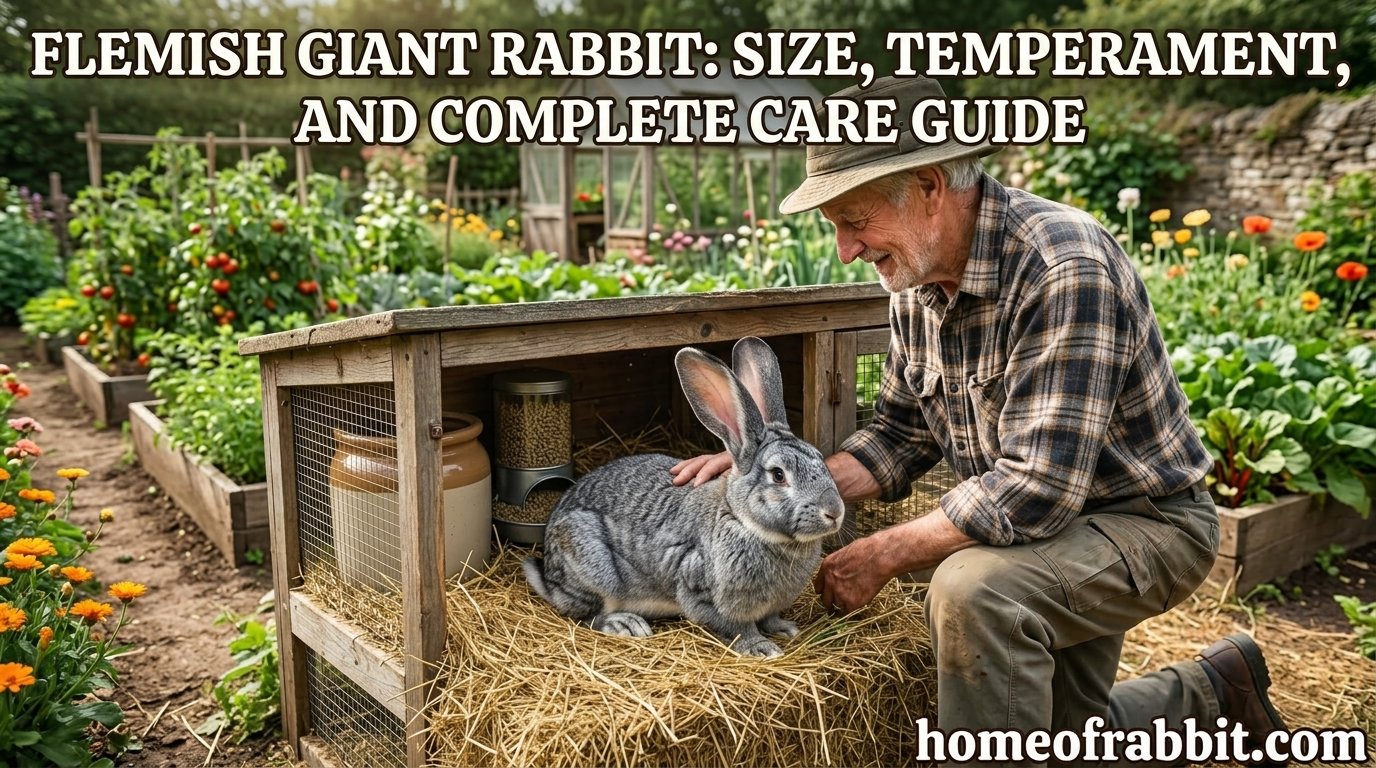
A Flemish Giant is the largest recognized breed of domestic rabbit, with adults commonly weighing 15 to 20+ pounds and stretching close to 2.5 feet long. Despite the size, they’re known for being calm and easygoing, which is why breeders nicknamed them the “gentle giants” of the rabbit world. But their size changes almost everything about their care — the cage they need, how much they eat, how you handle them, and even the health issues you should watch for.
Here’s what actually goes into keeping one well.
What Is a Flemish Giant Rabbit?
The Flemish Giant is a distinct rabbit breed, not just an oversized version of a common rabbit. It has its own body type, breed standard, and long history as both a working animal and a pet.
Origin and History
The breed traces back to Flanders, in present-day Belgium, where it was developed for meat and fur production. It was exported to America in the early 1890s to help improve the size of meat rabbits during a period known as the “rabbit boom.” In the U.S., dedicated breed clubs formed in the following decades to standardize the look and size of the rabbit, and it’s now recognized by the American Rabbit Breeders Association (ARBA) in seven official colors. arba
Physical Characteristics
Flemish Giants have a “semi-arch” body type — the breed is one of only a few recognized by ARBA with this shape, where the back arches starting behind the shoulders and carries through to the base of the tail. Key traits: lafeber
| Trait | Detail |
|---|---|
| Body shape | Semi-arch, long and muscular |
| Ears | Upright, minimum ~6 inches per breed standard |
| Body length | Minimum ~20 inches per breed standard |
| Coat | Dense, glossy, “rollback” fur |
| Recognized colors | Black, blue, fawn, light gray, sandy, steel gray, and white |
In 2010, a Flemish Giant named Darius set the Guinness World Record for longest rabbit, measuring 51 inches from nose to tail. That’s an extreme example, not a typical size — but it shows how large the breed can get. lafeber
One practical note on the coat: the thick, glossy fur that made this breed valuable for pelts also means Flemish Giants tolerate hot weather poorly and are somewhat more prone to fur mites and ear mites than short-coated breeds. Regular coat checks matter more with this breed than with many others. webmd
Flemish Giant Temperament: Are They Good Pets?
Yes, for the right household. Flemish Giants are generally described as docile, calm, and tolerant of handling once they’re used to it — which is a big part of their appeal, given how much less intimidating a large-but-mellow rabbit is compared to a large-but-jumpy one.
A few temperament notes worth knowing before you commit:
- They can be litter trained, often more reliably than smaller, more territorial breeds, especially after spay/neuter.
- Size affects how they should be handled. A rabbit this heavy can injure its own spine if it kicks out while being held incorrectly. Always support the hindquarters and back fully — never pick one up by the ears or scruff alone, and never let the hind legs dangle unsupported.
- They’re not “low maintenance” just because they’re calm. Their size means more grooming, more food, and more cleanup than a standard-sized rabbit.
- Individual personality varies. Some Flemish Giants are cuddly lap rabbits; others prefer to be near you rather than on you. Handling from a young age tends to produce a more tolerant adult.
How Big Do Flemish Giant Rabbits Get?
Weight Standards vs. Reality
The ARBA breed standard sets a minimum show weight, not a maximum. There is no maximum weight for the Flemish Giant, and they often exceed 20 pounds. The typical senior (adult) show minimums are around 13 pounds for bucks and 14 pounds for does, though pet-line Flemish Giants that aren’t bred to a strict show standard commonly land anywhere in the 13–22 pound range, with some individuals reported heavier. Treat any number above 25 pounds as an outlier rather than the norm, and be skeptical of extreme claims you can’t verify through a breeder or vet record. arba
For comparison, a mid-size breed like a New Zealand or Californian rabbit typically tops out around 12 pounds — a Flemish Giant can weigh nearly double that.
When Do They Stop Growing?
Flemish Giants take longer to reach full size than smaller breeds. Most don’t hit their adult “settled” weight until somewhere between 12 and 18 months of age, sometimes later for does. If you’re comparing your rabbit’s weight to breed averages, wait until closer to 1.5 years before assuming something is wrong — a lanky, still-filling-out young adult is normal for this breed.
Housing a Flemish Giant Rabbit
This is the area where a Flemish Giant differs most from other pet rabbits, and it’s the thing most new owners underestimate.
Minimum Cage and Enclosure Size
General rabbit-welfare guidance (from organizations like the House Rabbit Society) recommends at least 8 square feet of floor space for an average-sized rabbit, with more space per additional rabbit. A Flemish Giant needs meaningfully more than that baseline because of its length and how far it can stretch out and jump.
Recommendations vary by source, which is worth knowing rather than glossing over:
| Source/Approach | Recommended minimum |
|---|---|
| Basic pet-care guidance | 3 feet by 4 feet cage |
| Experienced Flemish Giant keepers | Around 4 feet by 4 feet, ideally an exercise pen rather than a wire cage |
| Enclosure-sizing method (4x body length) | Roughly 10 feet long by 4 feet wide by 4 feet tall for a fully outstretched adult |
The honest takeaway: there’s no single “correct” number, but bigger is always safer, and a small wire hutch or standard dog crate is not adequate as a permanent home. Standard dog crates work for rabbits around 5 pounds, but they don’t provide enough space for a Flemish Giant long-term. Whatever base enclosure you choose, plan on supplementing it with several hours of supervised free-roam or exercise-pen time daily — the enclosure is for resting and safety, not the rabbit’s only space. binkybunny
Also worth noting: Flemish Giants can jump as high as 3 feet, so any enclosure needs to be tall enough — or covered — to prevent escapes. webmd
Indoor vs. Outdoor Housing
Both are possible, but each comes with trade-offs:
- Indoor: Easier to monitor health and behavior, protects against predators and temperature extremes, and works well with litter training. Requires bunny-proofing (cords, baseboards, houseplants) on a larger scale, since a Flemish Giant can reach and chew things a small rabbit can’t.
- Outdoor: Needs a secure, insulated, predator-proof structure — a converted shed is a common solution given the size requirement. Because of the coat’s heat sensitivity, outdoor housing needs reliable shade, ventilation, and a cooling plan for hot months; heatstroke risk is a real concern for this breed specifically.
Feeding a Flemish Giant Rabbit
Daily Diet Basics
The foundation of a healthy rabbit diet doesn’t change with breed size — it’s still built around:
- Unlimited grass hay (timothy, orchard, or similar) — this should be the largest part of the diet by volume, supporting both digestion and dental wear.
- A measured portion of rabbit pellets (timothy-based, not seed or nut mixes).
- Fresh leafy greens and vegetables daily.
- Fresh water, available at all times — a giant breed will drink noticeably more than a small one.
How Much to Feed (Adjusted for Size)
A commonly cited House Rabbit Society guideline for adult rabbits (1–5 years old) is 1/4 to 1/2 cup of pellets per 6 pounds of body weight per day, along with a minimum of 2 cups of chopped vegetables per 6 pounds of body weight. binkybunny
Here’s the catch for Flemish Giant owners: scaling that pellet ratio up linearly for a 20-pound rabbit can mean well over a cup of pellets a day, which is often more concentrated calories than an adult rabbit actually needs, especially if it’s not very active. In practice, many experienced giant-breed keepers cap pellets on the lower end of the ratio (or below it) and let unlimited hay make up the bulk of the diet, then adjust based on body condition rather than a fixed formula. This is a case where “follow the math exactly” is worse advice than “watch the rabbit.”
Practical way to check body condition: you should be able to feel the rabbit’s ribs and spine with gentle pressure but not see them prominently. A Flemish Giant that’s hard to feel ribs on, even accounting for its large frame, may be overweight.
Grooming and Handling
- Brushing: Weekly during normal shedding, more often (every few days) during seasonal heavy sheds. Their fur is described as “rollback,” meaning it lies back down on its own after being brushed against the grain — a helpful visual check for a healthy coat.
- Nail trims: Needed regularly, similar to other rabbits, but a Flemish Giant’s larger nails and stronger kick make this a two-person job for many owners, at least until the rabbit is well accustomed to handling.
- Lifting technique: Always scoop from underneath with one arm supporting the chest/front legs and the other fully supporting the hindquarters and back. Never lift by the ears, scruff, or front legs alone. A struggling giant rabbit can hurt its spine or your arms — proceed slowly and let the rabbit feel secure before lifting fully.
Exercise and Enrichment
Calm temperament doesn’t mean low activity needs. Flemish Giants still need daily time outside their enclosure to move, stretch, and explore — both for physical health (joint and muscle condition, weight management) and mental wellbeing. Cardboard boxes, digging boxes, and chew-safe toys work well; just size everything up, since a Flemish Giant will flatten a toy built for a 4-pound rabbit in short order.
Common Health Issues in Flemish Giants
Some health concerns apply to all pet rabbits (GI stasis, dental overgrowth, respiratory illness) and aren’t specific to this breed. A few issues are worth flagging specifically because of the Flemish Giant’s size:
- Joint and limb strain: Carrying significantly more body weight puts more stress on joints over time, particularly on hard or slippery flooring. Rugs, mats, or soft flooring in main living areas help.
- Sore hocks (pododermatitis): Heavier body weight concentrated on the hind feet increases risk, especially on wire-bottomed cages. Solid flooring with soft bedding reduces this risk.
- Heat sensitivity: As noted above, the dense coat combined with large body mass makes overheating a real risk in warm climates. Watch for panting, lethargy, or drooling in hot weather and provide cooling options (tile surfaces, frozen water bottles, fans, air conditioning).
- Difficulty finding an exotic-animal vet comfortable with the breed’s size: Not a health condition itself, but worth planning for — confirm your vet has experience with giant rabbit breeds specifically, since medication dosing and handling differ from a standard-sized rabbit.
If you notice reduced appetite, reduced fecal output, lethargy, or reluctance to move, treat it as urgent — rabbits (regardless of breed) hide illness well and can decline quickly, and GI stasis in particular is a same-day veterinary concern.
Flemish Giant Rabbit Lifespan
Flemish Giants typically live about 8 to 10 years with good care — a solid range for a rabbit, though on the shorter end compared to some smaller breeds, which can occasionally live into their teens. As with most large animal breeds, individual lifespan depends heavily on diet, weight management, housing conditions, and preventive veterinary care, so treat 8–10 years as a general expectation rather than a guarantee in either direction. lafeber
Is a Flemish Giant Right for You? (Pros and Cons)
| Pros | Cons |
|---|---|
| Calm, generally people-friendly temperament | Needs significantly more space than other rabbit breeds |
| Can be litter trained | Eats and drinks noticeably more, raising ongoing costs |
| Striking, memorable appearance | Heat-sensitive coat requires climate management |
| Tolerates handling well once accustomed | Harder to lift/handle safely without practice |
| Long-lived for a rabbit (8–10 years) | Fewer vets have hands-on experience with giant breeds |
| Good option for households wanting a “big” pet without a dog | Grooming, nail trims, and cleanup all scale up with size |
Flemish Giant Care Checklist
- Enclosure at least 4×4 feet, ideally larger, with a tall or covered top
- Several hours of daily supervised exercise outside the enclosure
- Unlimited grass hay available at all times
- Measured pellets, adjusted by body condition rather than weight alone
- Fresh vegetables daily, fresh water always available
- Weekly brushing (more during heavy shedding)
- Regular nail trims
- Cooling plan in place for hot weather
- Soft or padded flooring to reduce joint and hock strain
- An exotic-animal vet identified in advance, ideally with giant-breed experience
- Spay/neuter scheduled, if not already done
- A plan for safe two-handed lifting and handling
Conclusion
A Flemish Giant can be a wonderful pet — affectionate, impressively large, and generally easygoing — but the size isn’t just a novelty. It drives real, ongoing differences in housing, food budget, grooming time, and vet care compared to a standard rabbit breed. If you can commit to the space and the slightly higher day-to-day effort, a Flemish Giant tends to reward that investment with a calm, dog-like companion that just happens to hop.
FAQ Section
How much does a Flemish Giant rabbit weigh?
There’s no official maximum weight, but most adults weigh well over the ARBA show minimums of roughly 13–14 pounds, and 20+ pounds is common in pet-line rabbits. arba
Do Flemish Giant rabbits make good pets for kids?
They can, given their generally calm temperament, but their size means an unsupervised young child could accidentally drop or mishandle one, risking spinal injury to the rabbit. Adult supervision during handling is important regardless of the rabbit’s temperament.
Can Flemish Giants live outside?
Yes, but only in a secure, insulated, predator-proof structure with reliable shade and cooling — their coat makes them more prone to overheating than short-haired breeds.
Do Flemish Giants need a companion rabbit?
Like most rabbits, they’re social animals and often do well with a bonded partner, but successful bonding takes space, patience, and usually spay/neuter first. It’s not a strict requirement for a single well-socialized pet rabbit, but it’s worth considering.
How much space does a Flemish Giant rabbit actually need?
At minimum, an enclosure in the range of 4×4 feet, but many experienced keepers recommend larger, paired with daily out-of-cage exercise time — a small hutch or standard dog crate is not sufficient long-term.

1 Comment
Pingback: How Many Babies Do Rabbits Have? Litter Sizes by Breed - homeofrabbit