
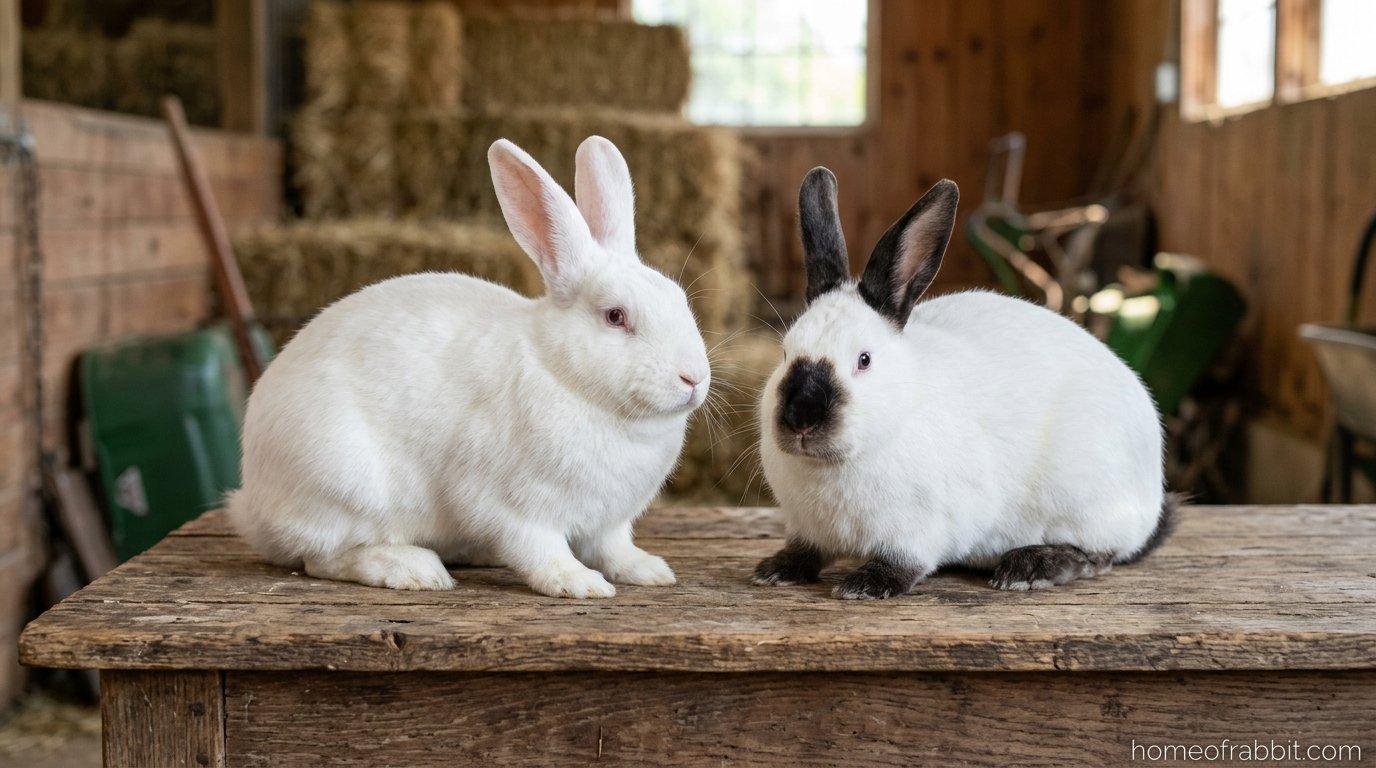
If you just want the short answer: the New Zealand White and the Californian are the two breeds almost every commercial and backyard rabbit raiser in the U.S. starts with. They grow fast, reach a good butchering weight in roughly 8 to 12 weeks, and have the meat-to-bone ratio that makes dressing them worthwhile. If you want a smaller carcass for a small household, the Florida White is worth a look. If you want meat plus a usable pelt, breeds like the Silver Fox or American Chinchilla are the better fit.
The rest of this guide explains why those breeds top the list, what the alternatives actually offer, and how to think through the decision if your situation isn’t the “average” homestead.
What Actually Makes a Rabbit a Good Meat Breed
Rabbit breeders and extension resources generally judge a meat breed on three things:
- Growth rate and feed efficiency. How fast a kit reaches butchering weight, and how much feed it takes to get there. This is the single biggest factor in whether raising rabbits for meat is worth the feed cost.
- Meat-to-bone ratio and carcass type. A “commercial” body type — broad, deep, well-muscled through the loin and hindquarters — dresses out with more usable meat per pound of live weight than a narrow, long-boned “fancy” body type.
- Mothering ability and litter size. A doe that reliably raises litters of eight or more kits, without excessive kit loss, determines how many rabbits you actually get to butcher each year. Good meat rabbits need to grow quickly and efficiently, have good mothering skills to routinely raise litters of eight or more kits, and reach the right size with a good meat-to-bone ratio. Mother Earth News
Coat color and fur quality matter more for the pelt market or showing than for meat production, though a few dual-purpose breeds do both well.
The Top Meat Rabbit Breeds, Compared
| Breed | Adult Weight | Growth to Butcher Weight | Best For |
|---|---|---|---|
| New Zealand White | Buck 9–11 lb, Doe 10–12 lb | ~8–11 weeks to ~5 lb | Most popular all-around meat breed |
| Californian | Up to 10.5 lb (ARBA) | ~8–12 weeks to 4–5 lb | Excellent meat-to-bone ratio, large litters |
| Florida White | ~5–6 lb | Faster to a smaller finished size | Small households, limited space |
| American Chinchilla | Buck 9–11 lb, Doe 10–12 lb | Fast, good ratio | Meat plus a usable pelt |
| Silver Fox | 9–12 lb | Moderate | Meat and fur, calm temperament |
| Champagne d’Argent | Similar large-breed range | Moderate | Heritage/dual-purpose interest |
Weights reflect ARBA breed standards and widely cited extension/breed-club sources; treat them as typical ranges, not guarantees for any individual animal.
New Zealand White
The New Zealand White is the breed most people picture when they think “meat rabbit,” and for good reason. A mature buck typically weighs between 9 and 11 pounds, while a mature doe weighs between 10 and 12 pounds, and kits can grow to a marketable size of around five pounds in 8 to 11 weeks under good feeding conditions. nbxsolucionesusda
Why it’s popular:
- Fast, efficient growth on standard commercial pellet feed
- Widely available, so it’s easy to find unrelated breeding stock (important for avoiding inbreeding)
- Docile temperament that’s manageable for beginners
Watch out for: individual does can vary — some breeders report inconsistent mothering or nervous temperaments in specific lines, so it’s worth asking a seller about a doe’s kindling and mothering history before you buy, not just her pedigree.
Californian
The Californian was developed in the 1920s by crossing New Zealand Whites with Himalayan and Chinchilla rabbits, which is where its white body and dark “points” (ears, nose, feet) come from. It’s now the second most popular meat-producing breed in the world after the New Zealand. Wikipedia
Californians have a good meat-to-bone ratio, produce large litters of 8–12 kits, and grow to fryer size (4–5 lb) in 8–12 weeks. The BRC standard calls for a desired weight of 9.5 lb with a minimum of 7.5 lb, while ARBA accepts a maximum weight of 10.5 lb. WikipediaWikipedia
Why breeders choose it over (or alongside) the New Zealand: Californians tend to be slightly calmer, and many small producers crossbreed the two for hybrid vigor — a New Zealand buck on a Californian doe (or vice versa) is a very common commercial pairing.
Florida White: The Smaller-Scale Option
Not every household wants a 5-pound carcass per rabbit. The Florida White was developed specifically as a smaller meat breed, originally for laboratory use, from a cross involving Dutch, Polish, and New Zealand White genetics.
At roughly half the mature weight of a New Zealand White, it reaches a smaller finished size faster and on less feed per animal — a real advantage if you’re feeding a small household rather than selling in volume. The trade-off is less total meat per rabbit and per litter, so you’ll process more animals to get the same amount of meat.
Dual-Purpose Heritage Breeds: Meat Plus Fur
If pelts matter to you — for tanning, crafts, or simply not wanting to waste any part of the animal — a few heritage breeds do double duty:
- American Chinchilla: Mature bucks weigh 9 to 11 pounds and does 10 to 12 pounds; the breed produces large litters, has good mothering instincts, and fryers reach market weight quickly. It’s medium-boned with a deep loin and broad shoulders that produce good meat proportions, and the meat is considered good quality. It’s also listed as a conservation-priority breed by the Livestock Conservancy, so stock can be harder to find than New Zealands or Californians. livestockconservancyfondazioneslowfood
- Silver Fox: A large rabbit weighing around 10–12 lb, with one of the highest dress-out percentages of any breed according to the Livestock Conservancy, and a temperament breeders describe as gentle and easy to handle. It’s currently a rare breed, so expect to pay more and wait longer for stock than with commercial breeds. Imperfectly Happy
- Champagne d’Argent: One of the older established breeds, known for a dense silver-gray coat and reasonable size, but less common in U.S. commercial meat operations today than New Zealands or Californians.
These breeds generally grow a bit slower than New Zealands or Californians and are harder to source, since fewer breeders keep them. They make sense if you value the pelt, the heritage-breed angle, or a calmer temperament more than maximum feed efficiency.
Breeds to Think Twice About
Flemish Giant. It’s tempting to assume “bigger rabbit means more meat,” but Flemish Giants grow more slowly, eat considerably more feed per pound of finished weight, and have a bonier frame than commercial meat breeds. They’re occasionally used in a terminal cross to add size, but as a primary meat breed they’re generally less feed-efficient than a New Zealand or Californian.
Pure fancy/show breeds (e.g., Angora, Netherland Dwarf, Holland Lop). These were bred for coat, size, or appearance for the show table, not for growth rate or carcass yield. Some are also too small to be worth processing at all. If a breed’s main claim to fame is its fur length or its status as a pet/companion breed, it’s not a meat-production choice.
How to Choose Between Them: Decision Criteria
Use these questions to narrow it down:
- How much meat do I actually need per batch? Large household or plan to sell → New Zealand or Californian. Small household → Florida White.
- Do I want a usable pelt too? Yes → American Chinchilla or Silver Fox. No → stick with commercial breeds; heritage breeds cost more and grow slower for no meat advantage if you’re discarding the pelt anyway.
- How easily can I find breeding stock and avoid inbreeding? New Zealand and Californian are the easiest to source in most parts of the U.S., which matters a lot for bringing in unrelated stock every couple of generations.
- What’s my feed budget? Feed cost is the largest ongoing expense in raising meat rabbits, so growth rate and feed conversion should usually outweigh coat color or appearance preferences.
- Do local regulations or a processor have breed or weight requirements? Some states’ definitions of “fryer” and “roaster” (see below) affect how you’re allowed to sell rabbit meat, which is worth checking before you commit to a breed and a sales plan.
Understanding Rabbit Meat Classes: Fryer vs. Roaster
Once you’ve picked a breed, it helps to know how the finished product is classified, especially if you ever plan to sell rabbit meat rather than only eat it yourself.
Under USDA standards, a “fryer” or young rabbit is a young rabbit carcass weighing not less than 1½ pounds and rarely more than 3½ pounds. Rabbits older or heavier than that fall into the “roaster, stewer, or mature rabbit” class instead. usda
Some states set their own thresholds for retail sale. For example, California law defines a “rabbit fryer” as a young domestic rabbit, usually under 12 weeks of age, weighing between 1½ and 3½ pounds ready-to-cook, a “rabbit roaster” as over 12 weeks and 3½ to 5 pounds ready-to-cook, and a “stewing rabbit” as a mature rabbit over six months old at any ready-to-cook weight. Check your own state’s rules if you plan to sell rather than just raise for your own table — thresholds like these can determine what you’re legally allowed to call the product. public
Common Mistakes First-Time Meat Rabbit Raisers Make
- Buying whatever’s cheapest or nearest, regardless of breed type. A mixed-breed or fancy-breed rabbit from a random listing may take much longer to reach a usable weight, or never reach one at all.
- Starting with related animals. Buying littermates or a bonded pair from the same breeder without checking pedigree can lead to inbreeding problems within a couple of generations.
- Ignoring mothering ability. A breed’s reputation doesn’t guarantee an individual doe will be a good mother — ask about her actual kindling history if you’re buying a proven doe.
- Overfeeding or underfeeding for the breed. Larger commercial breeds and smaller breeds like the Florida White have different feed needs; feeding a generic amount without adjusting for breed size wastes feed or slows growth.
- Skipping the local regulations check. If you ever plan to sell meat, verify your state and local rules on processing and sale before you’re ready to butcher, not after.
Quick Checklist Before You Buy
- Decided how much meat per batch you actually need
- Chosen a breed that matches your space, feed budget, and pelt preference
- Confirmed the breeder can show pedigree and mothering/kindling history
- Sourced unrelated stock (or a plan to bring in new bloodlines later)
- Checked your state’s rules on selling rabbit meat, if applicable
- Set up housing and feed appropriate to the breed’s adult size
Conclusion
For most people asking what rabbits are best for meat, the honest answer is the same one commercial producers have relied on for decades: New Zealand White and Californian, either purebred or crossed with each other. They’re not exotic or hard to find, and that’s exactly the point — proven growth rates, manageable temperaments, and easy access to breeding stock make them the lowest-risk starting point. If your situation calls for something different — a smaller carcass, a usable pelt, or an interest in heritage genetics — the Florida White, American Chinchilla, or Silver Fox are reasonable, well-documented alternatives. What matters most isn’t chasing the “best” breed on paper, but matching a breed’s growth rate, size, and temperament to your actual space, feed budget, and goals.
FAQ
How long does it take a meat rabbit to reach butchering weight?
Most commercial meat breeds (New Zealand, Californian) reach a 4–5 lb fryer weight in about 8 to 12 weeks with good nutrition.
Can I raise a mixed-breed rabbit for meat?
Yes, and many small-scale raisers do, especially crosses between New Zealand and Californian lines. Just be aware that growth rate and carcass yield become less predictable the further you get from known meat breed genetics.
Is a bigger rabbit breed always better for meat?
No. Larger breeds like the Flemish Giant grow more slowly and less efficiently than mid-sized commercial breeds, so bigger doesn’t automatically mean more or cheaper meat.
Do I need a special permit to raise rabbits for meat at home?
That depends entirely on your city and state. Raising for personal consumption is generally less regulated than raising to sell, but rules vary widely, so check local ordinances and your state’s agriculture department before you start.
